
Spirit & Lens
Doug Fountain and Jon Linton Bring Heritage and Healing to EXPO
Writer Susan Kern-Fleischer
Two artists arrive at the 22nd annual Arizona Fine Art EXPO carrying more than their work — they bring transformation. Doug Fountain, a Spirit Lake Dakota Sioux sculptor descended from Sitting Bull, turns thousands of hand-washed feathers and prayers into masks and creates contemporary totems with a primitive edge. Jon Linton, a documentary photographer who spent years bearing witness to homelessness and war, now points his camera toward healing: the light and geometry of Southwest landscapes.
Both are among more than 30 new artists joining the show this year, and both understand that making art is an act of reclamation.
The Arizona Fine Art EXPO opens Jan. 16 and runs daily for 10 weeks through March 29 under the “festive white tents” on the southwest corner of Scottsdale and Jomax roads. More than 90 diverse artists work in 124 patron-friendly studios within a 44,000-square-foot space, where guests can meet the artists, watch them create, and learn about their inspiration and techniques. Art is for sale and commissions are welcomed.
Rick Long, who co-owns Arizona Fine Art EXPO with his wife, Ji, said this year’s show promises to be one of the most memorable yet.
“Our goal is to support the artists and provide immersive, memorable experiences for guests that showcase our artists’ creativity and skills,” Long says. “We’re excited to welcome more than 30 new artists to this year’s show. We also devoted a lot of time to expanding our sculpture garden, and we’ll be offering more entertainment this year throughout the show.”
Symbols of Strength and Survival
When Doug Fountain was growing up in Florida, he never thought much about his Spirit Lake Dakota Sioux heritage or the fact that he was a direct descendant of the legendary Chief Sitting Bull. His mother, one of 11 children, grew up on the Spirit Lake Nation Reservation in north-central North Dakota. She didn’t talk much about her experience attending the Fort Totten Industrial School, a U.S. government-run boarding school for Native American children. It wasn’t until his grandmother came to visit that he learned how the school was a harsh assimilation center.
Fountain’s father served in the U.S. military and later became a builder, working in architecture and construction. Fountain credits his passion for three-dimensional art and his innate ability to work with his hands to his father, whose ancestors came from England and France.
After high school, Fountain attended college in Florida and in Colorado, where he trained as an architectural engineer and then as a professional photographer. He also minored in music, and to this day, he strives to create contemporary sculptures that “sing.”
A self-taught artist who spends part of the year living in Phoenix, Fountain believes he was called to his creative work to elevate the awareness of tradition in the culture of Native Americans — to their universal love and respect for the Earth and all its elements.
“Each dot represents a prayer of thankfulness, each triangle represents unity and each rectangle represents family,” he says of his art. “These symbols represent the strength of character, their struggle to survive, and their honor and deep respect for Mother Earth and Father Sky. All these elements come together to create the journeys and experiences of our lives.”
He describes his artistic process as “mind-boggling” and says it can sometimes take a full year to create one mask.
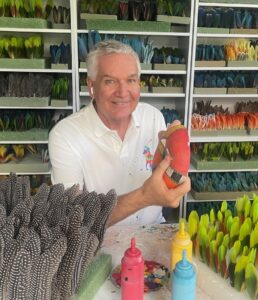
The process begins with materials. He sources his feathers from a large aviary in Florida that breeds more than 1,100 birds. The feathers he purchases have fallen off the birds. Over the span of one year, he works with thousands of feathers, which require a rigorous, labor-intensive cleaning process — hosing, multiple tub washes with protective gear, a gentle machine cycle, then dried to restore natural oils.
He creates each mask using a layering technique. He says he must be extremely focused, especially when it comes to adding the feathers.
“I will sometimes look at a mask 10 times before finding the right feathers that work,” he says.
While the Sioux never created totems, Fountain was inspired by other cultures. He began creating colorful totems to achieve a different look from his masks.
“I love totems from the Pacific Northwest, and I was inspired by the elegant architecture of the Greeks and Romans,” he says. “I have always been drawn to the shapes and forms on totems, and I like that I can create contemporary totems with a primitive edge.”
He creates the structures on a 3D printer and wraps them with a fiberglass tape.
“It’s a lightweight foam core that is very dense,” he explains. “I do a scratch coat of plaster and then I do a textured layer of Venetian plaster where I add color and wax. I start with a trial using cutting and palette knives.”
Fountain credits his success and the enormous interest in his work to his firm belief in positive affirmations, a genuine belief in himself and his joy in creating it.
“The biggest reward is when I learn that my art has touched someone’s spirit,” he shares. “The greatest lesson I’ve learned over the years is to honor your heart and live by your heart.”
From Witness to Healer
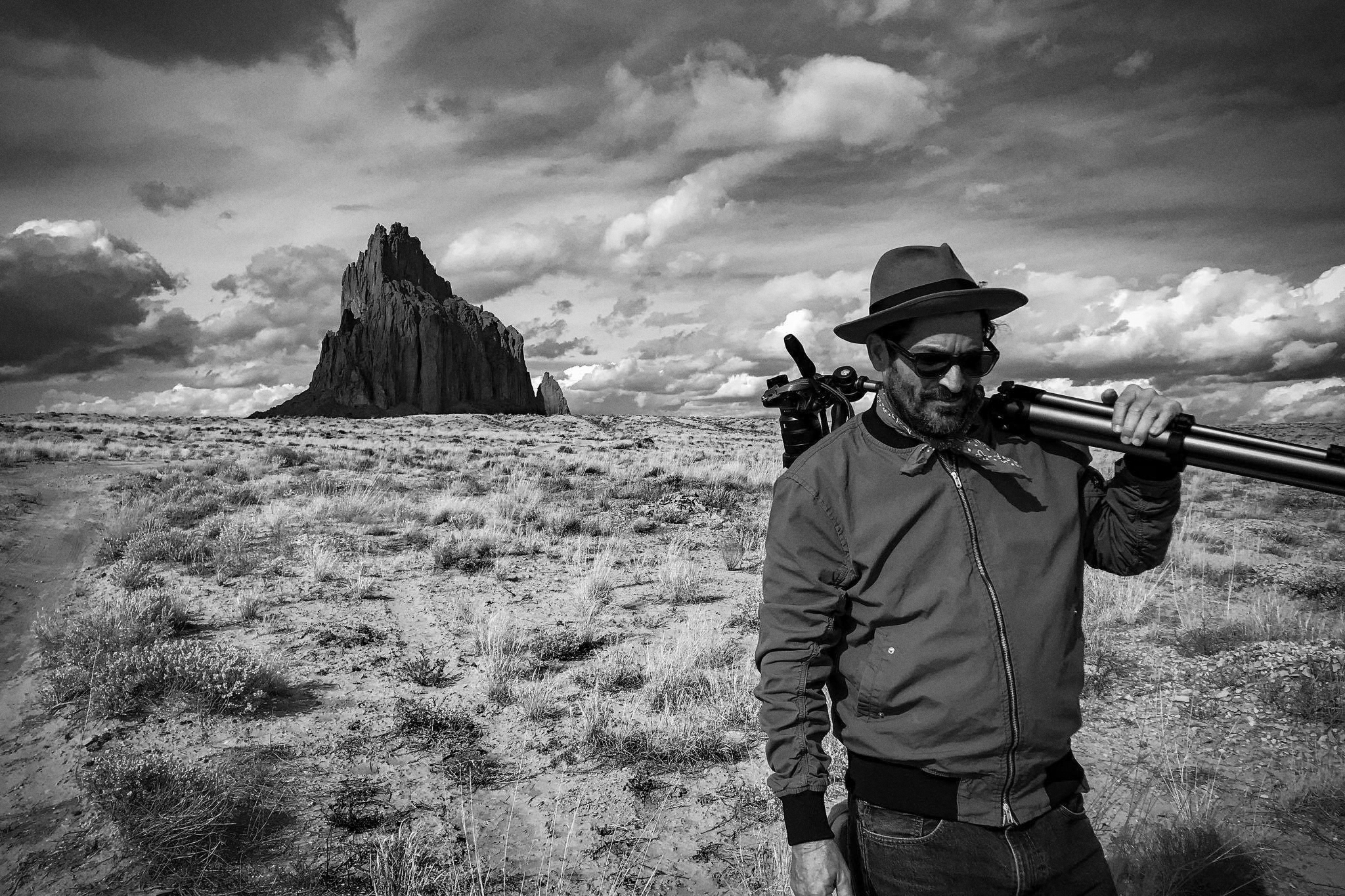
In some ways, fine art photographer Jon Linton has come full circle — back to that memorable, peaceful time 15 years ago when he photographed wild mustangs at Monument Valley.
It was a black-and-white photograph that would change his career. While visiting Santa Fe, Linton had the chance to show his street and landscape photography to renowned photographer Ray Belcher.
“Ray stopped at that photograph and told me that it was magical. He encouraged me to show my work and said that photographers could go a lifetime and never capture such an incredible moment in time,” he says.
Linton cherishes his many adventures exploring the Southwest, but he is equally passionate about advocating for the homeless and other underserved populations. In 2007, he began documenting and helping unhoused men and women living on the streets of Phoenix. His “I Have a Name” street photography series expanded to other cities as Linton traveled with volunteers in a colorful outreach bus to bring attention to the unhoused crisis.
Recently, philanthropist Adam Bronfman was so compelled by Linton’s street photography that he felt inspired to produce a film, “I Have a Name,” that captured the homeless crisis in a new light.
Linton’s passion for social justice also extended internationally. In 2022, he accompanied a painter friend to Ukraine to document the war atrocities from the Russia-Ukraine war.
“I’m always seeking truth through my camera lens, and I use my camera as a social justice instrument,” Linton shares. “I captured imagery of war-torn villages and displaced Ukrainians and raised money to feed people in those villages. When I returned in June 2022, I had a small exhibition in Bisbee, and used the funds to support a Ukrainian orphanage.”
While he will always advocate for human rights, Linton found himself feeling exhausted and empty.
“I experienced compassion fatigue,” he says. “I decided that the ills of society that I had seen along with the horrors of war had left me essentially broken. I needed some time for myself, and I decided to concentrate solely on my fine-art photography.”
Linton is back to exploring the vast beauty of the Southwest and seeking soulful moments, like the time he photographed the wild mustangs at Monument Valley.
“I’m honored that ‘I Have a Name’ lives on as a film in a very meaningful way. It also allows me to focus on my creative life, and my work has gotten stronger as a result,” he says.
He is also looking forward to exhibiting his new black-and-white and color photography at the Arizona Fine Art EXPO, where he will have a double booth to showcase his work in a more in-depth, expansive way.
“I’m proud to be one of the artists who is leading the way to make Arizona Fine Art EXPO one of the premier shows in the West,” he says.
Arizona Fine Art EXPO
Jan. 16-March 29 // 10 a.m.-6 p.m. // 26540 N. Scottsdale Road, Scottsdale // $12; discounts available // 480-837-7163 // arizonafineartexpo.com