
Shared Vision
When Camera and Canvas Capture the Same Desert
Writer Susan Kern-Fleischer // Photographer Robert Elenbaas
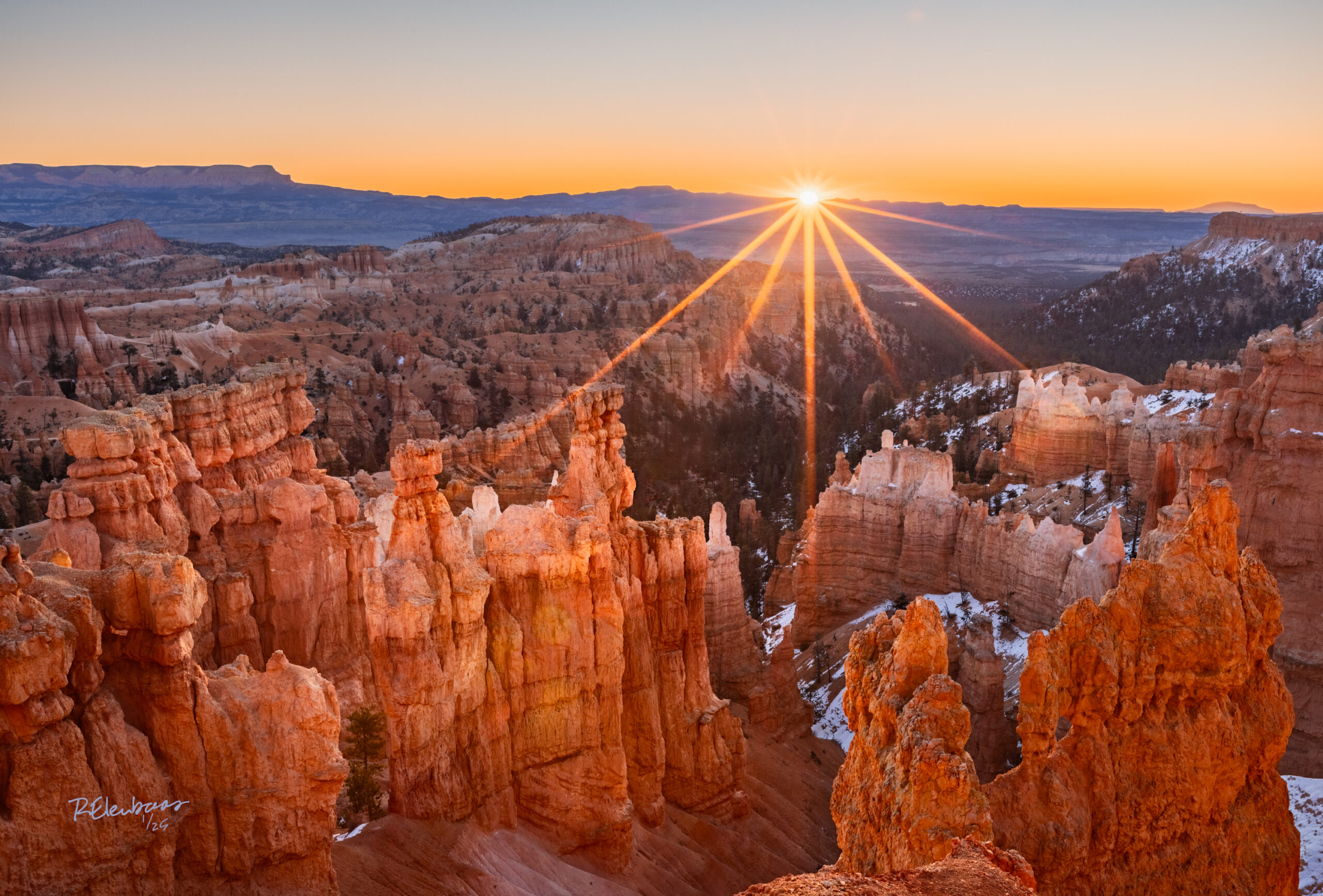
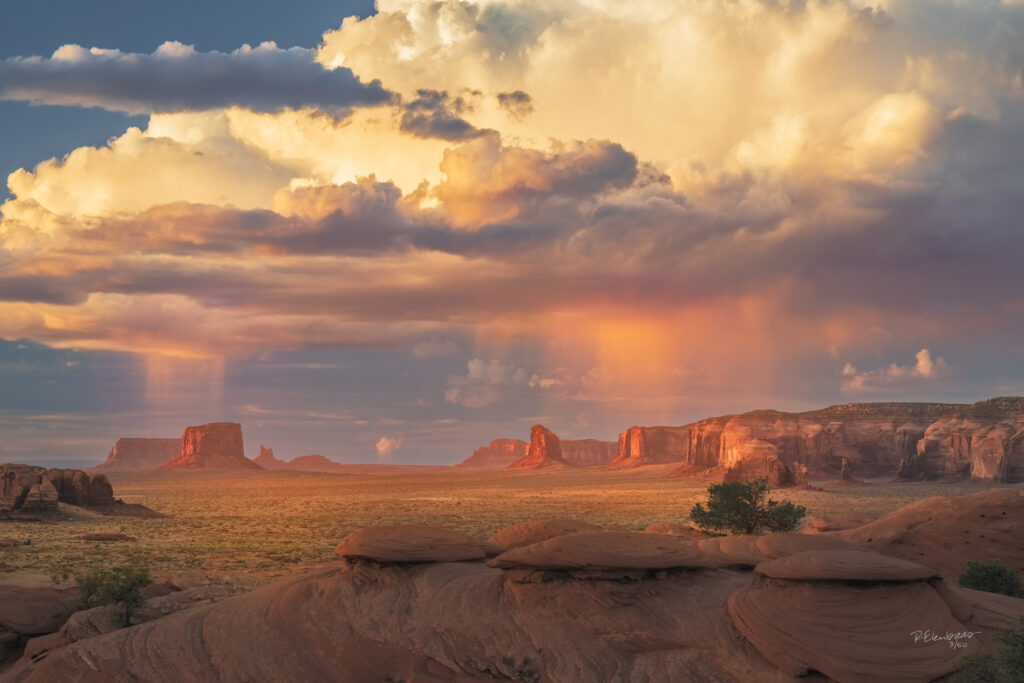
A stunning desert sunrise. Light and shadow playing across a jagged canyon as a river winds through it. Majestic saguaros standing sentinel as a storm approaches in the distance.
For Tom Conner and Robert Elenbaas, the beauty of the Southwest is more than something to behold. Both artists feel drawn to explore rugged hiking trails, peaceful forests and other landscapes off the beaten path to observe, document and share their experiences through their art.
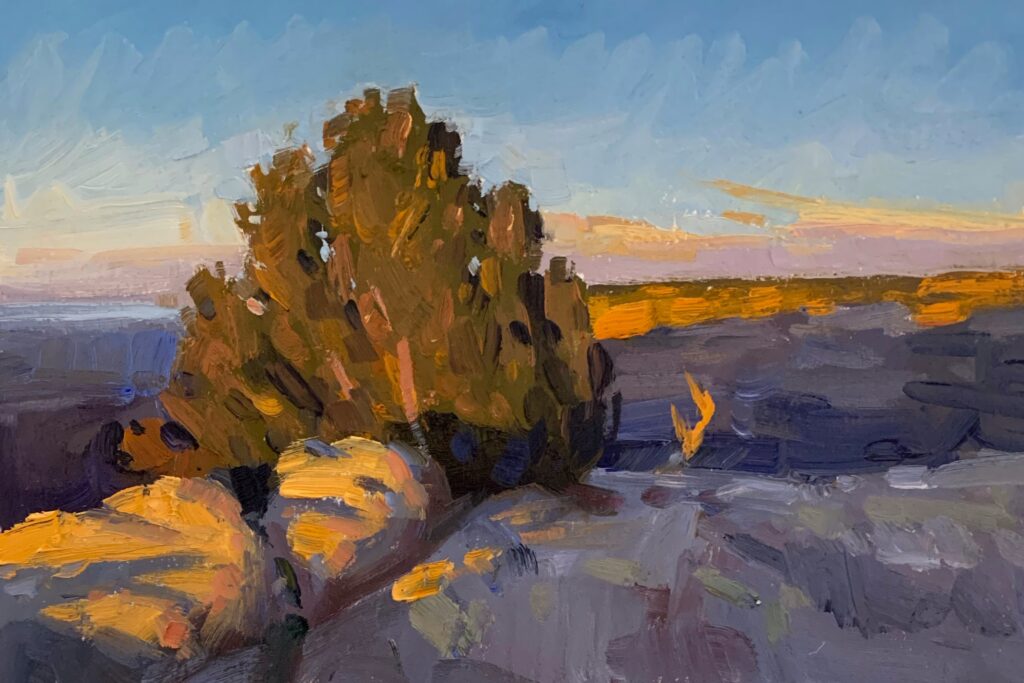
The scenes they experience may be similar, but Conner chooses to express nature’s beauty through colorful, impressionist realistic oil paintings while Elenbaas uses his camera to capture moments in time through stunning black and white and color photography.
Both artists will showcase this shared reverence for the Southwest at The Finer Arts Gallery’s Feb. 20 Art Affaire, where their work takes center stage in the Cave Creek gallery’s semi-annual refresh. The event marks the unveiling of six months’ worth of new paintings, sculpture, photography, glass, wood, fiber, ceramics and jewelry from the gallery’s roster of 50 diverse Arizona artists — a space known as much for its daily artist demonstrations as for its welcoming atmosphere.
The Architect’s Eye
As a child growing up in North Carolina, Tom Conner loved to paint and draw. Later, after graduating from North Carolina State University’s School of Design with a degree in architecture, he continued to draw and paint in his free time. It wasn’t until Conner moved to Arizona in 1994 that his true art education began.
“I moved to Arizona on a whim and didn’t think I was going to stay, but I fell in love with the beauty of the Southwest and never left,” he says.
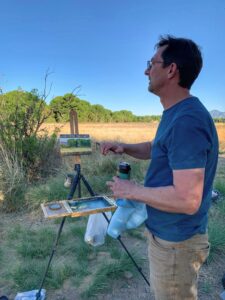
He began backpacking, rock-climbing and camping with other architects and eventually started venturing out on his own, bringing his paintbrushes, oil paints and canvases to paint plein air.
“Architecture is creative in its own right, but there are limitations based on building codes, city ordinances, costs and other factors. While I enjoy working full-time as an architect, I cherish the time I have painting either in my home studio or outside,” he says.
The essential quest for him in both painting and architecture is similar: Light and form are in partnership to reveal the nature of one another.
“I am always in the pursuit of capturing greater truths,” he says. “Light is what every artist or architect strives to capture in a scene or a design. Light can enrich colors, create edges, soften forms and create a focal point. Without light, there is no personality.”
Primarily a landscape artist, Conner is inspired by legendary California impressionists and Western artists, including Edgar Alwin Payne, William Wendt and Maynard Dixon. His work has evolved from traditional smooth, tight brushstrokes to impressionist realism, characterized by visible, short brushstrokes, a focus on light and atmosphere, vibrant colors, soft edges and fewer details to convey mood and movement.
He prefers working with oil paints, painting with thick impasto style to add texture and depth.
“I like to break an object down into smaller bits with loose, free brushstrokes to let the image sing,” he says. “I also like that oil is forgiving. I am constantly scraping down paint to adjust the composition or color of a scene.”
Conner’s biggest challenge painting plein air is weather, and when he is painting in his studio, he prefers to listen to music or a ballgame.
“I don’t watch TV after work. Painting is how I relax,” he says.
Some of the work he does is from photographs he took while hiking. “The hope is that I’m painting the same scene I experienced when I took the photo. As a viewer, you shouldn’t be able to tell the difference between a studio painting and plein air,” he says.
Always curious, he is open to trying new techniques and experiences to hone his skills.
“I have stretched myself to do urban nocturne paintings and have gone out with friends during the summer to capture the city lights plein air. I wear a headlamp and it’s tricky to achieve. I have also dabbled in other media, and I still do a weekly life drawing class, but I don’t think I will ever get tired of painting landscapes,” he says.
And while he has traveled throughout the world, he prefers to focus on painting the desert and other Southwest scenes.
“There is a subtle beauty in the desert. It is rugged, the quality of light is different, there is a crispness to the air and clean colors that are fun to capture. You have to look for the beauty, but it is definitely there,” he says.
Discovering Nature’s Beauty — Day and Night
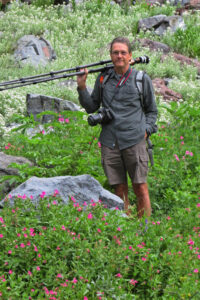
Like Conner, Robert Elenbaas embraces any chance to explore rugged trails, hidden valleys and other remote areas of the Southwest. An Anthem resident and one of the co-owners of The Finer Arts Gallery, he is passionate about discovering nature’s beauty both during the day and at night.
The fine-art photographer and adventurer will go on long treks to unique places that he can’t describe in words. So he uses his camera, the changing light and shadows and his keen skills in his “digital darkroom” to capture the awe of breathtaking landscapes and the profound beauty of the night sky.
As a child growing up in Southern California, Elenbaas had a box camera that he would play around with, but it wasn’t until he was in college that he really became interested in photography.
“My father traveled to Hong Kong for business around 1970. I asked him to buy me a 35mm SLR camera. After college, I started to do wilderness backpacking with friends, to places one can get to only by hiking or riding a horse. I would try to capture in photographs the beauty and wonder of these places so I could share them with other people,” Elenbaas says.
After completing his residency training, Elenbaas worked for 15 years as an emergency medicine clinical pharmacist before becoming executive director of the American College of Clinical Pharmacy. In his spare time, he would travel or backpack to remote areas with his camera.
The advent of digital photography became a game-changer for Elenbaas as it opened a new world of photography for him as an expressive art form. His digital darkroom allows him to “think like a painter,” which gives him much more flexibility to emphasize or de-emphasize certain aspects of each photo.
“All of my images are free of AI,” he says. “There is nothing in my images that was not originally there. I simply try to help people see things in nature that they don’t normally see or appreciate, either because of the limitations of human vision or because they just don’t take the time to really see what’s in front of them.
“A great example would be my nightscape photos of the Milky Way, star trails, lunar eclipses and timelapses of meteor showers. A lot of what we are able to do today in terms of nightscape photography would have been difficult to do in the predigital age. I really enjoy being out at night. It’s very humbling when you realize the vastness of our universe and the night sky.”
Elenbaas is very intentional in his use of light, and he often finds the best lighting during the golden hour of the early morning or at dusk when the light is soft and the shadows are long.
“The word ‘photograph’ means to draw with light,” he shares. “As a photographer, I am capturing and recording light. I need to be aware of what the light is doing — whether it’s a warm, cool or a reflective light. I’ve created some interesting photographs during the middle of the day, when the sunlight is harsh. It’s about knowing how to use the light.”
Elenbaas is inspired by other fine-art photographers as well as landscape painters.
“I enjoy viewing paintings in museums, particularly the older work at the Hudson River School in New York … those painters’ ability to render the landscape was amazing and very inspirational,” he says.
He also enjoys teaching others about photography.
“I tell new photographers to think like a plein-air painter. You have to think about the scene, the light and what made you stop in that spot in the first place. You need to consider what you want your photograph to communicate. To paraphrase Ansel Adams, ‘You don’t take a photograph, you make it,’” he says.
Elenbaas includes the Japanese kanji “wa” on each photograph as part of his signature logo. In common usage, “wa” translates as “harmony” and “peace,” as in being in harmony with one’s environment and in a peaceful state of mind.
“My goal is that my images serve as visual metaphors for the emotions I felt when the shutter clicked,” he says.
Art Affaire
Friday, Feb. 20 // 5–7 p.m. // The Finer Arts Gallery // 6137 E. Cave Creek Road, Cave Creek // Free // 480-488-2923 // thefinerartsgallery.com