

The B-Side
Music Alive! Teaches the Valley to Listen
Writer Joseph J. Airdo // Photography Courtesy of Arizona Musicfest
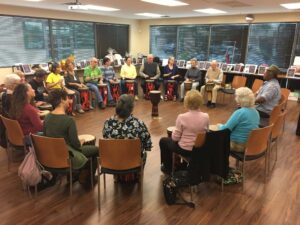
Every Wednesday morning, something unexpected happens inside two buildings off Thompson Peak Parkway in North Scottsdale. People gather — 100 of them, sometimes more — not for a concert, not for a gala, but to learn. To listen. To play ukulele for the first time at 70. To argue about James Taylor. To find out, with some surprise, that they are not alone in loving this music as much as they do.
Most people who know Arizona Musicfest know it as a concert series — 35 years of world-class performances, a sold-out season drawing more than 50,000 ticket buyers, a roster of guest artists that has included Johnny Mathis, Mandy Patinkin and Joshua Bell. What those same people may not know is that a parallel programming track has been quietly growing beneath that marquee. It’s called Music Alive!, and this season more than 5,000 people will pass through its doors.
“For a long time we had two pillars — the concert season and what we did for youth,” says Allan Naplan, Musicfest’s executive and producing director. “Now we have a very stable third pillar, and that’s Music Alive! and our community engagement programs.”
The idea came to Naplan in his third year leading the organization, when something obvious suddenly became impossible to ignore. The community surrounding Musicfest — largely retirees in one of the Valley’s most affluent corridors — was showing up for evening performances in enormous numbers. They loved music. They had time. And during the day, Musicfest had nothing to offer them.
“I thought, this is such a ripe opportunity,” Naplan recalls.
He launched the program in 2016 with characteristic modesty. The original offering was called Music and Muffins — structured like a book club, built around a weekly listening list that participants would explore on their own time before gathering to discuss it. The muffins helped. So did the content. So, perhaps most importantly, did the simple act of bringing people together around a shared passion. The common area of Musicfest’s then-offices in Carefree started filling up every week with people playing ukulele. It was, Naplan says, unmistakable proof of concept.
Today, Music Alive! spans roughly 350 events per season — free lectures, music theory classes, drumming circles, instrument lessons, guided listening seminars and a clinical partnership with the Neurologic Music Therapy Services of Arizona that treats the organization as a laboratory for evidence-based cognitive health programming. During the height of the season, from January through April, there are five to six events every week.
The man most responsible for that programming is Josh Condon, Musicfest’s resident artist and director of community music programs. His background is the kind that resists a single sentence: classically trained pianist, jazz musician, musical theatre director, former cruise ship music director for Norwegian, Celebrity and Princess cruise lines. He came to Musicfest three years ago through a mutual friend, with no particular plan to become a community music educator.
“I never thought I would be in this particular kind of role,” Condon says. “But my background lends itself to the variety that Musicfest provides. When I do these sessions, I’m not thinking of it as teaching per se. I’m simply sharing my own genuine interest in the topic with the audience. I’m somewhat of a nerd — you look up interviews from artists, you learn everything about the style and interpretation. And I think that’s what resonates.”
The flagship offering Condon leads is Listen Up, a weekly Wednesday morning seminar that he describes as a program with no single format. Some sessions are lectures. Some are guided listening exercises. Some unfold in a podcast-style dialogue with a guest artist. What they share is a consistent mission: to illuminate the music, the person who made it and the human impulse that drove its creation.
“Behind every great piece of music, there’s a compelling story,” Condon says. “What I’m trying to isolate is this: every piece of music was created by a real human, in real time, in a real place. What were they motivated by? What rules were they following — or breaking?” He pauses. “I also try to give people the vocabulary to talk about what they’re hearing, to put words to things they may have always felt but could never articulate. That’s why it’s called Listen Up — at the end of the day, it’s teaching people how to listen to music better and how to get more out of the experience.”
The people in those Wednesday morning chairs are, by Condon’s description, curious people — people of good taste, as Michael Feinstein recently told an audience of them directly. They skew older, reflecting the community Musicfest has always served, though Condon resists language that makes the programming sound exclusive. What he will say, carefully and with some feeling, is that for many of the people who come through those doors, Music Alive! is doing something that goes well beyond music appreciation.
“We are explicitly building community,” he says. “Studies have shown that seniors who maintain an active social life are happier, live longer, have better health. Someone comes in, hears music they love, looks over at a stranger and says — oh, you love this too? A friendship is born when one person says to the other, ‘I thought it was just me.’”
Naplan makes the same point from an institutional angle. The program is free — no admission, no per-class fee for the lectures and seminars — because it is understood as a charitable mission, subsidized by the margin the concert season generates on sold-out nights, as well as through the generosity of Musicfest’s donors.
“Instead of paying $10 or $15 per class,” he says, “our patrons are giving very meaningfully at the end of the season, because they know we are greatly enhancing their quality of life. It has become part of their lifestyle.”
The music-making classes — piano fundamentals at three levels, ukulele, guitar, West African drumming, HealthRhythms drumming sessions — carry a modest fee of $200 to $225 for an eight-session course, with class sizes running between eight and 15 participants. Condon doesn’t teach them himself; he recruits for them, and the recruiting, he says, is everything.
“If it’s a perfunctory exercise for the teacher, that translates immediately to the students,” he says. “But if the teacher is passing on genuine joy, genuine excitement, a real love for the art — that connects.”
What happens to an adult who learns an instrument for the first time, or returns to one abandoned 60 years ago, is something Condon has watched closely. Audience members used to come up to him after performances and say they wished they hadn’t quit piano. They were 70. They had quit at seven. Music Alive! exists, in part, to answer that wish.
“Music happens in time,” he says. “You’re coordinating your brain with your hands with your ear — all in real time, all within a rhythmic constraint. For people going through dementia, music and musical memory is often the very last thing to go, long after speech and short-term memory have faded. It lives in a deep place in the brain and the spirit. But there’s also just the profound sense of accomplishment. I think it’s so valuable for anyone, at any age, to do hard things and see them through.”
Once a month, Condon loads his materials into his car and drives to the city of Scottsdale’s Via Linda Senior Center to deliver a smaller version of what he does at Musicfest — a promotional session for an audience that, on a good day, numbers about a dozen. He admits that early on, the disparity gave him pause. He mentioned it to Naplan. They decided to keep going.
On one particular morning, Condon loaded the car early, drove over, and caught himself doing the math — all of this preparation, all of this effort, for 12 people. It was a fleeting thought. But it was there.
Walking out to the parking lot after the session, a woman named Doris stopped him. She told him about her first husband, a musician. Her second husband, the love of her life, recently lost. The long days at home afterward. Her daughter calling, urging her to get out. She wasn’t someone who had hobbies, she said. She had been an executive. But she loved music. So she came to his session at the senior center, and then she started coming to everything at Musicfest.
“You have given me, in however many years I have left, my first hobby,” she told him. “And that has given me a new reason to live.”
Condon gets quiet for a moment.
“I was so angry at myself for having walked in with anything less than full presence for that moment,” he says. “Because what I do here is so much bigger than me. I think about Doris, and I think — there are probably many other Dorises out there. And I try to facilitate spaces where anyone can come and have that kind of moment, whatever their story is.”
Music Alive! programming runs year-round. The instrument classes conclude in mid-May, but Wednesday morning sessions continue through the summer — a Songs of Summer series, film screenings, iced coffee — before ramping back up to five events a week when the concert season returns in the fall.
“Five years from now, Music Alive! will be even bigger,” Naplan says. “I have no doubt about that.”
Condon frames it somewhat differently, in the way that people who do the work rather than run the organization tend to frame things.
“I’m always their gateway drug,” he says, “into whatever they choose to explore.”
From the Top
The youngest people in Arizona Musicfest’s orbit and the oldest don’t often share the same room. But they share the same institutional commitment — and occasionally, the same stage.
Musicfest’s youth programming runs parallel to Music Alive!, built around the conviction that an organization serious about music’s future has to invest in the people who will make it. That investment takes several forms.
Six annual competitions across divisions — strings, winds and brass, piano, voice, jazz and chamber ensemble — give young Arizona musicians a professional performance context and, for winners, cash prizes and a place in the Young Musicians Concert Series. From there, standouts earn access to the Access to Artistry Masterclass Series, working directly with the nationally and internationally acclaimed guest artists who anchor Musicfest’s main stage season.
The Arizona Musicfest Scholarship Program, launched in 2011, has awarded a combined $233,640 to students pursuing college degrees in music — a merit-based program that draws from the competition pipeline and requires prior participation in Musicfest’s youth programs. Recipients have gone on to the Juilliard School, Manhattan School of Music and elite orchestras across the country. Some have come back to solo with the Festival Orchestra — a full-circle moment that Allan Naplan describes with undisguised pride.
A newer initiative reaches further. The Summer Music Camp Scholarship Program, now in its third year, is 100% need-based — built for students whose school-year momentum would otherwise evaporate over a long Arizona summer. Aligned with partner Valley arts organizations serving underserved communities, the program has sent students to Interlochen Arts Academy in Michigan, Brevard Music Center in North Carolina, Meadowmount School of Music in New York and Berklee College of Music’s Aspire summer program in Boston, among others.
The concert season fills the hall. The scholarships fill the pipeline.