

Play It Forward
Jubilate Conservatory Turns Musical Literacy Into a Lifelong Gift
Writer Shannon Severson // Photography Courtesy of Jubilate Conservatory of Music
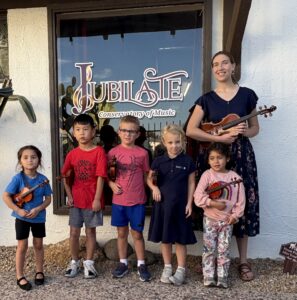
Small fingers grip the bow of a violin, gliding across the strings as the instrument sings in the hands of a young student at Jubilate Conservatory of Music. More than tools for making sound, the violin and bow are doorways to community, history and self.
Laya Field is the school’s founder and director — a composer, curriculum author, operatic vocalist and violin and viola instrumentalist. Her vision for a multigenerational community music program has come to life among the white stuccoed walls of Carefree’s Spanish Village, where the conservatory opened its doors last November, conveniently situated next to a coffee shop for parents who linger while students practice.
“Jubilate — pronounced ju-bil-ah-tay — means joyful,” she explains. “A joyful conservatory of music. We have children and adults; everyone is welcome here. Our focus is to guide children into becoming literate musicians.”
As afternoon sunlight streams into the cozy studio, Field reflects on her Northern California upbringing, where her church organist mother would nestle young Laya into a basket as she worked the pedals and keys of a glorious pipe organ. The reverberant sounds of the organ, accompanying choral oratorios and eventually violin lessons, awakened her musical DNA, prompting her to pursue music education at Humboldt State University, where she studied violin and voice as a rare contralto.
When she moved to Arizona and her church asked her to assemble a children’s choir, her enthusiasm gave way to concern when, among 15 young participants, only one could match pitch. As she surveyed the mothers and grandmothers of the children with the same results, she had a worrying thought: “I started imagining the country with no one being able to sing. Music is one of the major, unifying tools for people and for our country. It transcends time and connects us with history.”
Field was determined to restore musical literacy in a welcoming environment with a curriculum strong on the basics. Ultimately, she sees music as a means to bond human beings; her nonprofit conservatory uses voice, instruments and rich musical heritage that crosses generational and cultural boundaries.
“Music is a language,” Field explains. “You read it; you write it; you speak it. Anyone could go to Germany, for example, and communicate with music even if they didn’t share a language.”
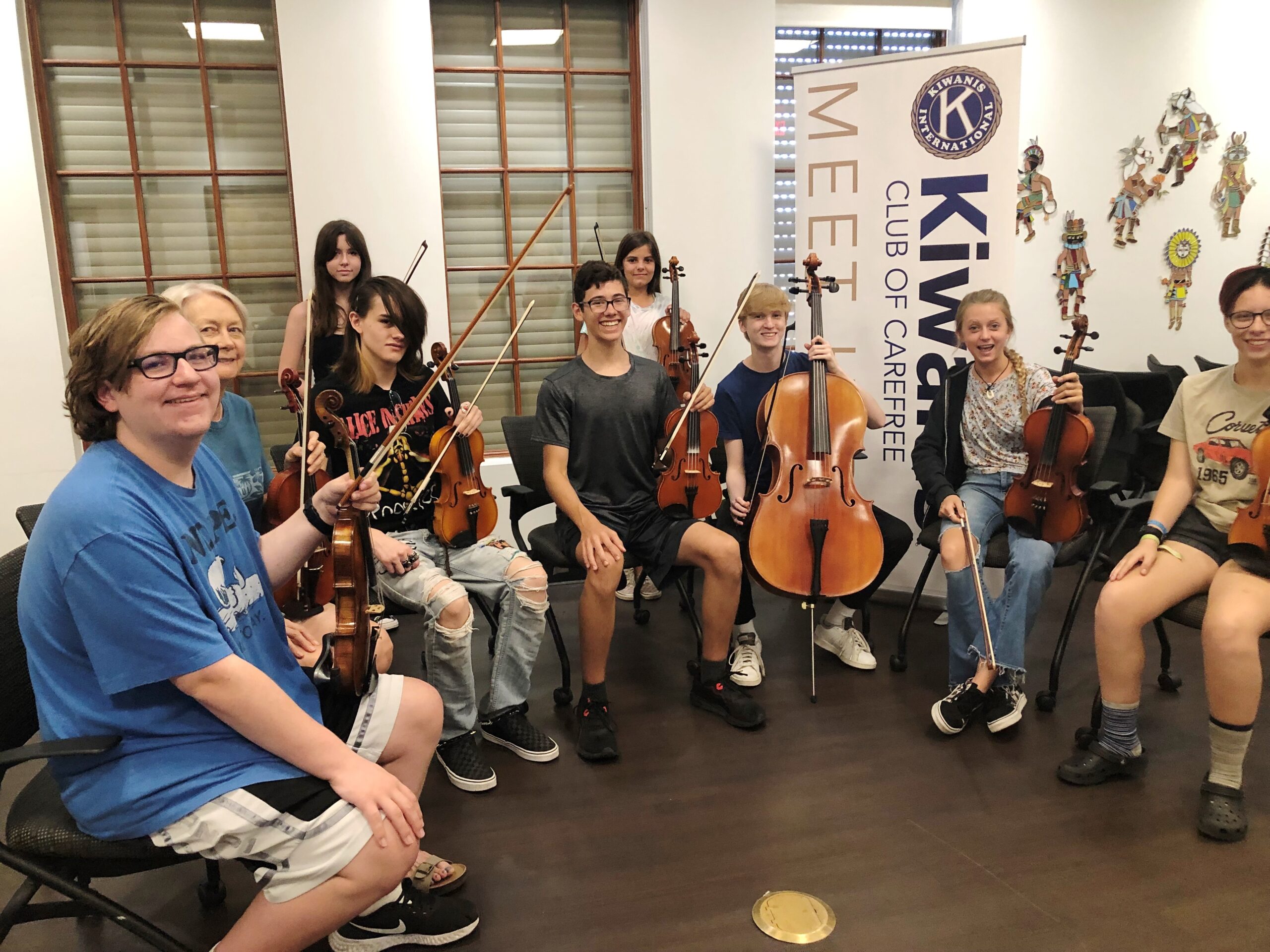
Family and community support, particularly from the Kiwanis of Carefree, guided Field through solidifying her nonprofit business model and helped with funding grants. Conservatory students have been invited to play at the Sanderson Lincoln Pavilion for Kiwanis-sponsored Christmas events and other community-sponsored festivals like Earth Day.
“Laya is more than a music instructor,” says Edward Edling, a Kiwanis funds request committee member. “Her love for her pupils, along with her passion, have made her a life-changing mentor to many. I’ve witnessed several of her pupils grow up to be engaging and talented musicians. Kiwanis will continue to support her mission.”
In December 2025, the school received special recognition from Rep. David Schweikert for “outstanding public service and entrepreneurial achievement,” with a special certificate and an emissary present at the Carefree studio’s ribbon cutting.
Instructor Esme Peters found her musical voice at an early age when she joined a parks and recreation program that filled the gap in music education at her Portland, Oregon, public school. She sees her younger self reflected in many of her students.
“I started private violin lessons at age 5 but it wasn’t a big joy for me until I joined the community children’s orchestra,” she recalls. “The conductor was a very theatrical woman who made it fun. That’s when music became what I wanted to do and now want to share with others.”
With a degree in violin performance from the University of Oregon, Peters is completing her master’s in music performance at Arizona State University and had taken a few teaching jobs before finding Jubilate. She was immediately drawn to the intentionality of Field’s instructional methods and the community-oriented nature of the ensemble classes and teaching space. She is one of 11 teachers at the conservatory, giving private violin and viola lessons and serving as lead instructor of the string orchestra and string quartets. Field says there’s a camaraderie among students and teachers that bonds musicians of all ages.
“For anyone, playing alongside friends makes it more enjoyable,” Peters says. “Many approaches can be limiting; playing in a group is part of what really resonates with me as a teacher and with my students at Jubilate.”
Field explains that Jubilate takes a one-room schoolhouse approach, particularly with the Jubilate Violin Orchestra, where older students become mentors and teachers for younger or less experienced students. She advocates music immersion as a holistic teaching method.
“It’s teaching the children to understand musical concepts without telling them what they are,” Field says. “I’ve patterned it after group family music sessions; if someone isn’t singing, they may be playing the spoons or a tambourine.”
Peters says it’s easy to fall into a trap of focusing only on the individual notes on the page. At Jubilate, students aren’t just “doing the math” but also listening to the other instruments around them, hearing the music as a whole, singing and even composing as they learn musical fundamentals.
Field encourages her students — who have grown in number from 6 in the early days of 2008 to 51 today — to write their own compositions. At the conservatory’s Composers Concert in November, teachers will exclusively perform pieces written by their pupils.
“I didn’t write music until I had to in college,” Peters adds. “It was daunting. To have the children do it from the beginning is so great.”
The response from families and students — who are learning recorder, violin, viola, cello, piano, percussion and voice — has been overwhelmingly positive. Most participate in both private lessons and at least one ensemble class.
Ava Cohen recalls beginning classes with Field when she was in second grade, having no musical knowledge at the time. Now 16 years old, she plays violin, sings, participates in ensemble and choir and even teaches theory to younger students in Jubilate’s Music From the Heart class.
The foundations she learned using Jubilate’s approach helped her grasp music as a whole rather than in disconnected pieces. She can sight read multiple clefs and pick up guitar and piano, and says reading, writing and singing the language of music has made a profound difference in her life.
“I gained the ability to express myself and stimulate my mind in ways I otherwise wouldn’t be able to,” she says. “I write and compose pieces and songs that can convey a meaning big or small. Jubilate has been a place that has helped me grow and has given me a foundation that is strong and purposeful. It has been an amazing experience; I have skills and talents that I can use throughout my whole life to achieve more.”
Cohen says her problems subside when she’s immersed in music, and that music’s positive effects on cognitive function and focus ring true in her own experience. Jubilate’s program, she adds, has helped her become “a better version of myself.”
The conservatory offers string lessons for adults with plans for a recorder ensemble centered on early Baroque music in the coming year. Each Saturday, the Jubilate Violin Orchestra — comprising musicians ages 5 through adult — meets at the Desert Foothills Library in Cave Creek, a free, open gathering of the musical community.
“Each piece I write has multiple skill levels so every musician can participate where they’re at, skill-wise,” Field says.
“This brings people together; it creates healthy socialization for the children. They’re not playing video games, they’re practicing Bach! Their brain synapses are all working together; it helps them to center and work things out.”
On the fourth Sunday of every month from 2:30–3:30 p.m., Jubilate’s percussion teacher leads a family drum circle at Sanderson Lincoln Pavilion where everyone uses rhythm instruments, with an optional parade around the Sundial at the session’s conclusion.
Field’s participants include homeschool, private school and Cave Creek Unified School District students, but many also come from North Scottsdale, Anthem and North Phoenix. Events on Saturdays — including occasional faculty recitals — make attendance easier, and there’s an online music library for remote students. Visitors are welcome to stop by if the door is open, and Jubilate’s free online newsletter regularly announces scheduled concerts and events.
The year culminates in the Spring Concert — a final recital Saturday, May 23 from 1–3 p.m. at Desert Foothills Library featuring all of the conservatory’s ensembles.
In this musical one-room schoolhouse, Jubilate reaches beyond recitals to build something lasting: a community of musicians who hear the world differently because of what they’ve learned here, and who carry that gift into lives that are richer for it.
jubilateconservatoryofmusic.org
Jubilate Conservatory of Music Spring Concert
Saturday, May 23 // 1 p.m. // Desert Foothills Library // 38443 N. School House Road, Cave Creek // Free // jubilateconservatoryofmusic.org