

Framing the Fairy Tale
The Art and Engineering Behind ABT’s ‘Pretty Woman’
Writer Joseph J. Airdo // Photographer Loralei Lazurek
The streetlight on Hollywood Boulevard started with a pool noodle.
Arizona Broadway Theatre’s acting technical director Cody Burgoon needed to replicate the rounded arm of a period streetlight — the kind that cast sodium-vapor orange over the stretch of Hollywood Boulevard where Vivian Ward makes her living in Pretty Woman: The Musical. The solution came together from schedule 40 pipe, box tube bent through the pipe bender, notched and welded, then sheathed in foam pool noodles to achieve the correct cylindrical profile.
“From 30 feet away, it’s completely convincing,” Burgoon says.
This is how theatrical magic gets made at Arizona Broadway Theatre — not with smoke and mirrors but with ingenuity, steel and occasionally the sporting goods aisle. For Pretty Woman: The Musical, running March 13 through April 19, the Peoria dinner theater has constructed two complete architectural worlds on a single stage: the gritty horizontal sprawl of 1990s Hollywood Boulevard and the gilded vertical grandeur of the Beverly Wilshire Hotel. Between scenic designer Clifton Chadick’s emotional vision and Burgoon’s structural reality, an entire city has been built — and engineered to disappear.
The Hopeful Blueprint
Chadick approaches scenic design not as decoration but as emotional argument. His Music City — which placed its audience inside a Nashville dive bar that simultaneously served as multiple locations throughout the show — earned a 2025 Drama Desk Award nomination for Outstanding Scenic Design of a Musical, placing him among nominees that included David Rockwell and Derek McLane. He traces his instincts to his grandfather, a NASA simulation engineer and amateur magician who took the family to Disney World three times and thought constantly about the marriage of engineering and wonder.
“As a toddler at Disney on Ice, I remember looking up at the grid and thinking, oh, there are going to be bubbles — I could see the bubble machines,” Chadick says. “I grew up in a blue-collar town, not a particularly artsy place, but somehow I was just exposed to that way of seeing early on. I think I saw a high school production when I was very young and something clicked: creating different worlds. How do we do that? My grandfather instilled that question in me, along with my parents.”
For Pretty Woman, the answer to that question began not with architecture but with feeling.
“This is a hopeful story — that was my starting point,” Chadick says. “I knew I wanted it to feel that way — a landscape of the Hollywood Hills and the Hollywood sign somewhere in the distance, something you’re reaching toward, something you desire. The colors carry that. We’re working in ‘80s vivid: hopeful, fun, vaporwave. It’s Vivian’s story, her Cinderella story, and the palette reflects that.”
The design’s visual signature is its portal landscape: forced-perspective palm trees and Spanish Revival arches framing the entire stage, embedded with LED elements that allow lighting to shift the show’s emotional register at the touch of a button. A ground row of the Hollywood Hills anchors the horizon. The class divide is encoded in the palette itself — purples, periwinkles and grays for Hollywood Boulevard; corals, golds and warm marble tones for the hotel world.
“Vivian’s world — Hollywood Boulevard — is really represented by two physical elements on stage: the apartment building and a wagon unit with a bus bench, a leaning streetlight, a trash can, those kinds of street-level details,” Chadick explains. “The lean of the apartment building and the streetlight says something — this is a deteriorating space, a world slightly off its axis. When we move to the hotel, everything gets bigger, grander, cleaner. That color shift is doing a lot of the class work without the set ever having to announce itself.”
The Beverly Wilshire interiors in the original 1990 film were built as sets at Disney Studios in Burbank, bearing limited resemblance to the actual Italian Renaissance building at Wilshire and Rodeo Drive. Chadick is designing a stage set of a movie set of a hotel — three layers of theatrical construction deep.
“I remembered the corals of the bathroom from the movie — those are interesting colors for a businessman’s penthouse, I always thought,” he says. “So I leaned into that, working from my memory of the film. From there I did my own grand columns, my own sense of what that lobby’s grandeur might feel like.”
The sheer coral drapes — swooped and swagged — fly in whenever the action moves to the hotel, regardless of which specific space, as a consistent visual shorthand for the elevated world. The polo match that opens Act Two introduces yet another architectural register.
“The polo tent is striped, very black and white, clean lines,” Chadick says. “Those rigid lines say something about the social construct that space represents.”
Structural Reality
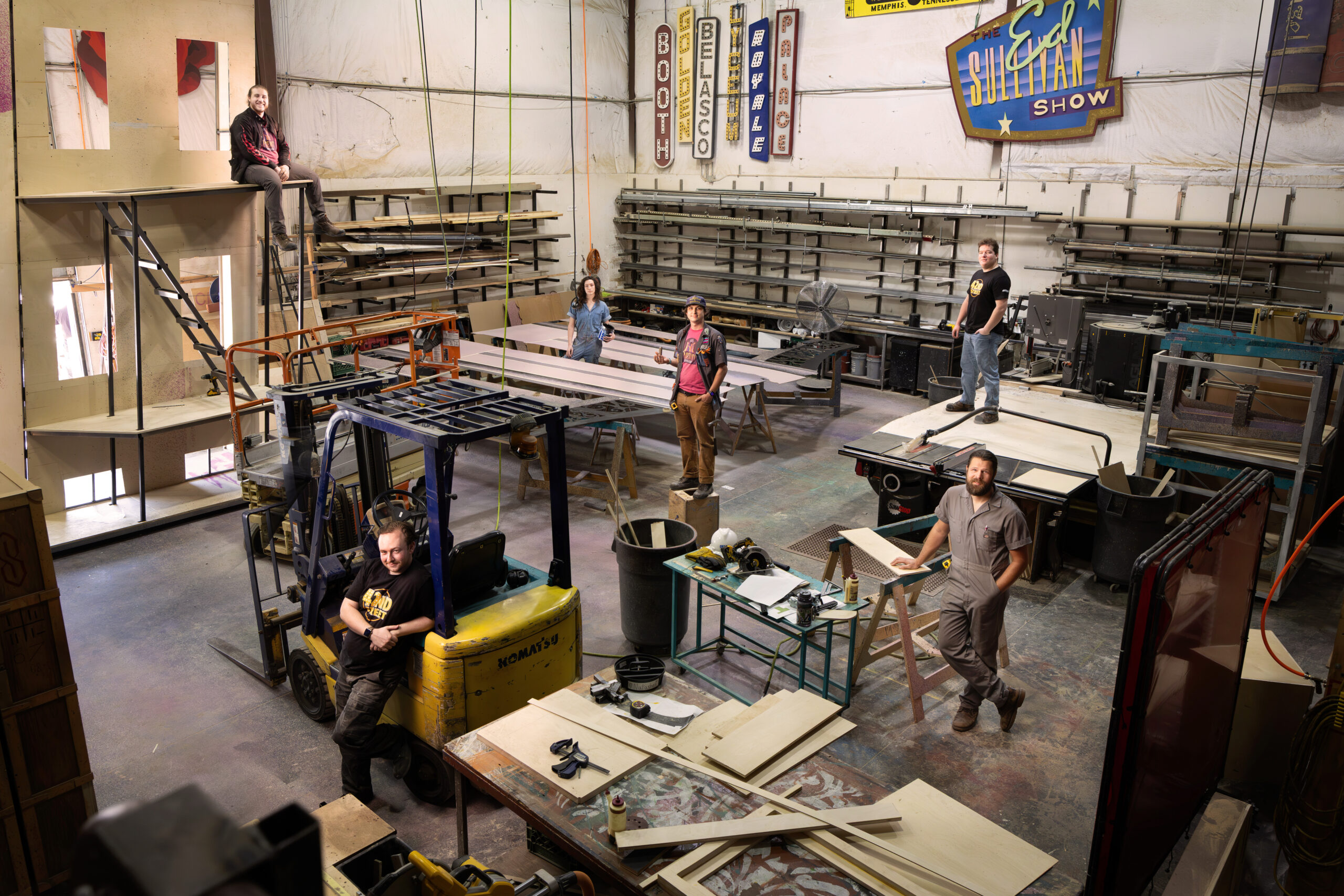
Getting any of this from the rendering to the stage is Burgoon’s job. His path to ABT moved through a Kansas City community college, a Bachelor of Fine Arts in technical direction from the University of Minnesota Duluth and a string of summer stock positions in upstate New York before he arrived in Peoria last September as assistant technical director. When the permanent TD resigned to move his family to New York just weeks into Burgoon’s tenure, the 18-foot apartment building and everything attached to it became his responsibility.
“The first problem I identified was the apartment building,” he says. “It’s very tall, very large, and the entire thing is set at an angle because we wanted to create forced perspective. One of the walls has compound angles cut into steel, which we have to do manually with a portaband saw because none of our chop saws can actually make that cut. One degree off in one direction can throw something two feet out of alignment by the time you’re 18 feet away.”
The building’s engineering challenges didn’t end with the compound cuts. It was too tall to fit through ABT’s rolling shop door — and the problem had to be solved without compromising the design Chadick had built the whole production around.
“I was told in no uncertain terms that we were not leaning it over to angle it through,” Burgoon says. “So I talked with Clifton and we agreed to make it smaller. We made it smaller — and then the space between the two platforms wasn’t sufficient for the actor. So we had to make it taller again. We solved it by designing the top section to detach. We’ll get the main structure through the door during load-in, then attach the top once it’s on the stage side. It won’t come back through that door until strike.”
This kind of negotiation — between vision and physics, between what a rendering calls for and what a scene shop can deliver — is the central work of Burgoon’s role. He describes himself, without complaint, as the production’s designated no.
“You’re the no guy — you’re the one who sometimes has to say something can’t be done as specified,” he says. “But saying no almost always opens a conversation: okay, if we want this effect, how do we actually get there? Those conversations are some of the best parts of the job. I’ve always believed you should never stop learning, and this apartment building taught me something new about physics.”
That conversation runs through email threads copied to production manager Jamie Hohendorf-Parnell, pulled into shop discussions, resolved through proposals that try to preserve emotional intention while accommodating structural reality. Theater’s collaborative nature is not incidental to how ABT works — it’s load-bearing.
“When I hit a problem, I’ll draft a proposed solution — one that tries to preserve the artistic intention and the emotional effect while also being structurally possible,” Burgoon says. “I also think that being a good TD means understanding what you’re trying to achieve artistically, not just structurally. Every TD needs some background in set design, because if you don’t understand what an environment is trying to evoke for the audience, you can’t make smart compromises. You might solve the engineering problem while inadvertently killing the effect.”
The in-house scene shop attached to the theater — an institutional rarity in regional theater, where most productions truck finished pieces in from off-site builds — makes those compromises possible in ways they otherwise wouldn’t be.
“The biggest advantage is that we can build things at their full, final scale without ever having to break them down for transport,” Burgoon says. “If we’d been at an off-site shop, we would have had to build everything so it could fit in a box truck, then reassemble it on stage. Trying to make large scenic pieces fit into a box truck is a real constraint — and it can sometimes compromise the design in ways that shortchange the show. When we can just roll something directly onto the stage, we don’t have to play with hinges and break-away joints. We can weld the frame and know it’s going to be exactly right.”
The Language of Illusion
Chadick, for his part, will be adding paint and detail until opening night — the proximity of shop to stage keeps the design fluid and responsive in ways that a distant build never could.
“I tend to be working on the set and finishing it and painting it and adding details right up until the day of opening,” he says. “It helps having the shop there, because I can just run and get whatever paint color or molding I need and then run back to the stage.”
Much of what gets added in those final days is surface — the language of illusion that Chadick directs through vocabulary as specific as the techniques themselves. Scenic charge artist Gray Passey is currently painting the hotel’s grand column structure, a piece that is entirely two-dimensional but will read as a colonnaded three-dimensional entryway from the house. The opera box — another hotel element — carries 70 individual pieces of trim, precisely placed to read as authentic architectural detail from across the room.
“A lot of my direction lives in the visual renderings themselves,” Chadick says. “But there’s also real conversation about technique — about how to paint brick to get that gritty, spattered quality, versus the Venetian plaster feel of a hotel room. When I was talking with Gray, I used terms like rag rolling — where you wrap fabric around your roller and paint with it, which creates that Venetian plaster effect in different sheens and different shades. Because we wanted this show to live in a stylized, heightened world, I painted in a way that has a slight graphic quality to it — not comic-book exactly, but theatrical. Fun. Exciting. Something that says right away that this world has been heightened.”
When audiences settle into their dinner tables and the house goes dark, none of this will be visible. Not the portaband saw cuts in compound steel, not the pool noodles, not the 70 pieces of opera box trim. Not the physics negotiation that determined exactly how tall an apartment building can be and still make it through a door. The work of Chadick and Burgoon exists precisely so that none of it shows.
“It goes back to why I fell in love with theater in the first place — building something and then watching people encounter it,” Burgoon says. “You can see them deciding to believe in what they’re looking at. Theater is a place where magic can be real. And I get to be part of making that magic happen.”
He just happens to know what the magic is made of.
‘Pretty Woman: The Musical’
March 13–April 19 // See website for showtimes // Arizona Broadway Theatre // 7701 W. Paradise Lane, Peoria // See website for ticket prices // 623-776-8400 // azbroadway.org