

Desert by Design
Where Architecture Meets the Sonoran Landscape
Writer Joseph J. Airdo
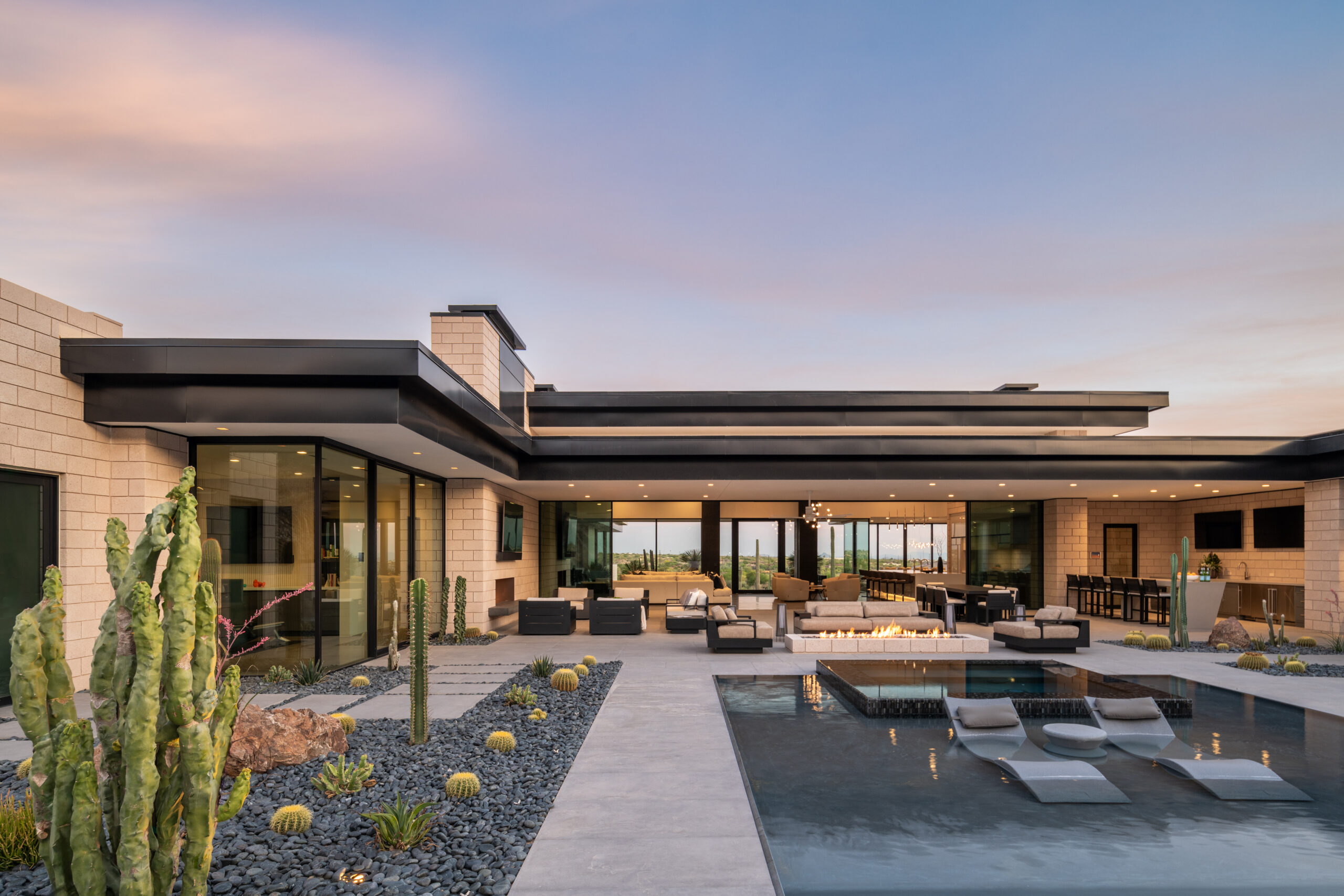
The moment you notice it, you can’t un-see it. The travertine running from the kitchen floor continues, without interruption, beneath the pocketing glass doors and across the pool deck beyond. The ceiling treatment inside reappears outside. The fireplace on the interior wall finds its twin on the covered patio. The house doesn’t end — it simply changes state.
In the Sonoran Desert, where the backyard is the primary reason most people choose to live here, this dissolution of the indoor-outdoor boundary is the defining challenge of luxury residential design. It requires an architect who understands light and orientation, a landscape team that thinks in three dimensions and materials, and a horticulturalist who knows that the right plant in the right place isn’t landscaping — it’s sculpture. We convened five of the North Valley’s leading design authorities to define how it’s done.
Mark Tate // Tate Studio Architects
Mark Tate begins every project the same way: by trying to understand how the land wants to be lived in.
“We begin by studying the views — where they’re strongest, how they shift throughout the day, and in what ways they can be enhanced,” he says. “We then look for any unique landforms, rock formations, native plants, and any features that can be preserved and incorporated into the design.”
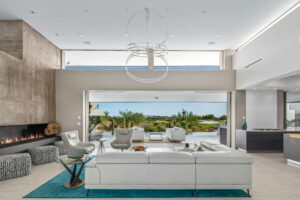
A sun study is conducted for every project at Tate Studio Architects, informing the home’s orientation before a single line is drawn. The payoff shows up in the finished product. His homes are often 30% or more glass — a figure that redefines what it means to live indoors.
“Full-width sliding or pocketing glass doors open entire rooms to the outdoors, creating a seamless flow with uninterrupted views,” Tate says. “Flooring, site walls, ceiling treatments, and fireplace details are carried from inside to outside for continuity.”
What’s evolved in recent years is the ambition behind the ask. Clients aren’t simply requesting a patio anymore.
“We’re seeing an increased interest in saunas, cold plunges, sport courts, meditation or Zen gardens, yoga and Pilates studios — all incorporated and connected to the outdoor spaces,” Tate says. “It’s become less about simply being outside and more about creating intentional environments that support a holistic lifestyle.”
Clint Miller // Clint Miller Architects
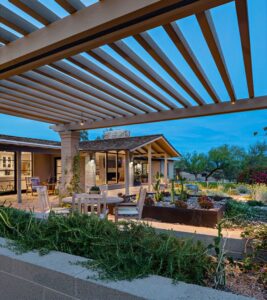
Where Tate pursues transparency, Clint Miller pursues balance. The organic, adobe-influenced tradition he works within doesn’t reject openness — it insists that openness requires its counterweight.
“Every project begins with connecting the interior to the outdoors,” Miller says. “A well-placed picture window or a pair of French doors can define the entire feeling of a room.”
But the orientation of that connection matters. A west- or south-facing view demands a sheltered, connected patio to mediate the harsh afternoon sun. A north or east orientation opens different possibilities — less overhang, more exposure, the vast open expanse made comfortable by cooler light.
“Most projects benefit from both — a cozier, defined outdoor room and an open expansive space,” he says. “There is always a time of day when one works better than the other, and designing for both gives the homeowner a complete outdoor experience rather than a single static setting.”
The tension between shelter and exposure, Miller argues, is precisely the point.
“Whether the need is to retreat from the harsh sun or simply to find a comfortable chair to read in, the cozier space has its moment. But the open view has its moment too. The best designs don’t choose between them,” he says.
John Turnock // Azul-Verde Design Group
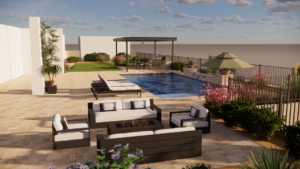
The architects define the envelope. John Turnock defines the geometry of what lies beyond it. His company, Azul-Verde Design Group, has built a reputation on hardscape that thinks like architecture — pools, terraces, retaining walls, and pavers that don’t merely surround a home but extend it.
“We always start by walking through the house on the way to the backyard,” he says. “That first experience of the space — moving through the interior before you arrive outside — is where the design begins.”
It’s an approach rooted in Turnock’s background in high-end residential construction across California, Colorado, and the Valley. The principle holds across terrain: when a site presents elevation changes, his team treats the slope as an asset rather than a liability.
“We treat elevation the same way — as an opportunity rather than an obstacle,” he says. “We’re not going to put up a sheer eight-foot retaining wall and call it done. We’ll terrace it, work in a planter, add a water feature. We use the slope of the land the way the land actually wants to be used.”
In 2026, the material calculus is shifting. Travertine has become Turnock’s default recommendation for pool decking and patios — not for aesthetics alone, but for a practical reason that matters in the desert.
“It runs about 30% cooler than other materials,” he says. [VERIFY: travertine temperature claim]
Rather than simply replacing what’s already there, his preferred approach honors the existing palette. A lot of older homes in the Valley carry natural ledge stone that can’t simply be torn out — so Turnock brings the new travertine to the deck and puts the old stone to work facing a water feature, a fire pit, or a barbecue surround.
“Enhancing the old with the new — that’s the approach,” he says.
Chad Norris // High Desert Designs
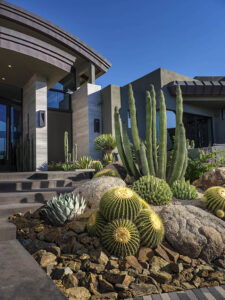
Where the hardscape team establishes geometry, Chad Norris softens it. His work begins where the pavers end — in the space between the architecture and the open desert, where the challenge is making a transition that feels inevitable rather than designed.
“Modern homes often rely on strong geometry and sharp architectural lines, so the landscape plays an important role in softening those edges and reconnecting the structure to its natural surroundings,” he says. “I prefer to move away from rigid linear arrangements and use mass groupings of plants and materials to create a more natural progression from the architecture into the surrounding desert landscape.”
The approach is deliberate and sequential. At the Haselden residence — designed by Tate Studio Architects — Norris anchored the entrance with golden barrel cacti and agaves set against a blue glass water feature, two varieties chosen for the way their sculptural forms echo the home’s geometry and establish what Norris calls a “sense of arrival.” As the eye moves outward from the structure, the compositions loosen, the terrain begins to undulate, and the planting transitions gradually into the character of the surrounding desert.
Boulder placement follows the same logic. The right stone — chosen for its size, patina, color variation, and natural veining — is set deeper into the soil than clients typically expect, and often larger than they initially envision, because plants grow around it and the scale shifts. The goal is a boulder that looks as though it was never placed at all.
“Less is often more in the beginning,” Norris says, “leaving room for the landscape to mature so it feels organic rather than overdesigned.”
The broader shift he’s witnessing in the Valley confirms the instinct. For years, the dominant model leaned heavily on formal European plantings — sometimes seven or more shades of green, requiring significant water and regular pruning that left landscapes looking clipped and geometric. Norris takes a different approach: drought-tolerant, sustainable species chosen not just for texture but for pops of seasonal color that the all-green palette never could deliver.
“Today we’re seeing a shift toward landscapes that balance structure with texture and variation — respecting the architecture while embracing the authenticity of the Sonoran Desert,” he says.
Kris Johns // Desert Foothills Gardens Nursery
By the time the architects have oriented the home, the hardscape team has extended it into the terrain, and the landscape designer has softened its edges, one critical element remains: the plant that makes all of it land. Kris Johns, manager of Desert Foothills Gardens Nursery, calls it the focal point. Others might call it the hero. The principle is the same.
“There needs to be a focal point — a special tree, a large cactus, even an interesting sculpture can serve that role,” she says. “Sometimes it works well to offset the sharp angles of a modern home with the softer lines of trees, or to let a stark, large cactus anchor a facade that already has a lot of detail going on.”
Placement is its own discipline. Most homeowners think first about curb appeal — but the view from inside the window deserves equal consideration.
“Most homeowners want the view from inside the window to be just as considered as the street view,” Johns says, “so that interior sightline has to factor into where the focal point lands.”
As for what’s trending in 2026, Johns resists the narrative — and her resistance is itself revealing.
“I’m not sure I’d call it a trend — every new home I see being landscaped seems entirely different from the one next to it,” she says. “The one consistent shift is the disappearance of living lawns. That much has changed.”
In the desert, perhaps that was always inevitable. When the land itself is the spectacle, the lawn was always beside the point.