

On the Level
West-MEC’s Next Generation Picks Up the Tools
Writer Shannon Severson // Photography by Loralei Lazurek
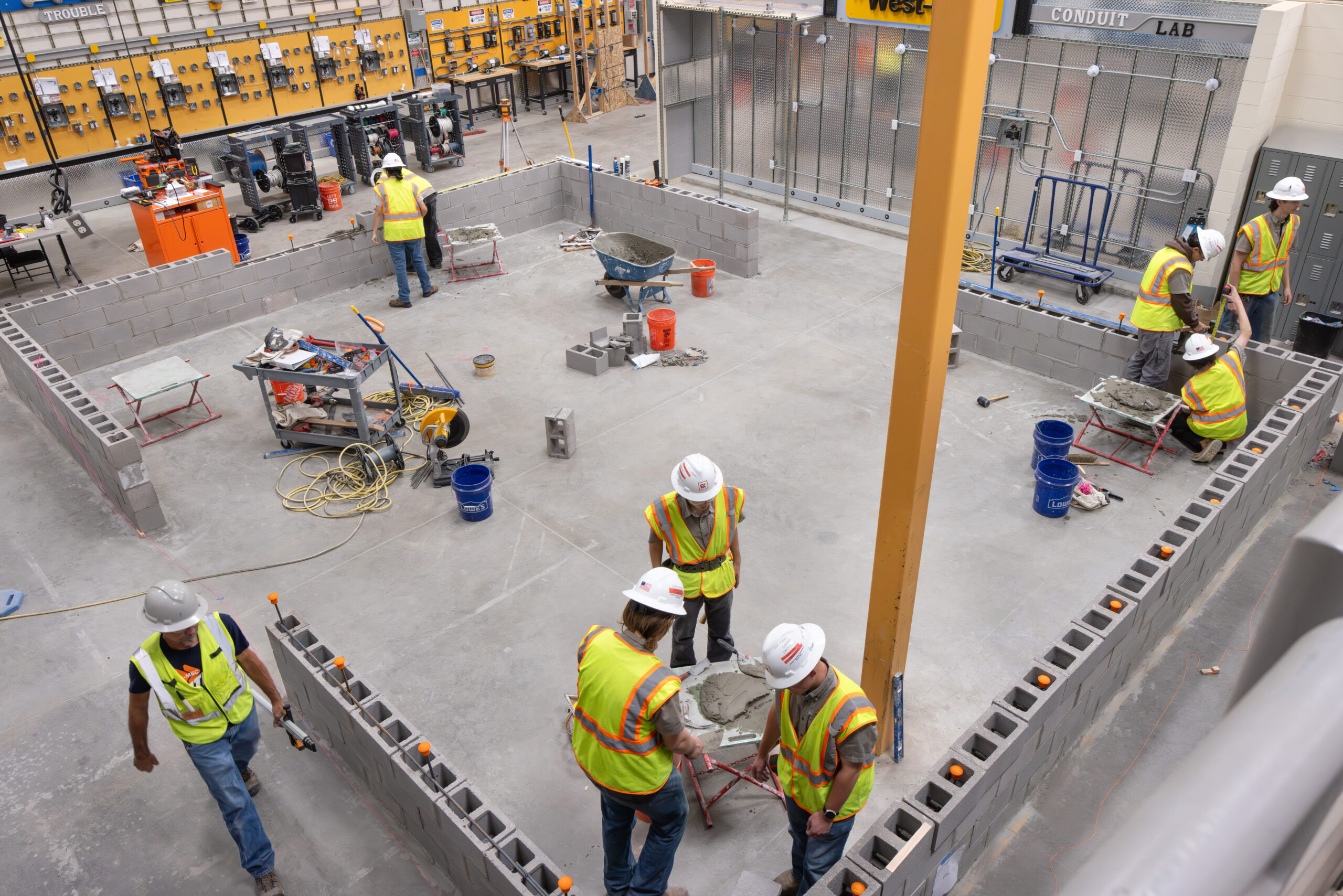
A warm breeze flows through the bay doors of West-MEC’s Northeast Campus construction lab, lifting concrete dust and ruffling the edges of project plans. Students arrive in hard hats, safety glasses and bright vests; two haul cut concrete blocks for inspection, another needs help with a jammed tape measure. Instructor Robert Wellman is fair but exacting — praising precise edges, calling out sloppy cuts, demonstrating a trick for the tape measure with an easy smile — pushing his students to solve problems themselves with steady care.
“I’ve been an instructor, trainer and facilitator my entire career, and when I found out about this program, I knew I needed to be a part of it,” Wellman says of his first year on the job.
He proudly points to six students who took top honors at a recent skills competition.
“When their eyes light up and they realize, ‘I did it!’ — that is a win for me,” he continues. “It’s been a phenomenal experience.”
These exchanges across sawhorse workbenches are the program’s foundation — lessons in measurement, safety and workmanship that build toward steady jobs and a healthier Arizona economy.
Wellman helps students navigate the language of the blueprint, acting as translator until the concepts click, reminding them not to fear the challenge. First-year students often arrive wary of the math; Wellman watches their confidence grow as they acquire a new fluency.
“The empowerment of building is the biggest thing,” he says. “They can go into any building and get hired on the spot because they know every aspect — it lets them shed fear and worry. When you shut down the generator and roll up the tools, you can tangibly look at what you did.”
He recalls a student who failed a truss challenge one year, then placed first in the skills competition the next.
“He got an honorable mention for his attention to detail, and in that mention, he just looked over his shoulder and smiled, and I kind of teared up,” Wellman says, his eyes welling at the memory.
He watches for engagement and a willingness to stop and fix small issues — the same quality control the job site demands. In the shop, students rotate through concrete and masonry, framing, drywall, basic electrical and plumbing, rigging and materials handling — all reinforced with tool mastery, estimating and site safety.
These fundamentals lay the groundwork for future specialization.
Fabian Hernandez and Nancy Solis, both juniors, say the program has reshaped how they see construction.
“Not a lot of people think construction is a valuable job,” says Solis, a Thunderbird High School student whose hard hat is plastered with tool mastery stickers. “In reality, it’s really important that more people have that experience to get the job done. You can build from apprentice to foreman or superintendent; the work reflects the skills you’re building.”
Solis is building a movable desk as a personal project — designing, measuring, cutting and refining the finish.
“I’ve learned there’s a difference between quality and quantity,” she says.
She plans to enlist in the Marines and later pursue finish carpentry.
Hernandez, a Moon Valley High School student who grew up helping his father build office spaces, is serving as foreman on a masonry wall the class is constructing. The experience, he says, has extended well beyond technique.
“I’ve got to lead but also do my part,” Hernandez says. “I have to work with different people, different skill levels and approaches to the project.”
He’s new to framing but plans to focus there, with welding close behind.
“I’ve learned more of the different jobs and what fits best for me. Some trades earn more than carpentry, but I want to do something I enjoy.”
For some graduates, the program is a direct launch into the industry; for others, it’s a foundation for college or military service. Wellman is proud to be part of both pathways.
Foundations and framing are just the beginning. A structure is finished only when its systems work — electrical, plumbing, HVAC — and the program introduces those too.
The Greater Phoenix Chamber Foundation’s Build Your Future Arizona campaign estimates at least 10,000 construction jobs in the state are currently unfilled — a shortfall expected to widen to more than 20,000 by 2030. The Associated General Contractors of America reports that more than half of current construction workers are over 45. The 83 students enrolled across West-MEC’s Northeast and Southwest campuses represent one local pipeline producing young, skilled reinforcements to meet that demand.
John Russell, director of operations at Concord General Contracting in Mesa and the father of a current student, knows the industry’s stakes firsthand.
“In construction, we can’t make many mistakes,” Russell says, “so to be in a class setting where you can mis-measure or mis-cut something and learn from it is an immense opportunity.”
He’s confident the foundational skills taught at West-MEC give graduates a leg up in the job market. Entry-level construction wages vary — the Bureau of Labor Statistics cites a range of roughly $12.50 to $20.70 an hour — making career and technical education a direct pathway to earning a living.
David Thomas, a field manager for DSI, a trim and carpentry firm serving greater Phoenix and Tucson, has 13 years in the industry and has worked with several vocational programs. He singles out West-MEC’s approach.
“One of our biggest challenges is finding capable, dedicated individuals who are willing to step confidently into the workforce,” Thomas says. “West-MEC plays a vital role in addressing this need. Their instructors’ real-world experience allows them to provide honest, practical insight into what the industry truly requires and what it takes to build a lasting career in carpentry.”
DSI hosts student visits that offer a firsthand look at the pace and expectations of a carpentry career. Thomas says program graduates tend to arrive motivated, competent and clear-eyed about the realities of the trade.
The industry benefits from more than technical skill — it benefits from the character and confidence instructors like Wellman actively cultivate.
“This is not just a job,” Wellman tells his students. “We’re not just building the state and the nation — we are reinvigorating the American tradesman. This is not just a need that needs to be fulfilled, something we have neglected for some time. We are also getting our dignity back as a nation.”
It’s a mission that extends beyond graduation day. Wellman urges his students to focus on knowledge and certifications that will carry them through market fluctuations and shifting headlines.
“There will always be a need for builders,” he says. “So I tell them, ‘You keep pushing full steam ahead and remember the objective is that empowerment, that knowledge, that certification — you are set.’”
This fall, families and students can learn about and apply for the 2027-28 school year of the growing two-year program, which is expected to reach capacity.
“We all need each other and we’re one of the major spokes in the wheel,” Wellman says. “Building infrastructure is something that’s easy to take for granted — the door that opens and closes easily, the lights and plumbing that operate. I want to bring that back to the forefront. We need this industry; it’s critical; it’s valued; and the people that do it need to understand that they are badly needed.”