
The Texture of Luxury
Alishan Halebian’s Gold Standard
Writer Joseph J. Airdo
In a downtown Los Angeles workshop decades ago, an Armenian immigrant nearly discarded a German design magazine. His boss warned him: Make jewelry like that, and you’ll never sell it.
Alishan Halebian took the magazine anyway.
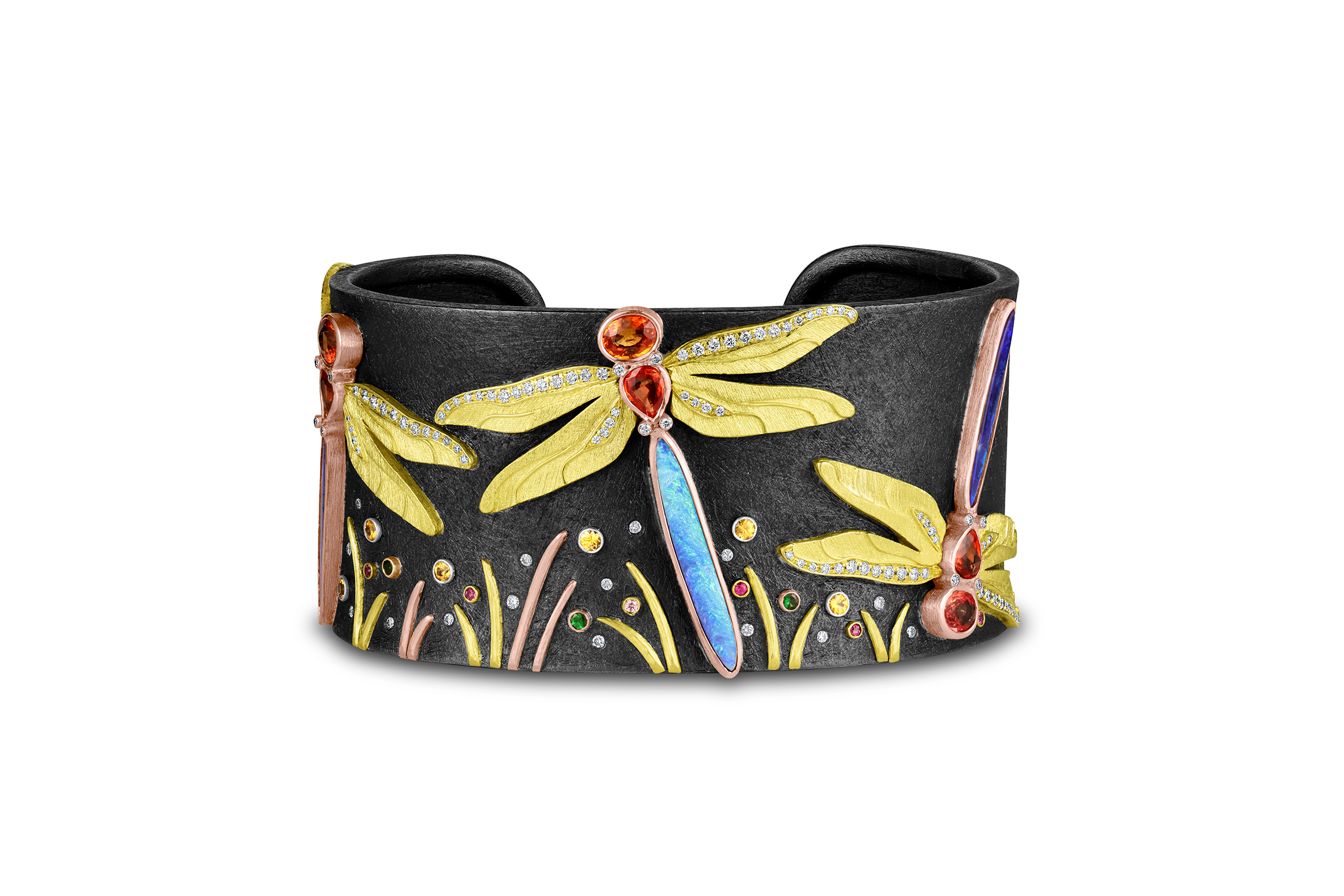
Today, the pieces inside those pages — where form and space triumph over gemstone size, where metal becomes sculpture — define his life’s work. For over a generation, this master jeweler has treated gold, platinum and oxidized silver not as settings for stones, but as his primary palette, layering them with the fluidity of watercolor and the restraint of fine art. In an industry obsessed with carat weight and sparkle, Alishan creates what the cognoscenti call “anti-bling” — jewelry for the confident collector who already owns the classics and now seeks something singular.
“Alishan doesn’t just work with metal; he treats it like a canvas,” says Natasha Lazorova, jewelry curator and head gemstone expert at Grace Renee Gallery in Carefree, where Alishan will showcase his work March 20–21. “He has this exceptional ability to layer gold, platinum, and oxidized silver as if he were applying paint, creating depths and textures that most jewelers simply cannot replicate. In the industry, we think of him as a ‘jeweler’s jeweler’ — the artist who is quietly entrusted with the most complex, high-stakes commissions for major houses because his technical brilliance is unmatched.”
Yet for all that technical prowess, Alishan’s path to jewelry was anything but traditional.
“When I finished high school, I knew I liked art — I liked drawing — and I knew art was going to be my path somehow,” Alishan recalls. “So I went to an art college and took ceramics. That was my start, and I enjoyed it very much. But it was short-lived because I emigrated to the United States in 1970.”
That ceramics training — brief as it was — planted seeds that would eventually blossom into his signature approach. While traditionally trained goldsmiths learn rules, Alishan learned to think in form and space, in volume and negative space, in the language of sculpture.
“I had very little knowledge about the jewelry industry — or jewelry in general,” he says.
Working for that Austrian-trained jeweler in downtown Los Angeles, Alishan discovered those German magazines — publications showcasing European designers who treated jewelry as wearable sculpture rather than gemstone display cases.
“What I was seeing in those pages versus what I was seeing in downtown Los Angeles was completely different,” he says. “The approach, the philosophy — everything was different.”
When his boss prepared to discard part of an issue, Alishan intervened.
“He said, ‘Oh, don’t worry about it. If you make something like this, you’ll never be able to sell it,’” Alishan remembers. “I said, ‘Forget about selling — just give it to me.’ And I looked through it. I kept looking, and I thought, ‘Wow, this is exactly what my understanding of jewelry should be. This is my perception.’ What I saw in those designers’ work was that form and space were the main attraction — which is what sculpture is all about. That spoke to me immediately.”
What emerged from that revelation was a technique that mystifies even seasoned jewelers: the ability to “paint” with metal, creating depth and shadow through oxidation and mixed-metal fusion that appears as effortless as brushstrokes on canvas. The reality is far more demanding.
“Most of our work consists of mixed metals, and the design itself — the drawing — actually dictates what I want to do,” Alishan explains. “If I need a certain contrast, that tells me which metals I’m going to use, which textures I’ll apply. Almost everything we make has hand texture in addition to patina and colorization.”
That hand texture — applied by his own fingers, sometimes layered over previous texture to create visual depth — transforms metal into something unexpected.
“We take the metal out of its inherent characteristics, and sometimes it will look like fabric,” he says. “I love that transition. That texture gives us the ability to transform the metal, so visually it appears as something else entirely.”
The oxidation process itself requires alchemical precision. Using liver of sulfur, Alishan coaxes silver through graduated tones of gray until achieving the exact shade — sometimes nearly black — that creates maximum contrast against warm golds.
“It’s very tedious work because it’s not entirely predictable,” he says. “You have to be extremely precise with the temperature and the amount of liver of sulfur. It’s quite technical. It took us a long period of time to reach the point where we felt comfortable and confident with achieving the exact color we wanted.”
The result? Jewelry that demands closer inspection. Pieces that reveal new details with each viewing. Work that earns Alishan quiet commissions from major houses — projects bound by nondisclosure agreements but whispered about with respect throughout the industry.
“We examine every step of the way, starting from the initial design,” says Lydia Tutunjian, Alishan’s wife and business partner. “Most of our jewelry pieces are handcrafted and fabricated — some are cast, and others use a combination of casting and fabrication techniques.”
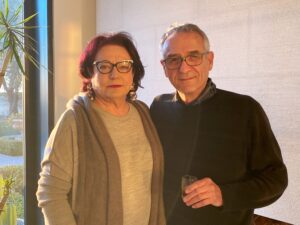
The Alishan-Lydia partnership forms the human heart of this artistic enterprise. For decades, they’ve navigated the delicate balance between artistic chaos and business necessity, between creative impulse and client satisfaction.
“It took a while,” Lydia admits. “It’s hard when your life partner is with you 24-7 and you still need to keep the integrity of both the business and the relationship going. In the beginning, it was hard until we each found our own tasks and responsibilities, and we learned how to work together well.”
Their only friction point? The design process itself.
“If Alishan asks, ‘How do you like this?’ and I critique it, sometimes he doesn’t like my critique — or vice versa,” Lydia says. “But we’ve learned how to handle it. I’ll give my opinion, but he’ll have the last word on it. Or if I design something and he has time to execute my designs, then the process works in reverse.”
That partnership — her grounded business acumen balancing his restless creativity — creates the warmth that clients notice immediately.
“Customer satisfaction is our goal, 100%,” Lydia says. “I always like to hear back from clients, or I’ll call them after they’ve received the piece to make sure they’re completely satisfied and love what we’ve created for them. That’s what makes us happy.”
For Alishan, inspiration comes from everywhere and nowhere predictable.
“Inspiration is very important for me,” he says. “I have very little patience — I need to be inspired all the time. Otherwise, I cannot do anything.”
He’s a beekeeper. He listens to jazz when fatigue sets in. He studies African art — not to copy, but to absorb its restraint, its ability to say just enough and then stop.
“These pieces weren’t made to hang on walls — they were created for ceremony, for spiritual and communal purposes,” he explains. “That deeper meaning resonates with me. And here’s what I find remarkable: Every time I look at the same piece of African art, I discover something new. It’s not overdone. It’s executed just enough, and then it stops.”
That philosophy — knowing when to stop — defines his work. So does his refusal to follow trends or even acknowledge what other designers create.
“He never follows trends,” Lydia says. “He doesn’t follow other designers. He doesn’t even look at other designers’ work when we go to shows. So he’s not influenced by what’s popular or what others are doing. Everything he creates comes from his own creativity.”
She pauses, considering his legacy.
“What I think really makes him stand out in the industry is that he experiments all the time,” she continues. “Whether it’s with metals — and remember, he’s a self-taught goldsmith — or with other materials like wood, he’s always pushing boundaries. And people love seeing that. It’s so different.”
That difference shows in unexpected places — like the Arizona desert, where shadows and textures echo the restraint in Alishan’s work.
“It’s so serene, so deserted,” Alishan says of the landscape. “Most people pass through and see it as empty, but there’s so much there — the shadows, the mountains, the textures, the colors. All of it seeps into your unconscious mind. Eventually, when you sit down to work and search for inspiration, it rises up naturally. You don’t have to force it.”
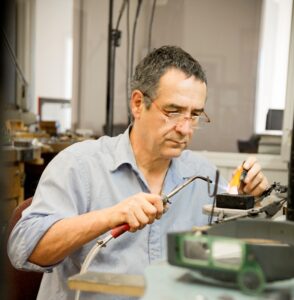
The upcoming showcase at Grace Renee Gallery offers a rare opportunity to meet this quietly influential maker in person — and to understand why human hands create something machines never can.
“I’ve seen beautifully done AI videos — the colors, the movement, the characters, the surrealism — and at first, you say, ‘Wow, this is incredible! This is so beautiful,’” Alishan reflects. “But keep watching that same video over and over again, and notice how quickly you get bored. How quickly the magic fades.”
Compare that to museum art viewed repeatedly across decades, he suggests — paintings that reveal new brushstrokes, new color relationships, perpetual inspiration.
“I think that’s the fundamental difference,” he says. “New technology is wonderful — it absolutely is — and it’s a powerful tool. But it’s just that: a tool.”
What technology cannot replicate is the soul embedded in each hammer mark, each deliberately applied texture, each oxidized shadow. What machines miss is the conversation between maker and metal, the dialogue between artistic intention and material reality.
“We experience this every time we do a show or personal appearance,” Alishan says. “As much as our customers and clients see our work, we learn just as much from them — from their approach, their understanding, even their criticism. And we just love it.”
That exchange — between maker and wearer, between artistic vision and lived experience — completes each piece in ways no studio work can achieve.
“There’s one point of view when I’m sitting at my bench, looking at and finishing a piece,” he explains. “But then there’s a completely different point of view from the person who will wear it, who will purchase it, who will live with it. And that perspective is so important to me.”
Visitors to Grace Renee Gallery this March will encounter one-of-a-kind pieces alongside signature designs — rings, necklaces and bracelets, including a strong collection of men’s jewelry. They’ll also find something rarer: a jeweler eager to collaborate on custom designs incorporating clients’ own meaningful gemstones.
“If someone brings in stones that are meaningful to them, we’ll collaborate to create a custom design around those pieces,” Lydia says. “So there will be opportunities for both ready-to-wear and bespoke work.”
More than that, they’ll meet a maker who still marvels at metal’s possibilities after decades at the bench, who listens to jazz and keeps bees, who studies African sculpture and draws by hand in an increasingly digital world. They’ll encounter jewelry that asks to be examined closely, pieces that reveal new details with each wearing, work that transforms precious metal into something approaching fabric, shadow or light itself.
They’ll discover, in other words, what happens when a sculptor accidentally becomes a jeweler — and never forgets that first love.
Alishan Jewelry Showcase
March 20–21 // 10 a.m.–5 p.m. // Grace Renee Gallery // Historic Spanish Village // 7212 E. Ho Road, Carefree // Free // 480-575-8080 // gracereneegallery.com