

Suited for Stardom
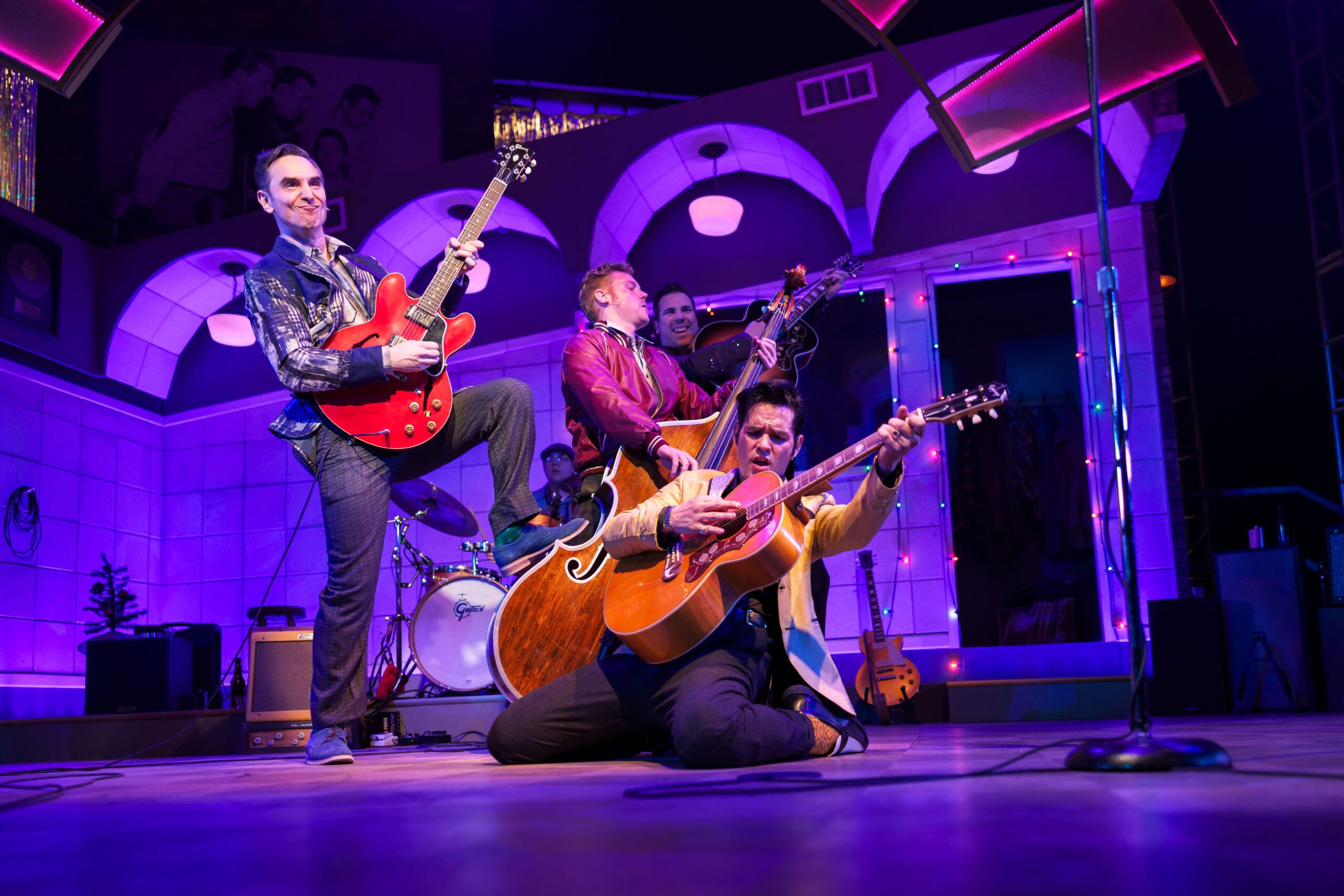
Behind the Seams at Phoenix Theatre Company’s ‘Million Dollar Quartet’
Writer Joseph J. Airdo // Photographer Billy Hardiman
The morning hum begins quietly. At Phoenix Theatre Company’s costume shop, Martha Clarke surveys her domain — an industrial atelier where bolts of fabric stand sentry beside sewing machines, where the ghosts of Elvis, Johnny Cash, and Jerry Lee Lewis hang on rolling racks, waiting to be inhabited. This is where theatrical magic meets couture craftsmanship, where a team of drapers, stitchers, and artisans engineer rock ‘n’ roll swagger one reinforced seam at a time.
“Usually, there’s some quiet time right at the beginning of the morning where everybody’s getting settled,” Clarke, the company’s costume director, explains. “The draper will be looking over her notes and plotting out the plan for the day — if she hasn’t already. That plan is based on what we need to be working on, plus what fittings we’re going to have that day with actors, and whether there are any meetings she needs to be involved with.”
It’s a Tuesday in the thick of building “Million Dollar Quartet,” the Tony Award-winning musical that captures Dec. 4, 1956 — the singular night when four young musicians gathered at Sun Records in Memphis for what would become legendary. The production, running through March 8 in the Hormel Theatre, demands more than nostalgia. It requires resurrection. And resurrection, Clarke knows, requires meticulous planning.
“Once that gets going, it’s just kind of the flow for the day, depending on whether we’re in fittings or whether the designer is going to be at the shop,” Clarke continues. “Sometimes they come in for fittings, of course, but they’ll also come in if we’re starting a new show. They’ll be looking for things in storage that can work in the show. They’ll be making shopping lists.”
The team — a draper, stitchers, a first hand, and an apprentice — moves with practiced choreography through the shop. Clarke herself juggles production meetings for multiple shows simultaneously, coordinating the intersection of designer vision, director expectation, and the physical reality of what five human bodies can build before opening night. Today, that reality includes a particularly delicate challenge: dressing actors as people the audience recognizes instantly.
When you’re costuming Elvis Presley, Johnny Cash, Carl Perkins and Jerry Lee Lewis, the audience arrives with expectations etched in collective memory — the swagger of Elvis’ unbuttoned shirt, the Johnny Cash black-on-black silhouette, the whole mythology of rock ‘n’ roll youth captured in polyester and denim. The shop works from photographs, television appearances and the designs of costume designer Adriana Diaz, who collaborated closely with director Scott Weinstein. Each musician had a distinctive brand — Elvis’ untucked rebellion, Cash’s ministerial severity, Jerry Lee’s wild-child energy. The costumes must read instantly to someone in the back row while flattering the specific actor who inhabits the role eight times a week.
“When an actor’s body type isn’t quite the same as the historical figure — if they’re very different — we have to make the costume as close to the character as possible, but also flattering and comfortable to the actor wearing it,” Clarke explains. “We’re not trying to squeeze them into something that’s too restrictive for their movement or put them in something that makes them look or feel like something’s not right. They need to feel good. In this show specifically, they need to feel sexy. They need to feel like idols.”
But feeling like an idol is only half the equation. These aren’t museum pieces displayed behind glass. They’re workhorses. “Million Dollar Quartet” delivers more than 20 classic hits — “Folsom Prison Blues,” “Hound Dog,” “Great Balls of Fire” — with the actors playing instruments live. Every guitar chord, every pivot, every lean into the microphone threatens a seam. The engineering happens in fittings, where Clarke and her team interrogate each garment’s performance capacity. What movements happen in this costume? Where is the stress?
“We absolutely take movement into consideration,” Clarke says. “The choreography isn’t particularly extreme — nobody’s doing splits or dropping to their knees — but we still have to ensure the costumes can handle the action without ripping a seam.”
They select fabrics not just for period accuracy but for durability. If a fabric can’t survive the run, duplicates get made as insurance. For the actor playing Elvis, there’s hidden strategy beneath the iconic open-shirt swagger. The costume shop has engineered an undershirt cut low and dyed to match the shirt color, creating an invisible barrier that absorbs sweat while maintaining the period silhouette. It’s a solution born from practicality — polyester doesn’t breathe like cotton, and two-show days demand backup plans.
This balance between authenticity and endurance requires strategic sourcing. The rockabilly aesthetic — camp collars, cuffed denim, knit polos, blue suede shoes — remains commercially viable 70 years later, which helps. But finding pieces that capture 1956 while surviving 2026’s performance demands requires resourcefulness.
“A lot of that stuff is out there already,” Clarke says. “There’s a whole rockabilly fashion market you can tap into. So you can find things that are very close to what you need and then just adjust them a little bit.”
The shop becomes expert at modification. One jacket built for the principal actor gets reconstructed for the understudy using fabric from a different garment, creating a visual cousin rather than a twin. Shoes get purchased from specialized reproduction retailers, then modified — painted, distressed, adjusted by local cobblers to look more historically accurate. Clarke’s team has become adept at knowing when to build, when to buy and when to blend the two.
This resourcefulness isn’t just about problem-solving — it’s about understanding why these silhouettes endure. The revival of 1950s menswear in contemporary fashion isn’t accidental. Those silhouettes — fitted without being restrictive, casual without appearing careless — occupy a sweet spot between formality and ease that resonates across decades.
“It’s flattering. It looks cool,” Clarke observes. “I think especially for young men, it’s something different that has a little more flair, but it’s still masculine. It’s casual most of the time, but without looking dumpy. They can put on one of those collared knit short-sleeve sweaters that are kind of fitted and they look slick — they’re not just in a T-shirt and jeans. There’s a little more finish to it.”
She points to the living culture around vintage dance — jitterbug enthusiasts who dress in period-appropriate clothing for authenticity. One of her former apprentices, now a full-time stitcher, dances regularly with her partner, maintaining a wardrobe that would fit seamlessly into “Million Dollar Quartet.” It’s this living tradition that makes the costume shop’s work both easier and more meaningful.
That former apprentice represents another dimension of the shop’s work: cultivating the next generation of theatrical artisans. The Phoenix Theatre Company’s costume shop operates under Actors’ Equity Association contracts, which mandate specific quality standards. The work must be impeccable — not only for opening night but for the entire run. Productions here can extend for months, and costumes must maintain their integrity through repeated cleaning, hot stage lights and the mechanical wear of nightly performance.
“The quality is pretty solid,” Clarke says. “We want to put out costumes that are made well, not only so they look as good as they can, but also so they last. Our production runs can be pretty long, so the costumes have to be well-made to maintain throughout the run of the show and not start to look too rough around the edges.”
Meeting those standards requires skilled hands, and the talent pipeline draws from Arizona’s educational institutions and from the broader theatrical world. Clarke herself taught at Stephens College before returning to the Valley, where she now mentors the artists who will become the next generation of costume directors and drapers. Her full-time stitcher studied at Stephens College years ago when Clarke was teaching there, returned to Arizona, and eventually joined the Phoenix Theatre shop Clarke now directs. It’s a small, talented world built on relationships and shared craft.
“Our current apprentice is the student of the wife of a fellow draper I worked with at the Utah Shakespeare Festival,” she explains, illustrating the interconnected web of theatrical craftspeople. “When I’m not running a shop and being a costume director, the other profession I go to is draping or pattern-making. So there are a lot of connections, because people work in lots of different places.”
The shop actively cultivates this emerging talent, hiring apprentices and entry-level craftspeople with the goal of elevating their skills. It’s an investment in the Valley’s cultural infrastructure — training the artisans who will sustain Arizona’s theatrical ecosystem for decades to come.
“You always need those beginning-level people,” Clarke notes. “If you can get them and help them develop their skills, they become an even higher commodity, and you want to keep them around.”
For Clarke, this mentorship represents a larger truth about the work itself. For those who imagine costume design as frivolous or secondary, she offers a different perspective. This is legitimate, challenging work requiring technical mastery, creative problem-solving and stamina. The days stretch long. The challenges can be maddening. But the fulfillment runs deep.
“I think our regular patrons know that there’s a lot of talent back here that nobody ever sees,” Clarke says. “But for somebody who might be interested in fashion and isn’t finding their place, this is legitimate work. And you can do really well doing this work. You’re going to have a different type of creativity than what comes from fashion design.”
The distinction matters. Fashion design imagines clothing for the everyday or the avant-garde. Costume design builds character, constructs narrative, tells stories about people who either were or could have been. Both require vision. Both demand craft. But costume work adds layers of collaboration — with directors, with actors, with the material constraints of what a human body can build before a deadline.
“It’s good, fulfilling work,” Clarke reflects. “And it’s hard. I mean, there are some really long days. We run into some pretty crazy challenges sometimes — like if something’s not working quite right, or we can’t quite get something to do what we want it to do. It can be really hard and challenging, but it’s also very fulfilling.”
On stage, when the lights hit and the first chords of “Blue Suede Shoes” fill the Hormel Theatre, the audience sees only the magic — four legends brought back to life, young and hungry and electric. They don’t see the hidden undershirts, the reinforced seams, the carefully sourced shoes painted to look like 1956. They don’t see the Tuesday mornings in the shop, the draper plotting her day, the apprentice learning to distress denim, the intricate calculus of making an actor feel like an idol while ensuring the costume survives another two-show weekend.
But Clarke and her team know. Every stitch carries intention. Every fabric choice serves the story. Behind the seams, world-class artistry happens daily in the Valley, hidden in plain sight, building the illusions that make us believe.
Million Dollar Quartet
Through March 8 // See website for showtimes // Phoenix Theatre Company’s Hormel Theatre // 100 E. McDowell Road, Phoenix // $60+ // (602) 254-2151 // phoenixtheatre.com