
Regalia in Motion
Bedouin Heritage Gallops Into Scottsdale
Writer Shannon Severson // Photographer AJE Photography
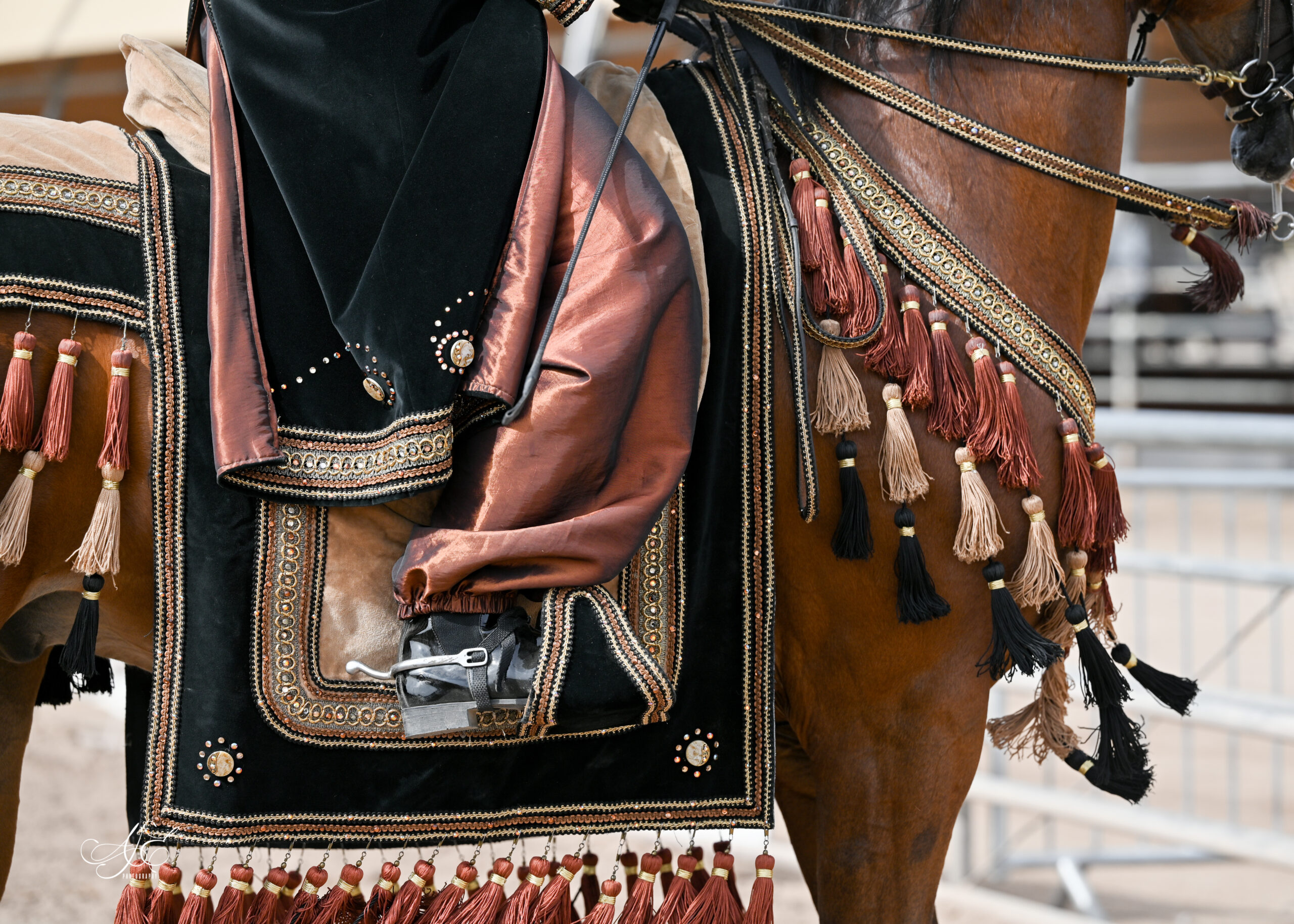
Steady hooves stride confidently over dusty ground, tassels swaying in time with each step. A flash of silver from an ornate bridle catches the light as a rider, enrobed in layers of richly decorated fabric in jewel-toned hues, expertly guides the steed. Horse and rider are a singular, moving sculpture echoing Bedouin legend and history.
This intriguing scene could be from the pages of Lady Anne Blunt’s “Bedouin Tribes of the Euphrates,” an 1879 travel narrative that captured Victorian-era imaginations. But instead, the setting is our own Sonoran Desert and the world-renowned Scottsdale Arabian Horse Show and Shopping Expo, held Feb. 12-22 at WestWorld of Scottsdale.
As the gate clicks open to the arena and a hush falls over the crowd, an idealized time machine effect materializes. Color takes motion as embroidered motifs, scarves and headdresses slide into view, accentuating the noble beauty of the Arabian breed and the dedicated community of competitors who prize them. A brilliant thread connects Blunt’s tales of the breed and Bedouin traditions to the beauty and artistry displayed in the ring today — Arabian horse breeders still trace the pedigree of modern bloodlines to Middle Eastern desert stock.
“Mounted Native Costume is more than a competition; it’s a living history lesson,” says Melissa Schalles, executive director of the Arabian Horse Association of Arizona. “It honors the Bedouin people of the desert and the Arabian horse they so carefully preserved, and it remains one of the most meaningful and captivating classes at the Scottsdale Arabian Horse Show. Authenticity is essential. In a modern show environment, this class provides a powerful connection to the desert origins of the Arabian horse and the Bedouin culture that shaped the breed.”
While the capes, cowries and keffiyeh count for a quarter of the overall score, the distinctive fashion of the Native Costume category is unique to the Arabian ring. Each year, Scottsdale launches the season in style as riders, breeders and makers descend from across the country — and around the globe — to test and display craftsmanship and horsemanship.
“The Scottsdale show is the most important Arabian show of the year,” says Janice McCrea Wight, who has served on the board of the Arabian Horse Association of Arizona in multiple capacities over four decades and now heads the public relations committee.
As a breeder, Wight has produced numerous champions in Scottsdale and internationally. She has traveled the world as an Arabian Horse Association Level 1 judge since 1981, adjudicating national championships in five countries.
“We try to depict how Arabians would appear in the Middle East, to be as authentic as possible with a little added bling,” she adds with a laugh. “Since it’s the first show of the year, it’s the runway in fashion. People break out their new outfits and riding apparel. It’s kind of like Fashion Week for Arabians.”
Schalles adds that Mounted Native Costume features a strong group of competitors for judges like Wight to assess.
“Exhibitors come from across the country specifically to showcase these horses and costumes,” she explains. “While it’s a specialized division, it’s a highly anticipated one and deeply respected. Even people unfamiliar with Arabian horses stop and watch because it’s so striking — one of those classes where the audience genuinely pauses and leans in.”
Wight traces her interest to a family tradition of breeding, riding and costume-making, a legacy passed down by her mother, Lois McCrea, now 105, who began breeding Arabians in 1959 and still enjoys watching the show.
“Horses are good for the soul,” Wight says, noting that she had anticipated during her first visit to the show at age 12 that she would one day live in Scottsdale. “One of my costumes was made by my mother after a trip to Egypt in 1967. She brought back a pair of stirrups from a Cairo market. To this day, I still own those stirrups. My mother made three different native costumes for me. My dad joked that he went for years and never saw our dining room table — she was always building a costume. The pageantry is so important.”
Schalles stresses that Scottsdale stages both the tradition’s ancient roots and modern iteration.
“Mounted Native Costume has a long-standing tradition at the Scottsdale Arabian Horse Show and is a meaningful part of the event’s identity,” she explains. “Scottsdale has long been a stage for honoring the Arabian horse’s heritage, and this class does that in a powerful and authentic way. One of the things that makes our event special is that we don’t just present this history in the arena; we invite the public to experience it firsthand.”
A general admission ticket allows spectators to meet an Arabian horse, try on Mounted Native Costume-inspired attire, sit on an Arabian horse and receive a complimentary photo. This experience is singular to the Scottsdale show and reinforces the Arabian Horse Association of Arizona’s commitment to education, heritage and community engagement.
“This is what makes the Scottsdale Arabian Horse Show ‘The Greatest Horse Show on Earth,’” Schalles says.
She highlights the community of makers that take costumes from dream to reality behind the scenes, noting that a relatively small number of highly specialized designers — many of whom are internationally known — put hundreds of hours of work into creating authentic attire for the class.
“Some exhibitors spend years collecting or commissioning pieces, making each costume truly one of a kind,” Schalles notes. “These designers are artisans in every sense of the word. Many costumes are passed down or carefully preserved, adding even more depth and history to each presentation.”
The rider’s costume and horse’s kit — collectively called regalia — carry both symbolism and structural logic. Their flowing forms nod to Bedouin dress used for concealment and mobility, necessary for the ghazu (desert raid), while costume construction choices meet mechanical realities. Trainers add pieces incrementally — cloth first, then metalwork, then full kit — until the horse accepts the regalia as part of its own moving mass. Everything must balance as a vision in which poetry, skill, artistry and horsemanship are rendered in kinetic form.
Beneath the intricate metalwork, tassels and layers of velvet and satin, anchor points and saddle pads serve as load distributors, directing mass toward the horse’s centerline and reducing yaw and roll. Within the rider’s aba (cape) and thobe (robe), flexible boning holds the shoulder line away from the rider’s neck and horse’s withers, preserving the silhouette without irritating the animal.
Hidden panels beneath the horse blanket keep decorative breastplates positioned and prevent shifting during movement. A center-back split in the cape’s hem allows the fabric to part cleanly over the horse’s hindquarters, finished with bound edges that create the illusion of a continuous hem at rest. Pleats and gussets expand as the horse moves, channeling airflow to prevent the cape from billowing uncontrollably.
Safety and skin protection are paramount. Primary fastenings pair with concealed safety loops that can be quickly released if the fabric snags. Riders make subtle adjustments — sitting slightly deeper and keeping their hands steady — to preserve balance and gait integrity while the garment reads as weightless.
Native Costume is more than decoration; it’s part of the overall score. Specifications are unique to the class, and rules of attire and performance elements must be executed to perfection. Extreme speed is penalized; this class moves in walks, canters and hand gallops.
“It’s written into the rules,” Wight explains. “It does no good to go fast. The cadence of the horse, performing gaits properly and correctly — that’s what’s important.”
Arabians’ intelligence and versatility have always been prized for transport, herding, ranch work and companionship, roles reflected today in the high value breeders and exhibitors place on the ancient breed. Historically, Bedouin families often allowed their prize mares to sleep inside their tents, emblematic of profound personal connection to these stately creatures. The reverence remains, even if stables have replaced tents.
The many capabilities of Arabians come into sharp focus at the Scottsdale show, with youth to adults competing in a multitude of class disciplines including Western, English, Halter, Ranch Sport and Reining as the world converges to celebrate the breed.
In her 19th century account, Blunt praised the Bedouin traditions of honor, hospitality and bonds built over shared meals and coffee around campfires in the Arabian Desert. At WestWorld, the social ritual has adapted but persists. The showgrounds become a modern camp where breeders, riders and makers reconnect beneath dusky desert skies and stadium lights.
Scottsdale Arabian Horse Show
Feb. 12–22 // 7:30 a.m.–7 p.m. // WestWorld of Scottsdale // 16601 N. Pima Road, Scottsdale // $15+; discounts available // scottsdaleshow.com