

‘Ragtime’ Revival
Musicfest Marks Milestone with Broadway-Caliber Theatrical Triumph
Writer Joseph J. Airdo // Photography Courtesy of Arizona Musicfest
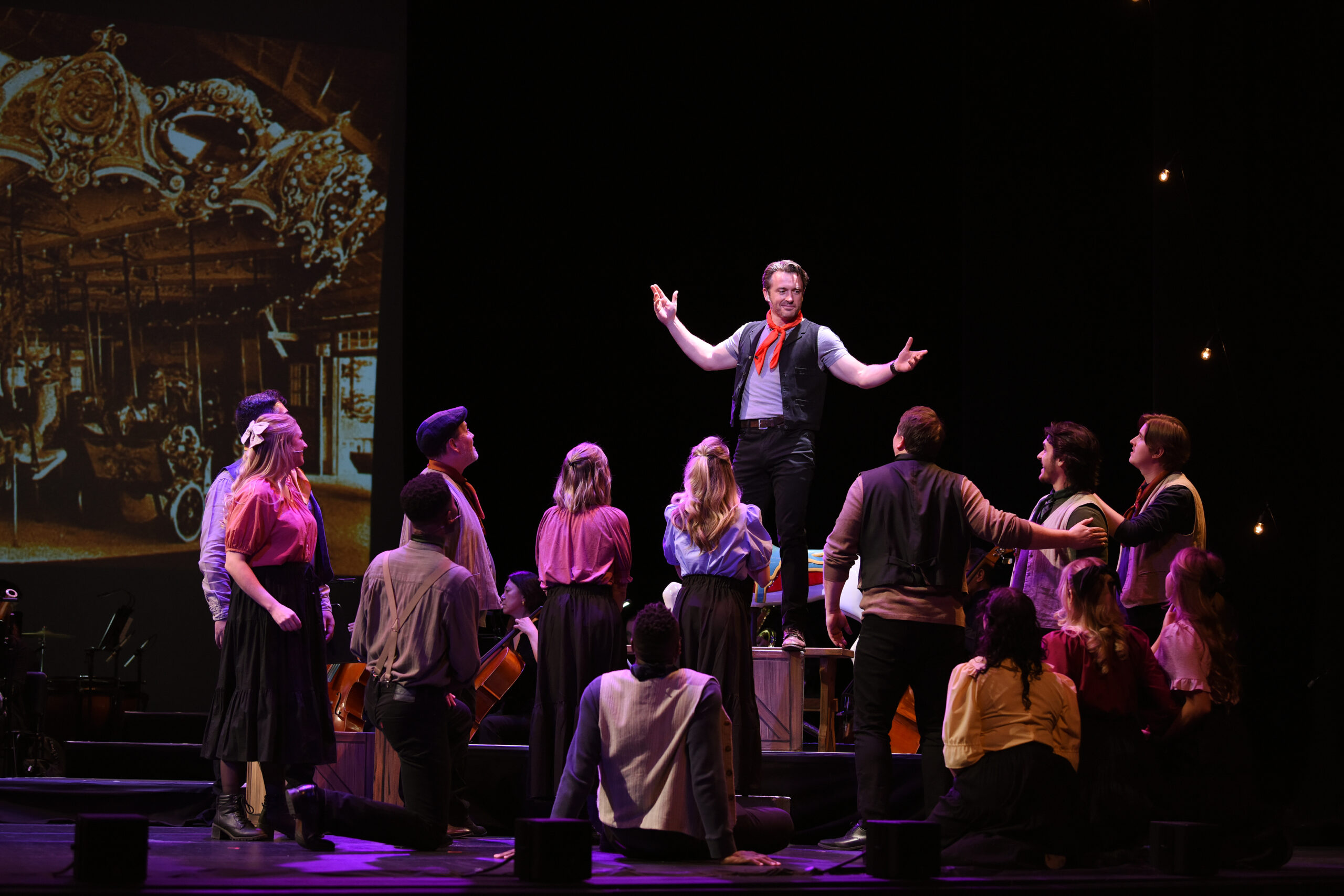
The orchestra doesn’t hide in a pit at Arizona Musicfest’s production of “Ragtime.” Thirty musicians occupy the Herberger Theater stage as co-stars, their instruments glinting under the lights, their presence as essential to the storytelling as the actors downstage. This isn’t traditional musical theater. It’s what Musicfest calls a “Theatrical Concert Experience” — a format that strips away spectacle to reveal the raw architectural power of one of Broadway’s most celebrated scores.
“Any show that has large orchestral resources as the accompaniment will also have very large-scale choral writing,” says Allan Naplan, executive and producing director of Arizona Musicfest. “There are three character communities in ‘Ragtime,’ and when they are all on stage, it creates a wall of spectacular sound. It’s unique and really special.”
That wall of sound arrives at the Herberger Theater Center April 24–26, marking the crown jewel of Musicfest’s 35th anniversary season. The production reunites the organization with downtown Phoenix’s iconic venue following last season’s acclaimed “Carousel: A Concert,” and it arrives at a moment when “Ragtime” has reclaimed its place as one of Broadway’s hottest tickets.
“A new ‘Ragtime’ production recently opened to great acclaim on Broadway,” Naplan explains, “but patrons don’t need to travel to New York to see outstanding Broadway talent performing this extraordinary and beloved piece of theater.”
The timing is deliberate. When “Ragtime” premiered on Broadway in 1998, it earned 13 Tony nominations and four wins, but it opened in the same season as “The Lion King” — a phenomenon that overshadowed nearly everything else in its path. The musical has remained beloved within theater circles ever since, and its return to Broadway in 2026 has reaffirmed its status as a masterwork.
“Within the theater world and among theater fans, ‘Ragtime’ is one of the most beloved classic musicals of the last few decades,” Naplan says. “That’s why it’s now in its second Broadway revival and continues to attract some of the greatest talent working today.”
For Arizona Musicfest, attracting that caliber of talent means working on a compressed timeline with artists who already know their roles intimately. The model differs dramatically from traditional theater companies that rehearse for months.
“We bring in major Broadway artists, many of whom are already well-versed in their roles, because we work on a very condensed production timeline,” Naplan explains. “We then pair them with some of the top musical theater talent from the Valley. Having this caliber of artists coming from Broadway and the opera world means we need people at the top of their game — performers who already have full character development and can bring the experience from their Broadway productions.”
The cast Naplan has assembled reads like a who’s who of contemporary musical theater royalty. Mamie Parris returns to the role of Mother, which she originated in the 2009 Broadway revival. Her extensive credits include Grizabella in “Cats,” Elphaba in “Wicked,” and Paulette in “Legally Blonde.”

In the pivotal role of Sarah, Ta’nika Gibson is taking a leave from the current Broadway revival specifically to perform with Musicfest — a remarkable coup for the organization. For Gibson, the role carries profound personal meaning that transcends professional achievement.
“I’m adopted,” she says. “When I embody the role of Sarah, I feel like I’m embodying my own biological mother — what she went through in having to potentially give up a child, or fighting for her child, fighting for her love, fighting for this relationship. When I’m holding baby Coalhouse on stage, I think of myself as baby Coalhouse — singing to all the circumstances that happened to me and what it took to get me here. It feels like a full-circle moment.”

The role of Coalhouse Walker Jr. — Sarah’s love interest and the beating heart of “Ragtime’s” tragedy — goes to Justin Austin, one of opera’s brightest rising stars. Named Rising Star of the Year at the 2024 International Opera Awards, Austin regularly performs at the Metropolitan Opera, Lincoln Center and Carnegie Hall.
“Coalhouse Walker Jr. is a dream role of mine,” Austin admits. “It’s really a testament to how hard work leads you to where you want to be in life.”
Austin’s connection to the character runs deeper than professional ambition. He grew up in Harlem and built his career foundation in St. Louis — the exact trajectory of Coalhouse Walker Jr., who leaves St. Louis for a better life in New York City’s Harlem.
“There are just a lot of similarities between me and this character,” Austin reflects.
The role has haunted him since high school. He attended LaGuardia High School of Performing Arts at Lincoln Center, arriving just as his school mounted “Ragtime” — but freshmen couldn’t audition. The same thing happened at Manhattan School of Music. He became an understudy, deepening his love for the piece while increasing his anxiety about whether he’d ever actually perform it.
“When it came back to Broadway, it was bittersweet for me,” Austin says. “With me being in demand in my opera career right now, it just wasn’t the right time. The last time ‘Ragtime’ was on Broadway was 2009. These things don’t come around often. I just thought it was possible that my chance had dwindled. And then when Arizona Musicfest contacted me about singing Coalhouse, I knew that I didn’t have any time in my schedule. But I was like, ‘I’ll make it work.’ Because I don’t know if this is ever going to come around again.”

The production also marks a homecoming for native Arizonan Sam Primack, the youngest actor to star as Evan Hansen on both Broadway and the national tour of “Dear Evan Hansen.” He returns to play Younger Brother, performing on the very Herberger stage where he grew up doing Valley Youth Theatre productions.
“I really grew up on the Herberger Theater Center stage,” Primack says. “I have so many amazing childhood memories on that stage. So when they asked me to come back for a show that I already love and that means so much to me, it just felt like a perfect fit.”
The shift from the intimate, internal world of “Dear Evan Hansen” to “Ragtime’s” sweeping epic excites him.
“This show is absolutely an ensemble,” Primack notes. “There are more than 30 cast members — it’s such a huge production. It’s fun because there’s a little mix of Arizona friends and New York friends.”
Rounding out the principal cast are David R. Gordon as Tateh — reprising his acclaimed portrayal from Goodspeed Opera House’s 2025 production — and local Valley favorite Jesse Berger as Father.
What makes Musicfest’s approach unique isn’t just the caliber of talent, but the theatrical concert format itself. Josh Condon, Musicfest’s resident artist and the production’s conductor, serves as the bridge between the storytelling and the 30-piece Musicfest Pops Ensemble.
“‘Ragtime’ is one of the most heralded scores in musical theater, and it’s playing on Broadway right now to critical acclaim,” Condon says. “We’re really excited and honored to showcase the same size orchestra that’s currently playing on Broadway. There are very few shows — outside of maybe Gammage to a certain extent — that will frequently do full orchestrations. Not a reduced orchestra, not a smaller pit orchestra, not tracks.”
The impact of having the orchestra visible on stage goes beyond aesthetics.
“There’s something that happens to the listener when the orchestra is on stage that you physically feel,” Condon explains. “The sound of the orchestra travels from the stage to the listener and physically hits you. It doesn’t go through a pre-EQ’d, pre-edited mix from a soundboard that’s processing a band in another room. You physically feel the live musicians there in front of you, and that’s an effect that just can’t be duplicated.”
For Austin, this concertized approach feels like home.
“In opera, we have this element to our performing life called the concert or the recital, where we take the grand, macro storytelling of the opera stage and put it under a magnifying glass,” he says. “In a recital, it’s just you and the pianist and the intimacy of the audience — everyone is there to see and experience your point of view. We as the characters, as the actors, have more of a responsibility to make sure that these themes, these stories, these circumstances come to life in a way where we don’t need the spectacle.”
Those themes — immigration, class divides, racial injustice, and the fractured American Dream — reverberate with particular potency in 2026 Arizona. Lynn Ahrens and Stephen Flaherty’s score uses the syncopated rhythms of ragtime, the martial precision of marches, and the graceful lilt of waltzes to represent three colliding worlds: Harlem, the affluent suburb of New Rochelle, and New York’s Lower East Side immigrant community.
“The composers and the orchestrators have done their job to create a really imaginative score,” Condon says. “My job is to serve that vision and bring all those details out. It’s all there in the score already — you just have to interpret it and guide the musicians in such a way that they play with the nuance and intention that will illuminate those details for the audience.”
The production also represents a geographic expansion for Musicfest, which has grown from a local festival into a valleywide cultural force over 3 1/2 decades.
“Even though we have a strong footprint in North Scottsdale, our reach has become valleywide,” Naplan says. “There is truly no boundary for Arizona Musicfest because people love great music all throughout the Phoenix metro area.”
The Herberger partnership makes practical sense — there’s no theatrical venue in North Scottsdale capable of hosting a production of this scale — but it also encourages North Valley patrons to see themselves as part of the broader metro Phoenix arts ecosystem. For those making the drive from North Scottsdale, Musicfest is offering Ragtime Railways — a convenient bus service that transforms the journey downtown into part of the evening’s experience.
As Musicfest celebrates 35 years, the numbers tell a story of sustained growth. Last season, 50,613 patrons attended Musicfest events — a record. This season is tracking at the same pace, with both ticket sales and philanthropy ahead of last year’s benchmarks at this point in the season.
“We’re just getting started in expanding our reach, while offering new types of musical experiences to Arizona audiences,” Naplan says.
For Primack, returning to perform on the stage where he once dreamed of a Broadway career, the full-circle nature of the moment is not lost.
“Arizona will always be home,” he says. “I owe everything to the community — to my teachers, to the community theaters that basically raised me. The community really lifted me up, and I owe so much to it. So anytime I can come back and thank the community, and they’re willing to welcome me back, I’m happy to do it.”
The Herberger stage awaits. The orchestra is ready. And for three nights in April, the syncopated heartbeat of America’s past will pulse through downtown Phoenix, played by an ensemble that’s spent 35 years proving that great music knows no boundaries — geographic, stylistic, or otherwise.
‘Ragtime’
April 24–26 // See website for times // Herberger Theater Center // 222 E. Monroe St., Phoenix // $79.50+ // 480-422-8449 // azmusicfest.org/ragtime