
Guardians of Glamour
Inside the Phoenix Art Museum’s Fashion Vault
Writer Joseph J. Airdo // Photography Courtesy of Phoenix Art Museum
Deep in the climate-controlled vaults of Phoenix Art Museum, a Balenciaga ballgown hangs motionless in the dark, its silk faille skirt frozen midswirl. Nearby, a 1780s robe à la française waits alongside a paper bikini from 1966, a Geoffrey Beene sculptural masterpiece, and a Dior purchased at a church resale.
More than 9,000 garments span these temperature-regulated aisles — centuries of fashion history pressed into padded hangers and acid-free boxes. What visitors see in the Kelly Ellman Fashion Galleries represents less than 1% of the collection. The rest lives here, in this archive that rivals the holdings of museums in New York, Los Angeles and beyond.
Helen Jean, the Jacquie Dorrance Curator of Fashion, knows every corner of this textile universe. She’s been here since 2007, when she arrived as a curatorial assistant under the legendary Dennita Sewell. Nearly two decades later, she’s become the primary guardian of a collection that began with a radical idea: that fashion deserves to stand beside a Monet.
“It’s a great honor to get to work with the collection, first of all,” Jean says. “I’m one in a line of a few curators who have helped guide it, and I work with a team of extraordinarily talented people who are experts in their own areas of object handling and research.”
Her days oscillate between the cerebral and the physical. Some mornings find her diving into research rabbit holes, tracing the provenance of a newly acquired piece or discovering unexpected connections between the fashion collection and other museum holdings. Other days, she’s in the vault with Fashion Collection Manager Rebekah Monahan and fashion intern Summer Rye, carefully padding a mannequin’s hips or carving foam to accommodate the exact proportions of a 1950s cocktail dress.
“As we craft the show and start to see these looks come together, that’s always very special and exciting,” Jean says.
The work combines artistry with engineering. Her background teaching mathematics in fashion design — a course that most people find surprising — turns out to be essential in this world of precise measurements and structural integrity.
“Fashion design is fundamentally based in mathematics,” Jean explains. “Patterns are geometry. The fit around the body relies on understanding stretch — whether you’re turning the horizontal and perpendicular grain on its bias to take advantage of that diagonal stretch in the cloth, or introducing a synthetically derived fiber like latex or spandex into the weave so it has stretch on its own.”
She points to one of the collection’s treasures: the Paper Dress Archive, which captures a fleeting moment in 1966 when Scott Paper Co. launched a mail-in campaign. For $1.25, customers could order a disposable dress in bold op-art graphics or red bandana prints. The fad exploded overnight. Mars Candies, Butterfinger, Dove Soap, Viking Kitchen Appliances, AT&T — suddenly everyone wanted to create “beautiful walking billboards.”
“That’s really where the conversation about technology, fashion, science, and style comes together,” Jean says. “The invention of aniline dyes in the 19th century, the discovery of dry cleaning chemicals — some of these breakthroughs were accidental, others came from searching for answers to completely different questions. That’s the juicy part of this conversation for me. That’s what gets me really excited.”
The Audacious Beginning
In 1966, when the fashion collection formally began, Phoenix was far from a fashion capital. The museum itself was only 7 years old. The decision to collect haute couture in the middle of the Sonoran Desert seemed, at best, improbable.
But Naomi Kitchel — the first woman on the museum’s board of trustees — had a vision. She assembled a group of extraordinary women with means, connections, and most importantly, fabulous wardrobes. Clare Boothe Luce, the playwright who wrote “The Women,” brought not only her own couture but her experience as a fashion editor and foreign ambassador. Sybil Harrington contributed pieces from her family’s collection. They all knew Stella Blum, then curator at the Metropolitan Museum of Art’s Costume Institute.
“When I say that some of these early pieces seeded the collection, I mean some of our most magnificent, oldest garments come from the Harrington family, from the Kitchels, from Clare Boothe Luce,” Jean says.
One of Jean’s favorite origin stories involves Adrienne Schiffner and the Grosvenor family. As a young girl, Schiffner remembers sitting on a bed in New York when her grandmother’s steamer trunk arrived from Detroit, filled with the family’s turn-of-the-20th-century gowns.
“She remembers these beautiful gowns being laid out on the bed, and the Met curator Stella Blum is there, and the ladies from Phoenix Art Museum — our first curator, Jean Hildreth, and Naomi Kitchel—are there selecting these garments to be the magnificent first pieces of the collection,” Jean recounts.
The founding members established something crucial: a standard. This collection would mirror the magnificence of the museum’s paintings and sculpture. Fashion would be treated as art, deserving to stand alongside any masterpiece in the permanent collection.
“Arizona Costume Institute was founded with a mission statement that actually alludes to that — that this collection is going to grow as artwork,” Jean says. “Fashion is art and will stand as such. These women had a message: that this is an investment in a craft, an artistry, and things worth collecting — things worth standing next to a Monet.”
The Living Exhibition
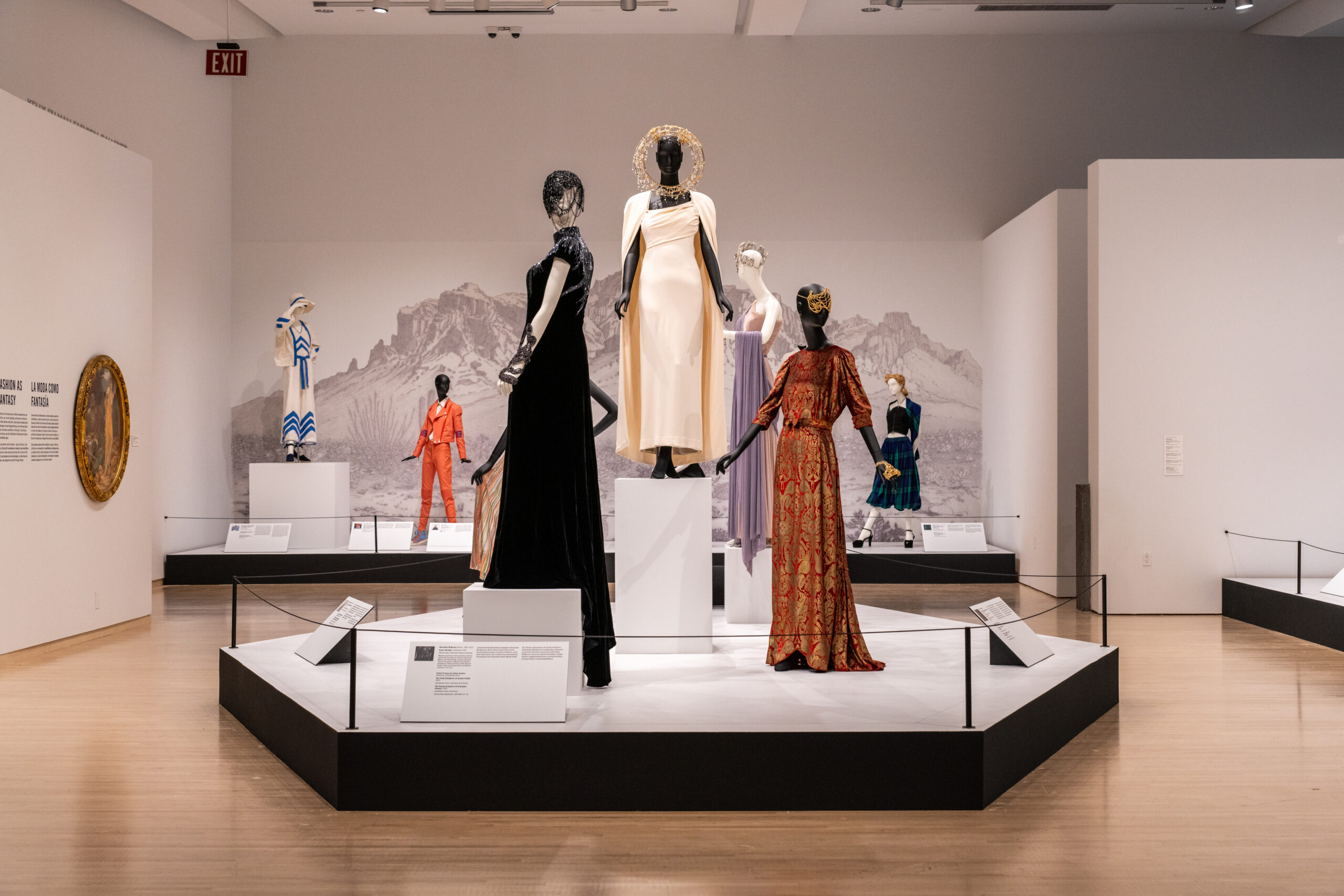
“Greatest Fits (Vol. 1): The Art of Archiving Fashion” opened in October 2024 as the museum’s largest collections-based fashion endeavor to date. The exhibition sprawls across three Kelly Ellman Fashion Galleries on the mezzanine level, and it does something unusual: it changes. This is a “living” exhibition, with garments rotating in and out over 18 months to showcase more than 100 pieces from the permanent collection.
The decision to focus the middle gallery on silhouette — creating a striking monochromatic display of all-black and all-white garments — came from both pedagogical and practical considerations.
“How do we approach learning about major fashion changes throughout time? We look at those silhouettes,” Jean explains. “Creating that elegant monochromatic view became very stunning, I think — a way to draw people into a gallery they might not normally walk into. Color can be very chaotic, and it can be off putting to some people.”
The strategy also addresses a persistent question: Why does fashion belong in an art museum? By stripping away color and focusing purely on form, Jean invites viewers to see these garments as sculptural objects, divorced from their practical use.
“We want visitors to step back, blur their eyes a bit, and take in what they’re seeing — divorced from any practical considerations like whether you could sit down or bend over in it,” she says. “That’s not what we’re discussing here.”
The exhibition closes March 1, making way for “Greatest Fits: Vol. 2,” which will debut this spring. Where “Vol. 1” explored the grand gestures of fashion — the sweep of a ball gown, the architectural drama of a bustle — “Vol. 2” will become a jewel box of tiny wonders.
“Our audiences will be introduced to our tiniest objects: shoes, pocket watches, hats, jewelry, scarves, those teeny tiny Judith Leiber pearl boxes covered with hundreds of Swarovski crystals,” Jean says. “When we’re looking at it historically, we’ve got these wonderful bonnets, and you have this entire language of flirtation that you can employ when you’re partially obscured.”
The shift from macro to micro will also showcase pieces from the collection’s four major archives: Anne Bonfoey Taylor’s midcentury couture (Balenciaga, Charles James, Givenchy), the Paper Dress Archive, the Geoffrey Beene collection, and the Emphatics Store holdings featuring avant-garde designers like Azzedine Alaïa, Thierry Mugler, and Jean Paul Gaultier.
The Spirit in the Seams
What separates fashion from other art forms is its intimate relationship with the human body. A painting hangs static on a wall. A dress remembers movement — the sway of a waltz, the pressure of a belt buckle, the scent of perfume in its fibers.
“I think a lot about that scene in ‘Beetlejuice’ when the wedding gown comes back to life,” says Jean, who has a background in theater. “At first, I’m thinking, ‘How did they do that? How did they make that happen?’ But then I buy into the scene emotionally, and by the end, it’s just tragic. That idea of the spirit still being there? That’s what I feel when I work with these garments.”
Every garment carries what curators call provenance: who owned it, who wore it, how it came to the museum. Jean cherishes these backstories as much as the technical details of construction or the designer’s reputation. One Dior in the collection was purchased at a church resale — the only way its owner could ever access haute couture. She wore it and loved it so completely that it now holds a special place in the museum’s holdings, its double provenance enriching its narrative.
“Someone wore that piece. A life happened in it,” Jean says. “It could have been a special moment like a wedding. We have christening gowns — ceremonial moments frozen in fabric. Sometimes it’s something they clearly danced in, and we can tell because the front is rubbed away where their partner’s belt buckle pressed against it.”
This bodily connection makes fashion exhibitions uniquely challenging. Visitors instinctively want to touch textiles in ways they’d never approach a painting.
“We wore it. We have an intimate relationship with it,” Jean explains. “That’s why we have to keep an extra eye on people in the fashion gallery — we touch clothing instinctively. We walk through a store and just reach out.”
The sensory pull of fashion extends beyond touch. It’s the sound of stilettos on marble, the weight of a hat, the way lipstick tastes, the rustle of taffeta.
“All of these sensory experiences,” Jean says. “The act of grooming is part of it too. When we look at romance films from the ‘20s and ‘30s with those beautiful vanity tables set up for beauty rituals — spending time with feathers and elaborate setups — that’s all happening again right now. That’s not new.”
Bringing Ghosts to Life
Perhaps the most critical — and least visible — aspect of fashion curation happens behind the scenes: creating the body that will inhabit each garment. Jean and her team never alter a historic piece to fit an existing mannequin. Instead, they build custom forms for every installation.
The team works with traditional tailor’s dress forms, torso mounts on poles, and Styrofoam blanks that mount maker carves to exact specifications. They pad with everything imaginable, collaborating with specialists who have backgrounds in theatrical prop-making. The goal: to make each garment appear as though a living person has just stepped away.
“Properly mounting a garment ensures that every time it’s on view, it looks as though a real human is wearing it,” Jean says.
Sometimes they dress a full mannequin with head and hands, creating a complete tableau. Other times, they opt for an “invisible mount” — just the garment floating in space, presented as pure sculpture. The decision depends on the story each piece needs to tell.
As Jean walks through the galleries one final time before “Vol. 1” closes, she pauses before a rotating lineup of silhouettes: an 18th century robe à la française beside a 1950s Dior New Look beside a contemporary sculptural piece. Sixty years of intentional collecting, preservation, and scholarship have led to this moment — and to the thousands of garments waiting in the vault for their turn to tell their stories.
“We consider ourselves one of a handful of museums that boasts such large holdings with such high-quality works that are so representative of such a vast time period of history,” Jean says. “We’re very lucky to have all of this wonderful support.”
In the end, that’s what the “Greatest Fits” series achieves: proof that those founding women in 1966 were right. Fashion does deserve to stand beside a Monet. And in the climate-controlled vaults of Phoenix Art Museum, 9,000 pieces of wearable art are waiting to prove it.
Greatest Fits (Vol. 1): The Art of Archiving Fashion
Through March 1 // Phoenix Art Museum’s Kelly Ellman Fashion Galleries // 1625 N. Central Ave., Phoenix // $28; discounts available // 602-257-1880 // phxart.org