

Building Blocks
An Architectural Field Guide
Writer Joseph J. Airdo
You’ve driven past them a thousand times — the copper shimmer on Central Avenue, the inverted pyramid hovering over Tempe, the mushroom columns sheltering a bank on Camelback. But when was the last time you actually looked? The metro Phoenix area functions as an inadvertent open-air museum, where midcentury pioneers and contemporary visionaries left behind a vocabulary of concrete, steel, and shadow that speaks directly to our desert climate. This is your field guide to the sculptural language written into our daily commute.
Hotel Valley Ho
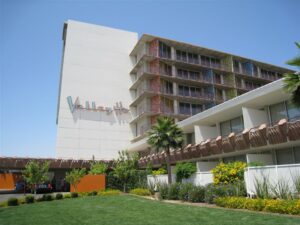
The low-slung resort on Main Street in Old Town Scottsdale represents a turning point in the city’s identity. Before Edward Varney’s 1956 Hotel Valley Ho, Scottsdale hospitality meant dude ranches and Old West kitsch. This design introduced Jetsons-style glamour for Hollywood stars seeking privacy. Precast concrete breeze blocks featuring abstract arrow patterns create the building’s signature texture, with constantly shifting shadows as the sun moves. The same facade looks entirely different at dawn versus dusk, the shadows reshaping the building’s appearance throughout the day. The guest room windows cant downward at an angle, a geometric trick that lets guests see out at night without interior lights reflecting back, while blocking brutal daytime heat.
After decades as a declining Ramada Inn and near-demolition in 2001, the 2005 rehabilitation finally realized Varney’s original vision, adding the seven-story tower he’d sketched but never built. The hotel’s lobby, ZuZo restaurant and bar areas remain open to the public — visitors can experience the breeze blocks, ribbon balconies and central courtyard without booking a room.
Phoenix Financial Center
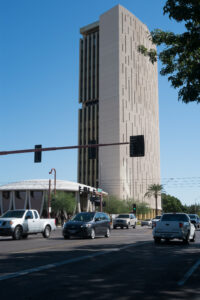
The 19-story tower at Central Avenue and Osborn Road earned its “Punchcard Building” nickname through architectural serendipity. W.A. Sarmiento designed the narrow vertical slot windows in 1964 for solar shading, but their rhythmic pattern accidentally mimicked the punch cards that fed IBM mainframes. The complex anchors Central Avenue through contrasting geometries: a curved tower (subtly concave on one face, convex on the other) paired with twin rotundas ringed by inverted parabolic arches. Gold-anodized aluminum creates a metallic shimmer that shifts as the sun moves — this building changes color by the hour.
Currently under redevelopment as a boutique hotel and residential project, the exterior remains the most recognizable silhouette in the Midtown skyline. The building is best viewed from the Valley Metro light rail stop at Central and Osborn, where the curves and gold shimmer project pure 1960s optimism about what corporate architecture could be.
ASU Music Building
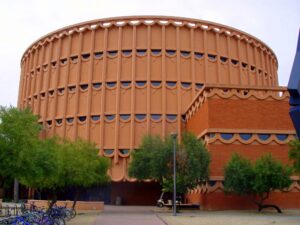
The circular, tiered structure adjacent to Gammage Auditorium solves an architectural challenge: how do you build next to a Frank Lloyd Wright masterpiece without embarrassing yourself? William Wesley Peters — Wright’s son-in-law — answered that question with contextual wit in 1970. He adopted Wright’s circular geometry and “Desert Rose” stucco but inverted the form. Where Gammage spreads horizontally, the Music Building stacks vertically in wedding-cake tiers. The decorative metal latticework wrapping each level in turquoise and gold adds playful ornamentation that Gammage would never tolerate — it’s the difference between the master’s restraint and the apprentice’s exuberance.
Curving elevated walkways connect the buildings, creating an architectural conversation across the lawn. The structure houses Katzin Concert Hall, the massive Fritts Organ and hundreds of soundproof practice rooms. The building is best viewed from the Gammage lawn at sunset when the Desert Rose stucco glows. The Music Library is open to visitors during academic hours.
Farmers & Stockmens Bank
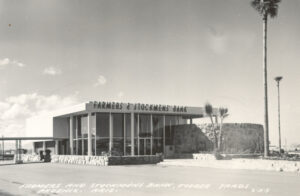
The sleek glass pavilion at the southwest corner of Central Avenue and Camelback Road remains the Valley’s purest argument for why glass can work in 115-degree heat — if you understand shadow. William Pereira’s 1951 design floats a massive flat roof over walls that dissolve the boundary between banking hall and street. Deep overhangs create shadow lines that protect the floor-to-ceiling glass while maintaining the illusion of weightlessness. But here’s the genius move: rough-hewn Arizona sandstone walls slice through the glass envelope, running continuously from the exterior plaza into the interior without pause, as if the desert floor itself had been pulled through the building.
When it opened in 1951, this intersection marked the northern edge of the city, gateway to the agricultural belt. The design proved cattle barons and cotton farmers could conduct business in buildings as sleek as anything in New York. The building now houses professional offices. Visitors walking the perimeter on Central Avenue can watch how the steel-framed glass reflects the northern mountain ranges, with the transparent walls offering clear views of the original stone planes from the sidewalk.
Chase Bank
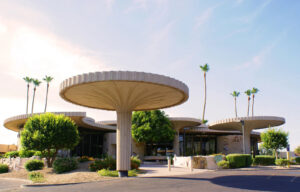
At the corner of 44th Street and Camelback Road, Frank Henry’s 1969 bank branch reads less like a financial institution and more like a grove of concrete trees. The design employs eight massive dendriform columns textured with exposed quartz aggregate that catches afternoon light like crushed diamonds. The columns taper outward as they rise, supporting a roof that extends far beyond the recessed glass walls, creating deep, cool shadow that makes brutalist fortress architecture feel protective rather than oppressive.
Walter Bimson, the visionary behind Valley National Bank, believed branches should be civic sculpture, not utilitarian vaults. For the affluent Arcadia corridor, he commissioned this masterpiece. The deep overhangs invite pedestrians to walk right up to the columns and examine the sparkling quartz texture. Inside, during normal banking hours, visitors can see the coffered ceiling — a waffle grid of geometric precision that appears to float overhead.
Tempe Municipal Building
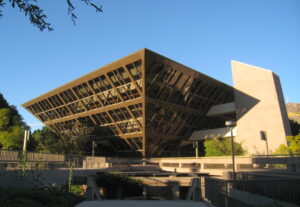
The geometric form hovering over the sunken plaza at Fifth Street in downtown Tempe is one of the few realized inverted pyramids in the world. Michael Goodwin’s 1971 design doesn’t just account for the Arizona sun — it makes solar geometry the entire concept. The 45-degree angle of the exterior walls is precise engineering: during summer, the building shades itself; in winter, lower-angled sun penetrates and warms the interior. The structure expands from roughly 2,000 square feet at ground level to 10,000 square feet at the top, creating a form that defies gravity while proving sustainability can be sculptural.
The genius appears at pedestrian level. The “ground” floor is actually a bridge — the true base is a sunken garden surrounded by lush vegetation that contrasts beautifully with the steel structure hovering above. Solar bronze glass reflects the desert sky. Separate concrete towers house the stairs and elevators, connected by bridges that keep the pyramid’s form pure. Visitors can walk through the sunken garden and experience standing beneath a building that appears to float, making this Tempe’s most photogenic landmark.
First Christian Church
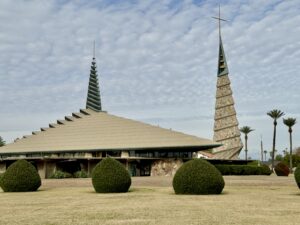
The diamond-shaped church complex on Seventh Avenue just south of Glendale Avenue is a Frank Lloyd Wright design that Wright never saw built. In 1950, he drew plans for a Southwest Christian Seminary that went bankrupt before construction. Twenty years later, William Wesley Peters — Wright’s son-in-law — retrieved the blueprints from the Taliesin archives and adapted them for this church site. The diamond-grid geometry rejects every right angle, creating sharp corners and prow-like edges that feel indigenous to the landscape. The 77-foot triangular campanile stands detached from the sanctuary, a three-sided lantern tower supported by open pillars that allow desert air to pass through.
Wright’s signature “desert masonry” technique is on full display: rough native stones placed in forms with concrete poured around them, creating walls that mimic the variegated texture of desert geology. The teal roof color comes from copper developing its natural patina, serving as a neighborhood landmark. The church welcomes visitors during Sunday services and frequently participates in Modern Phoenix architectural tours. Inside, stained glass inserts cast jewel-toned light into the diamond-shaped sanctuary.
Burton Barr Central Library
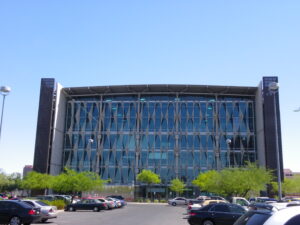
The massive copper-clad structure at Central Avenue and McDowell Road was designed by Will Bruder in 1995 to resemble a manmade geological formation — a mesa rising from the flat city grid. The east and west walls, clad in copper, have oxidized over three decades into purple-brown hues that shift with the light. The exterior is fortress-like, protecting books from brutal heat, but step inside and the experience transforms into a “crystal canyon” — a dramatic five-story atrium with glass elevators and a grand steel staircase pulling your eye upward.
The Great Reading Room’s ceiling appears to float weightlessly, suspended by a tensegrity cable system inspired by Buckminster Fuller. At exactly solar noon on the summer solstice, the sun aligns perfectly to project circles of light down through “candle” skylights to the floor — a modern Stonehenge effect engineered into the building’s bones. This structure put Phoenix architecture on the global map, earning the prestigious AIA 25-Year Award in 2021. Currently undergoing capital improvements through late 2026, the library remains operational. The copper skin puts on its best show at sunset when viewed from Central Avenue.
Scottsdale Museum of Contemporary Art
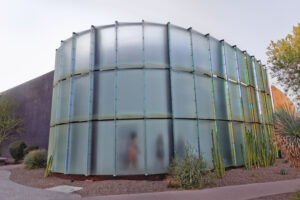
The iridescent steel structure in the Scottsdale Civic Center was once a generic 1976 movie theater. Will Bruder performed architectural alchemy in 1999, transforming it into a mysterious, glimmering art object. The building is wrapped in galvanized steel panels finished in custom iridescent purple-gray, designed to mimic the shadows of the Superstition Mountains. The metallic skin curves and shifts colors as visitors walk around it, reflecting the desert sky.
The real magic happens at the building’s edges. James Turrell’s “Knight Rise” Skyspace in the sculpture courtyard is a concrete elliptical chamber with a knife-edge aperture in the ceiling that frames the sky, isolating it as a pure plane of color. James Carpenter’s dichroic glass scrim wall on the south side captures sunlight and splits it into rainbows that dance across the exterior walkway. The installations aren’t just in the building — they are the building, proving that strip-mall bones can be redeemed through intelligent cladding and integrated art. The museum is open to the public with paid admission, and sunset viewings of the Skyspace are particularly popular.
Monroe Street Abbey
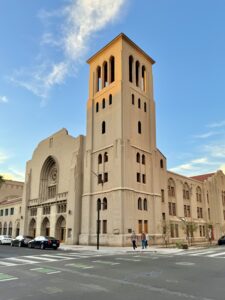
The roofless Gothic shell at the corner of Monroe Street and Third Avenue is downtown Phoenix’s most haunting architectural presence — a building defined by what it’s lost rather than what it’s preserved. Norman Marsh’s 1929 Italian Gothic Revival church was reduced to its skeleton by a 1984 fire. Here’s the twist: rather than restore or demolish, preservationists stabilized the walls and embraced the ruin. The poured concrete structure (which only looks like hand-carved stone) survived the flames that consumed the timber roof, leaving behind a roofless sanctuary where the sky now serves as ceiling.
The massive circular rose window frame on the south facade stands as dramatic silhouette — its concrete tracery intact though the original stained glass is gone. Inside, the columns and arches now function like a garden cloister, creating deep shadows and surreal indoor-outdoor atmosphere. The Abbey has transformed catastrophe into venue, hosting candlelight concerts and weddings beneath open sky and Gothic arches — a rare Phoenix example of accepting architectural loss as transformation rather than erasure. The facade is fully visible from Monroe and Third Avenue, though interior access generally requires a ticketed event.