

Arizona Aria
Desert-Raised, World-Bound
Writer Shannon Severson // Photography Courtesy of Jacob Soulliere

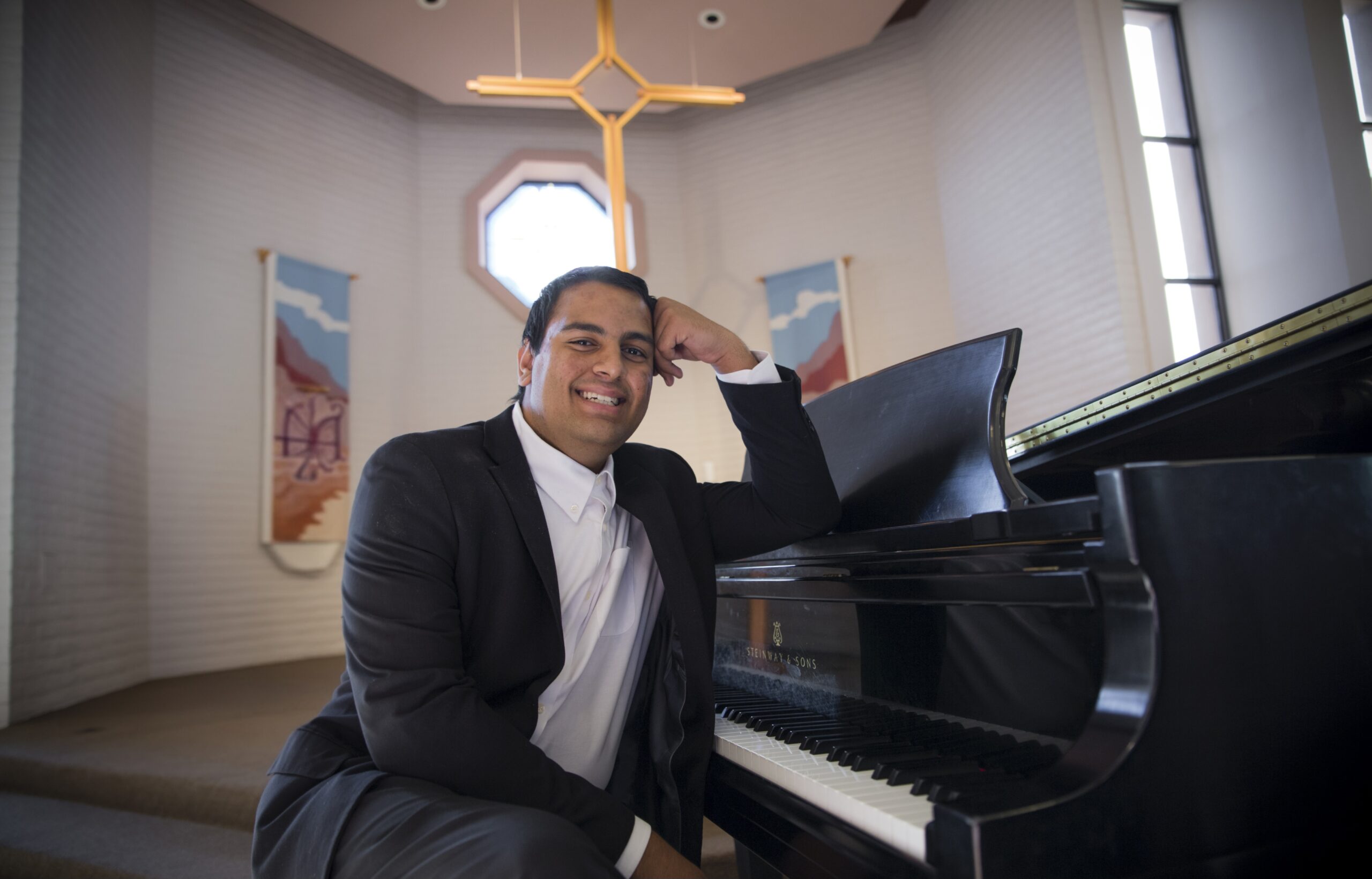
During a Choirs of America dress rehearsal at Carnegie Hall, 400 singers fell silent when conductor Z. Randall Stroope called for a volunteer to sing the bass solo “Soldier, Soldier, Won’t You Marry Me?” Jacob Soulliere raised his hand, sang the part and was chosen on the spot. That small, decisive moment — stepping forward and being chosen to tell the story — is one of several that map this young baritone’s steady climb from Arizona choirs to major stages.
“No one raised their hand except me,” Soulliere recalls. “I sang it and conductor Stroope said, ‘You got it!’”
That moment established a pattern — initiative meeting preparation, confidence meeting craft. His willingness to step forward, combined with an early commitment to developing his voice and working with the finest teachers, would set the course for everything that followed.
Adopted from Sofia, Bulgaria, at age 2 and raised in Anthem, Soulliere is the product of a tight network of church choirs, youth ensembles and early vocal training that guided him from local stages to international recognition. In Arizona, he was a two-time winner of the Upscale Singers Cheryl Siebs Memorial Competition and, as a winner of the Arizona Musicfest vocal competition under conductor Robert Moody, was invited to perform at the Musical Instrument Museum as “one of Arizona’s finest young musicians” at age 16. For six years, he served as a soloist at Christ the Lord Lutheran Church in Carefree, where he was awarded a scholarship.
Soulliere believes his talent may be rooted in his DNA — his biological parents were part of Bulgaria’s culture of traveling musicians. His mother noticed his singing ability early and enrolled him in the Phoenix Boys Choir, where he trained under George Stangelberger — a conductor whose résumé included the Vienna Boys Choir and work alongside the Three Tenors — and later advanced into the master’s program under Herbert Washington.
At Boulder Creek High School, he was introduced to mezzo-soprano Mary Sue Hyatt, former director of the school of music at Kent State University, who became his vocal coach and mentor. She, in turn, introduced him to opera coach Henri Venanzi, formerly chorus master of the Arizona Opera and now at the Cincinnati Opera. Together, the three became what Soulliere calls “the three musketeers,” working through recitals and repertoire for the better part of a decade.
What they gave him, he says, were two complementary educations most young singers never receive.
“Recital is a manual transmission and opera is automatic transmission,” he explains. “Mary Sue taught me vocal development with a particular quality for each titled recital performance — each selection has its own story, like a mini opera. Henri’s coaching taught me how to navigate my voice through different opera roles. I had the best of both worlds and still do.”
Soulliere earned his bachelor’s degree from Manhattan School of Music and is now pursuing a master’s degree in voice at the San Francisco Conservatory of Music. His résumé reflects a meteoric trajectory: multiple performances at Carnegie Hall — including a post-win recital after the 2022 American International Protégé Vocal Competition — a White House appearance, an Earth Day concert in Central Park with the Munich Symphony, and a spot in the Metropolitan Opera Laffont Competition’s Rocky Mountain region as the youngest participant at 20.
At the conservatory, he studies under Lester Lynch, a Wagner and Verdi specialist who continues tightening the connections between vocal technique, historical context and dramatic truth.
“A classical singer communicates the experience of the character at the time the composer imagined it,” Soulliere says. “Who were the composer’s friends? Which painters and thinkers shaped the era? What was happening in the world? All of this informs the music I bring to life. It’s important for future generations to see history re-enacted live on stage.” He pauses. “It’s important to me, at least.”
A pivotal turning point came during a summer at Opera in the Ozarks, where Soulliere performed the role of Baron Douphol in Verdi’s “La Traviata.” Standing onstage with the chorus rising behind him, something shifted.
“I felt a thrill of inspiration,” he recalls. “The chorus singers’ voices rose up behind me as I performed. That summer, I learned how to live inside a role. It’s not just about singing well; it’s about carrying the characters’ life experiences and emotions and communicating them on stage.”
Opera, he has come to understand, demands multidisciplinary dedication — vocal technique, diction, languages, history, art and literature. Soulliere describes himself as text-obsessed, driven to master diction in English, Italian, German, Latin, French and Russian alike.
“I’m a text fanatic,” he says. “Singing is the only instrument that has text. I found a love for it — and for poetry. It’s like a puzzle to communicate emotion on stage.”
The ambition is real, but so is the perspective.
“I may not be the next Richard Tucker,” he says, “but through the gift God gave me, I can touch the hearts of others.”
Interpretation, he insists, must begin with the words on the page. He is deliberate about limiting early exposure to existing recordings.
“Most opera recordings are 40 to 50 years old and those pieces have been performed in that same way for decades,” he explains. “I don’t want to pick up an imitation. That’s where my musicality comes in — I take ideas from different recordings and fuse them into something that’s mine.”
Though his career now takes him far from the Arizona desert, he returns when he can — most recently singing at Christ Anglican Church’s Easter services, catching up with friends and faculty, and fitting in a round of golf.
“Every time I come home, I feel like I’m getting older, but that translates into enjoying breaks more each time,” he reflects.
To young singers in the same choir risers he once occupied, his advice is direct.
“If you really love music, pursue it,” he says. “You only have one life. You should do something that you love and that makes you happy. I’m not saying it will be an easy reward, but music — whether professionally or in the community — is so therapeutic and it’s something that is really worth pursuing.”
Preparation, he adds, is everything.
“What serves on stage is preparation. If you have prepared, you have nothing to worry about. You have to live in the score, understand the text and what the composer wanted. It takes discipline but the process is its own reward.”
The horizon is bright. The conservatory’s current season has him performing Jules Massenet’s “Cendrillon” as Le Roi and Count Almaviva in Mozart’s “Le Nozze di Figaro.” He has an invitation to perform Elaine Hagenberg’s vocal works at Saint-Sulpice in Paris, along with a recital in the city. Ongoing collaborations with the Musical Instrument Museum, the Phoenix Boys Choir and the White House are also in development. He offers trial lessons and performance bookings.
“I love what I create and I love the process that leads me there,” he says, “from the first rehearsal, the staging, the language coaching, to the history classes that illuminate the world behind the music.”
The moment that set it all in motion — a teenager’s hand raised in a silent room at Carnegie Hall — was more than an audition. It was a declaration. Now, with a dream of someday performing at the Metropolitan Opera, Jacob Soulliere continues to aim higher, advancing the art of opera note by careful note.