

Above & Beyond
An Arizona Aviator’s Air Force One Legacy
Writer Joseph J. Airdo // Photography Courtesy of Col. Mark Tillman
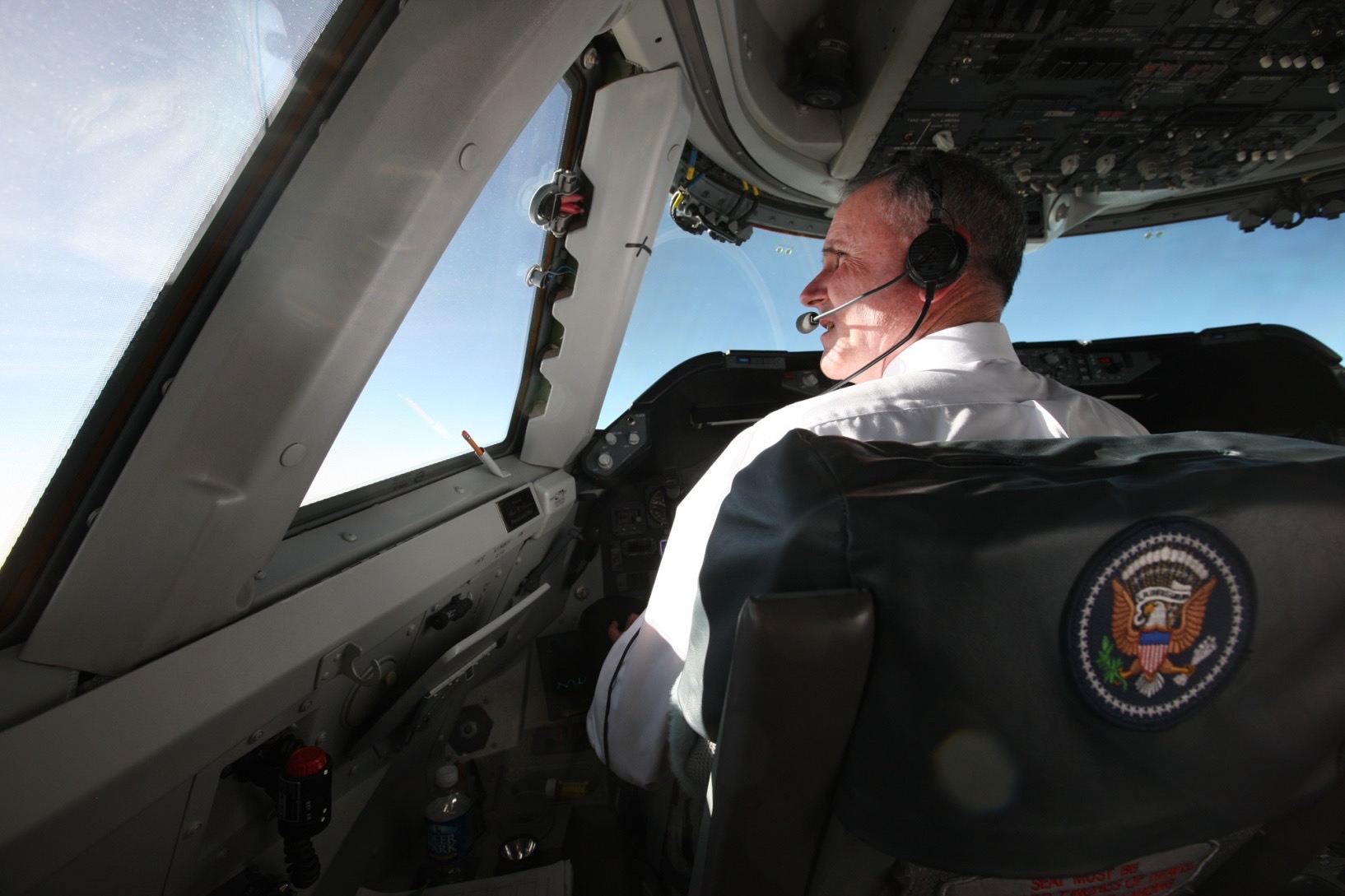
On the morning of Sept. 11, 2001, Col. Mark Tillman gripped the controls of the world’s most recognizable aircraft as chaos erupted across America. From the cockpit of Air Force One in Sarasota, Florida, he watched the second plane slam into the World Trade Center’s South Tower on a small television screen. In that moment, the weight of command crystallized: the safety of the President of the United States — and the continuity of American government — rested entirely in his hands.
“By the time the second plane hit the tower we knew the country was under attack and at that point the decision was made to do like we always do for the continuity of government — relocate the president of the United States,” Tillman recalls, his voice still carrying the gravity of those moments that redefined a presidency and a nation.
Today, the man who commanded Air Force One through America’s darkest hours lives quietly in Scottsdale, his extraordinary career a testament to Arizona’s remarkable tradition of producing the military’s most elite aviators. From his home near Pinnacle Peak — where dust and horses once defined the landscape — Tillman reflects on a journey that took him from Williams Air Force Base to the pinnacle of military aviation, then back to the desert he’s always called home.
The Zero Fail Mentality
Tillman’s path to Air Force One began, fittingly, in Arizona. After earning his chemical engineering degree from Tulane University, he found himself at Williams Air Force Base near Mesa in 1981, transitioning from rocket propulsion engineer to pilot. The five years he spent there as a T-37 instructor pilot weren’t just about learning to fly — they were about absorbing a philosophy that would define his career.
“Everyone at Air Force One trains constantly,” Tillman explains. “Nobody wants to be the one on the crew who fails, so you’re always pushing yourself to be better than everyone around you. There are 200 to 300 people all striving for the same standard of excellence.”
That standard — what the Presidential Airlift Group calls “Zero Fail” — became more than doctrine; it became identity. When President Bush selected Tillman as the nation’s 12th presidential pilot in 2001, he inherited command of an operation where perfection wasn’t aspirational — it was mandatory.
“We simply don’t let the president down,” Tillman says. “That’s the beauty of a highly trained crew. We’re the experts in the air — fixed-wing assets. That’s what we’re about.”
The Day That Changed Everything
The morning of Sept. 11 tested every principle Tillman had learned. As President Bush attended a reading event at Emma E. Booker Elementary School, Tillman and his crew monitored reports from New York. When the second tower was hit, the mission became clear: protect the president and ensure government continuity, regardless of his desires to return immediately to Washington.
“He couldn’t get back to Washington right away, as much as he wanted to,” Tillman remembers. “We simply weren’t sure whether Washington was safe. We sat in Sarasota, Florida, watching the north and south towers get hit. Then, as the president was moving toward us, the Pentagon was hit. We were told there were still more aircraft that had been hijacked.”
The challenges multiplied exponentially. Communication systems failed. Reports flooded in of truck bombs and car bombs in Washington. Secretary of State Colin Powell was airborne, returning from Peru. Defense Secretary Donald Rumsfeld disappeared into the chaos at the Pentagon.
“We could not gather the secretary of state and secretary of defense together to speak with the president,” Tillman explains. “Those were challenging times. But we did what we’ve always done.”
What they had always done was train for the unthinkable. Tillman executed what he describes as a near-vertical takeoff from Sarasota, spiraling Air Force One upward at maximum climb rate to avoid potential surface-to-air threats. The fog of war created false alarms and conflicting reports, but the crew’s training held firm.
“All the training we had prepared us to make it happen,” he reflects. “The radio operators established communication with all the right people around the world. Everything played out as it should have when facing a serious threat against the United States.”
Into the War Zone
If Sept. 11 tested Tillman’s crisis management skills, President Bush’s surprise Thanksgiving visit to Baghdad in 2003 showcased his ability to execute the impossible. The mission — flying a sitting president into an active war zone for the first time in history — required absolute secrecy and flawless execution.
“The beauty of it was that it came from the very top down,” Tillman recalls. “The president’s mission was clear: ‘I’m going to have Thanksgiving dinner with the troops.’ But he gave me specific instructions — if anything goes wrong, the mission is aborted immediately. He wasn’t going to take any chance that service members could be injured because of his visit.”
The operational security was extraordinary. Of the 70 people who flew that day, only four crew members knew the destination until the last moment. Even the troops in Baghdad remained unaware until Air Force One emerged from the darkness at Baghdad International Airport.
“They were alerted at the last second, and they reacted perfectly — did everything exactly as they should have,” Tillman says, his admiration evident. “The same was true for the U.S. military protecting BIAP in Baghdad. They didn’t need to know the president was coming. Our ground support included Delta Force and others, and only one person was initially briefed.”
The mission nearly faced compromise when a commercial airliner pilot radioed London air traffic control, asking if the aircraft below was Air Force One. Despite controllers’ denials, the pilot responded with knowing laughter: “OK, cheerio, Air Force One.” Tillman immediately briefed the President on the potential security breach, but no intelligence reports surfaced, and the mission continued.
The Man Behind the Office
Flying presidents requires understanding not just aircraft systems and security protocols, but the human beings who occupy the world’s most powerful office. Tillman’s observations of President Bush reveal a leader far different from his public persona.
“President Bush and his family, including Mrs. Bush, are deeply devoted Christians with extraordinary moral character,” Tillman reflects. “Their ability to connect with all Americans was remarkable. I was amazed by how President Bush would greet people at the foot of the stairs and remember their names.”
The president’s compassion revealed itself most powerfully in his interactions with military families, particularly those who had lost loved ones. “He took such pride in meeting them — especially the families of the fallen — sitting with them, listening, and talking about the profound loss they’d experienced,” Tillman recalls.
That compassion extended to Tillman’s own family. His daughter, who calls herself “handicapable” and uses a walker and wheelchair, became a particular favorite of the president’s.
“Every time he’d come to the cockpit, he’d ask me, ‘How’s my little buddy doing?’” Tillman remembers. “He would invite her to the T-ball games at the White House — the Challenger events. At one of the games we attended, before opening the game, he asked if his little buddy was there. She made her way to the front, and he handed her a baseball and gave her a hug. That’s what he’s about — he takes care of people.”
Back to Base
After eight years at the controls of Air Force One, Tillman faced a choice available to few: where to spend the rest of his life. The answer brought him full circle to Arizona, specifically to Scottsdale, where Bruce Halle of Discount Tire offered him a position flying corporate aircraft. The transition from flying the First Family to serving the Halle family proved remarkably seamless, reflecting shared values that transcended the difference between government and corporate service.
“After the military, I always wanted to move back here,” he admits. The Scottsdale he remembered from his Williams Air Force Base days — “kind of a dusty horse town” — had transformed into a sophisticated desert metropolis, but the essential appeal remained.
From his Cessna 340, which he owned until recently, Tillman would take visitors on aerial tours showcasing Arizona’s hidden beauty.
“The beauty up there isn’t just the Grand Canyon — though that’s obviously spectacular,” he explains. “The entire state is beautiful. Flagstaff with snow-capped mountains, then back through Prescott — it’s incredible how much beauty exists when people think it’s just a hot desert.”
Today, Tillman channels his Air Force One experiences into speaking engagements, sharing leadership principles forged at 40,000 feet during national crises. The core message remains unchanged: Trust your team, train relentlessly, and never accept failure as an option.
From his Scottsdale home, Tillman represents more than just one man’s remarkable career. He embodies Arizona’s extraordinary contribution to American aviation history — a tradition that includes multiple presidential pilots who chose to call the state home.
As Tillman looks back on his journey from Williams Air Force Base instructor to commander of the world’s most important aircraft, the arc seems both improbable and inevitable. In the desert where he learned to fly, he found his calling. In the crucible of national crisis, he proved his worth. And in the Arizona landscape he’s always loved, he’s found his peace.
The Presidents’ Pilots
Col. Mark Tillman represents just one chapter in Arizona’s remarkable tradition of producing presidential pilots. The state’s connection to the elite world of presidential aviation extends back decades, with multiple commanders of Air Force One calling Arizona home.
Col. Mark S. Donnelly, who served as the 11th presidential pilot from 1997 to 2001, flying for both President Clinton and early George W. Bush, embodies the deep Arizona roots that seem to cultivate exceptional aviators. Donnelly earned his private pilot’s license at age 16 from Sawyer Aviation in Phoenix, riding his bike to Deer Valley Airport when his mother couldn’t drive him.
“My mother was a pilot, and she inspired my interest in flying,” Donnelly recalls. “She earned her private pilot’s license during World War II, which was pretty amazing.”
After attending pilot training at Williams Air Force Base — the same Arizona facility where Tillman would later serve — Donnelly rose through the ranks to command Air Force One during a period he describes with characteristic humor.
“We used to joke that we operated on ‘Clinton standard time’ because President Clinton, when he engaged with someone, would stay involved in the conversation until he was truly finished,” Donnelly describes. “During one flight on a 12-passenger Gulfstream, President Clinton stuck his head into the cockpit to thank us and, by the way, started talking to us about golf. We chatted for maybe five minutes about golf before he climbed out of the plane and went on his way.”
After retiring from Southwest Airlines, Donnelly has remained deeply connected to Arizona’s aviation community, particularly through sport flying.
“I’m also a glider pilot,” he explains. “After I retired from the airline, I bought a sailplane and now I fly out near the town of Maricopa. What I really enjoy is the challenge: using my skill and knowledge of air currents and the atmosphere to stay aloft.”
Donnelly and Tillman are also joined in Arizona’s presidential pilot tradition by Col. Scott Turner, a Scottsdale native who served as the 13th presidential pilot under Barack Obama. Turner’s journey from local high school graduate to Air Force Academy distinguished graduate to commander of Air Force One represents the full circle of Arizona’s contribution to elite military aviation.
This concentration of presidential pilots in one state speaks to something beyond coincidence — perhaps the vast skies and pioneering spirit of Arizona naturally cultivate the kind of aviators capable of shouldering the ultimate responsibility of presidential flight operations.