

Home Is Where the Art Is
C.P. Drewett’s Desert Modernism Transforms How the North Valley Lives
Writer Joseph J. Airdo // Photographer Loralei Lazurek
Look down into the paint of a car beneath a standard recessed garage light and you’ll see it: the bulb, reflected. A perfect circle of interruption in the finish, disrupting every curve the designer intended. Most people never notice. C.P. Drewett noticed immediately — and the question of what to do about it says everything about how he thinks.
The answer, for Drewett, is canvas. Light shot across a stretched surface until it becomes soft, all-encompassing, ambient. No hotspots. No direct reflections. Just a glow that allows the body of the car to read exactly as its designers intended — every plane and crease and intentional line visible at once. It’s a detail that matters only to someone who understands that a serious automotive collection isn’t storage. It’s art. And art deserves proper light.
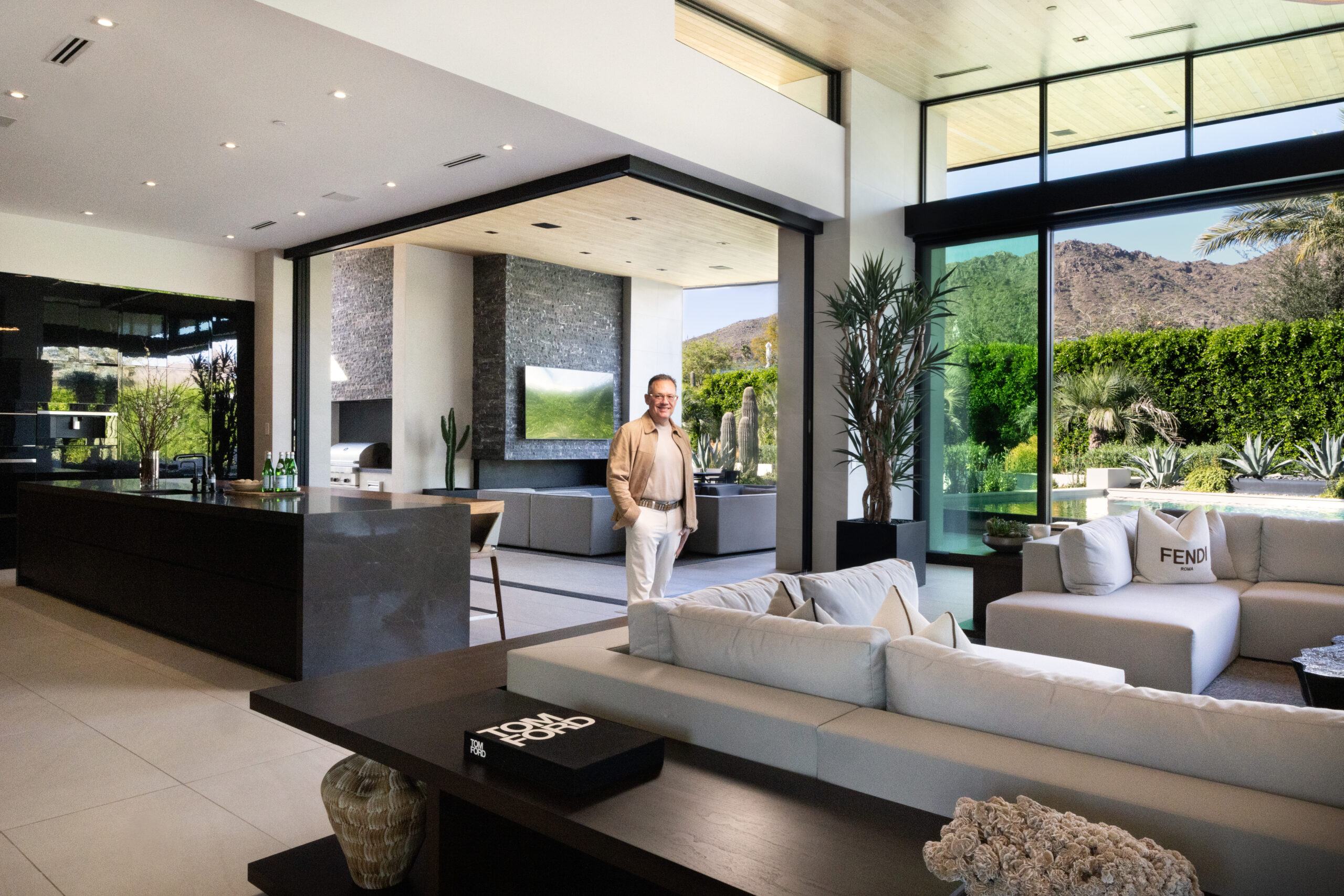
That understanding — that the spaces we inhabit are expressions of who we are, that every technical decision is also a philosophical one — has driven Drewett’s work since he arrived in Phoenix in 1993 fresh from Louisiana State University’s architecture program. Over the past three decades, the founder and principal of Drewett Works has become one of the North Valley’s most consequential architects, shifting the region’s luxury residential language from heavy Mediterranean enclosure to a transparent, horizontal modernism that doesn’t merely sit upon the Sonoran Desert but enters into conversation with it.
He is also, it should be said, not what you’d expect. Before the architecture, there was the military — a 14-year career in the Louisiana Army National Guard that ended at the rank of captain, with engineering school at Fort Belvoir, Virginia, and a platoon leader’s experience building roads, bridges, and structures in the field. There was a liver donation in 2001, when Drewett gave 80% of his organ to save his father-in-law’s life in what was only the third living-donor liver transplant in Mayo Clinic Hospital’s history. There was an Iron Chef battle at a Louisiana country club, which he won. There are Bach cantatas, sung in a three-octave range, and an orphanage in Uganda he helped build with his own hands. The man contains multitudes. The architecture, it turns out, contains all of them.
“It looked very production-oriented,” Drewett says of the Valley he encountered in 1993. “What I felt was missing were districts — art districts, entertainment districts. It was sort of uncontrollable sprawl at the moment.”
But the landscape held him.
“Coming from the South, it was so remarkably clean here — pride of ownership, everything felt renewed, like a great wide-open playing field,” Drewett explains.
He would spend the next three decades trying to play it well.
His early career coincided with Silverleaf’s development — and the architectural mandate that came with it. DMB Development’s guidelines for the community specified Spanish and Mediterranean Revival styles: stucco exteriors, red-tiled roofs, grand archways, sprawling fountain courtyards, a deliberate transplant of European old-world character onto desert soil. Drewett worked within it. He is careful to note this: he was not an outsider rejecting the prevailing style but a practitioner fluent enough in its vocabulary to eventually argue for something better.
“I’ve had the fortune of mostly curating modern architecture, though I’ve definitely done a good bit of work in Silverleaf, which is the interpretation of a sort of desert-oriented Mediterranean architecture,” he says. “That was something of a pre-mandate.”
The shift came as Phoenix grew up around itself. As museum districts and cultural cores emerged, something in the city’s collective eye began to sharpen. People’s expectations expanded.
“People’s awareness of architecture grows beyond just reaching for the word ‘contemporary’ — which I feel gets a little misused,” Drewett says. “Once we got grounded with these cultural centers, people started free-thinking and realizing that modern architecture really had its place here — and how connected it can be to our local topography. The metaphorical alignment could go on and on. It just makes so much sense with our landscape.”
He draws the line clearly.
“I think probably in the mid-1990s I really felt the tide start to turn, shortly after I got here,” he says. “And by the early 2000s, I wasn’t nudging people toward modern anymore. They were gravitating there on their own.”
The Valley’s relationship with the automobile made the next evolution almost inevitable. Scottsdale’s position as home to Barrett-Jackson and a constellation of collector car culture — favorable climate, no corrosive salt air, no flood risk — has drawn some of the world’s most serious automotive enthusiasts to the North Valley. They arrived with their collections and a question architects had rarely been asked: how do we live with these things properly?
“Our clientele have really, increasingly, come to us with requests for spaces that can house and celebrate their collections,” Drewett says.
The collector car space is now among Drewett Works’ signature design challenges — and Drewett approaches it the way he approaches every problem: purpose first. Who is this collector? Are the cars museum pieces, static and pristine, or are they driven regularly? The answer determines everything: the circulation logic, the door systems, the relationship between the garage and the motor court.
“There are really a few different approaches, depending on the client,” he explains. “There’s the approach where the car is essentially a museum piece — static, no fluids, never driven. And then there’s the driver who actually uses every car in the collection. So movement is front and center: how do you navigate around the space without dodging and having to move things out of the way?”
The fenestration options alone reflect how seriously Drewett takes the design problem. Drivable sliding door tracks. Guillotine glass. Hangar-style doors borrowed from aviation architecture.
“The way the space opens and connects to the exterior — that’s a great moment to celebrate, just like how we live,” he says. “Indoor-outdoor space is such a premium for us here, and opening up the auto collection to the motor court, having people over, entertaining — that whole experience is what it turns into.”
Which brings us back to the light. The canvas system that eliminates the recessed bulb’s reflection isn’t merely a technical solution — it’s a philosophical position. The car deserves to be studied. Its design deserves to be read in full.
“When the light is ambient and far-extending, it really allows you to study the car — to see how the body movement and all the intentionality of the design actually reads,” Drewett says.
The same precision governs natural light throughout his homes. The Sonoran Desert’s sun is the region’s greatest asset and its most demanding engineering problem, and Drewett has developed an exacting vocabulary for managing it. North light is soft and calming — ideal for certain interior spaces. South light is handled with horizontal projections that intercept the high summer arc while admitting lower winter sun. East and west are the difficult exposures, the sun arriving at its most intense right at the horizon line.
“You can’t combat that with a roofline,” he says flatly. “You can’t extend it far enough. Instead, you use a vertical panel.”
When a site offers no good southern exposure at all, Drewett goes vertical.
“You lift it up — really pay attention to the Z axis — and you can allow remarkable light in through clerestories,” he explains. “When a space is largely shaded at the human level and then you have this halo of light from above, it’s really something.”
The material palette that holds all of this together — limestone, rift-cut oak, copper, steel — is governed by a principle Drewett calls hierarchy. Not symmetry. Not visual balance in the conventional sense. A deliberate ranking of materials according to the spaces and views they serve, with a hero material anchoring each zone and a supporting cast stepping down from it.
“When I’m designing, I’m trying to be reductive — peel it back, peel it back, peel it back — until I find the bare essence of the solution I’m striving for,” he says. “It’s not about needing more stone on this portion of the house for balance. It’s about understanding the solvency of what each material is doing, where and why.”
The logic, once established, becomes self-perpetuating.
“Once you create that vocabulary and establish clear rules of engagement for the materials, they start placing themselves,” Drewett says. “And once that logic is founded, people experience it — they may not know tangibly what’s driving it, but they feel it.”
That feeling — the sense of being held by a space without being able to articulate why — is the closest Drewett comes to describing what he’s ultimately after. Ask him what daily life feels like inside one of his homes and he deflects, characteristically, toward the people who live there rather than the structures they inhabit.
“I love people more than I love architecture,” he says.
It sounds like humility. It is, in fact, a design philosophy.
“The business of loving people and creating space that’s relatable for them means you really need to be a student of your clients,” Drewett continues. “The relatability of the space comes from having spent so much time studying my clients, learning their lives and how they live, and then knowing I have the freedom to express that spatially. There’s a sense of belonging in the architecture. It’s embracing.”
That embrace is expanding. Drewett has recently launched his own development company — “I’ve always loved helping craft and create vision for communities,” he says — and is watching Old Town Scottsdale with the particular attention of someone who spent three decades shaping the Valley’s edges and is now focused on its center.
“Our city is at the precipice of growing up,” he says. “We’re seeing an increasingly refined clientele — people with very particular palettes — and a lot of relocation. Some really unique families are moving to the Valley.”
It is, in its way, the same thing he said when he arrived in 1993: the playing field is wide open. The difference is that now he has spent 30 years learning exactly how to play it — and the light, finally, is right.