

Serious About Joy
Hidden Masters of Museum-Quality Mirth
Writer Joseph J. Airdo
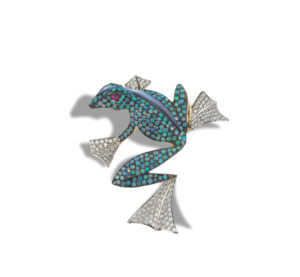
The frog sits perfectly still, as frogs do, its opal body catching light from impossible angles. Diamonds stud its webbed feet. A pink sapphire gleams where an eye should be. This is not costume jewelry. This is not whimsy for whimsy’s sake. This is a Santa Barbara husband-and-wife team proving that technical perfection and genuine joy are not mutually exclusive — and that some of America’s most awarded jewelry designers got there by refusing to take themselves seriously, even when working with stones worth more than most cars.
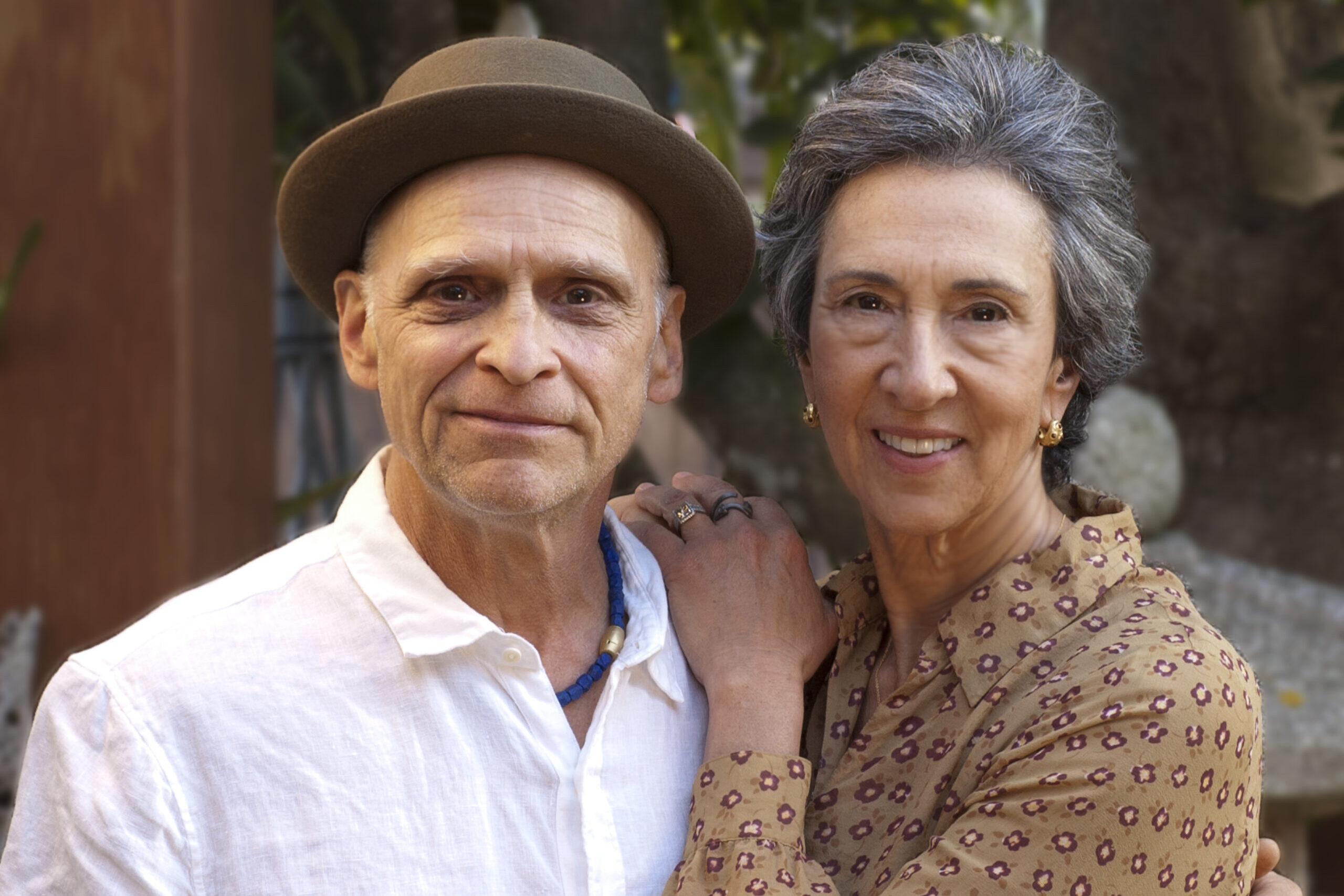
Gregoré and Jennifer-Rabe Morin have quietly amassed more than 30 international design awards, including multiple AGTA Spectrum Best of Show honors and a shelf of MJSA Vision Awards that would make any jeweler envious. Yet their most celebrated pieces feature frogs, spiders perched on leaves, and Buddha figures carved from pink opal. It’s a fascinating duality: old-world discipline married to playful, nature-inspired narratives. And it’s precisely why collectors who appreciate both technical mastery and personality have made them one of the most sought-after design duos working today.
Their path to this rarefied position began in anonymity. For more than a decade, both worked as “hidden masters” — designing pieces that ended up in museums, on red carpets and in private collections around the world, all without their names attached.
Jennifer’s journey began in London, where she received certification from City of London Goldsmiths Hall for fabrication and stone setting — under instructors who were creating pieces for Persian aristocrats. She’d already been at Silverhorn Jewelers for nearly a decade when Gregoré arrived. He worked his way up to head designer at the Santa Barbara gallery, known for its European-trained team and celebrity clientele.
While at Silverhorn, Jennifer earned her Master’s in Fine Art. Founder Michael Ridding purchased and sold the entire collection of gold brooches from her thesis exhibition — recognizing their merit even as they carried the Silverhorn name rather than hers.
“Silverhorn was truly a special place,” Jennifer says.
“Founders Michael and Carole Ridding had this remarkable approach,” Gregoré adds. “If they thought a design had merit, they’d give us permission to make it, even if they suspected it might never sell. That’s extraordinarily rare in our industry. Most places we’ve worked, the response was always, ‘You know, it’s lovely, but I don’t think I can sell it, so we’re not going to make it.’”
That creative freedom, combined with the technical demands of working for high-jewelry houses, forged something unusual: artists who could execute at museum-collection levels but weren’t afraid to put a jeweled frog on your shoulder.
“If we designed something for Silverhorn that required a stone that didn’t exist in standard shapes, Michael would simply commission it from cutters in Idar-Oberstein, Germany,” Jennifer explains. “That opened up an entirely different world of design for us — we weren’t limited to classic gem shapes anymore. We carry that philosophy forward today by cutting many of our own gemstones, both by hand and with CNC equipment.”
That attitude — both the creative permission and the material support — permeated the entire workshop.
“It wasn’t just us,” Jennifer continues. “Every jeweler who came through Silverhorn was given that same creative freedom. It allowed all of us to blossom, to create increasingly beautiful work, and to really push ourselves as if we were our own bosses.”
The technical foundation came earlier, built through rigorous apprenticeships that sound almost Victorian in their intensity. Gregoré trained under Swiss, Hong Kong and elite American masters who taught him that “nothing is impossible” — a philosophy he internalized while working in Vancouver beside Hon Chu Wong, whom he calls “probably one of the most excellent technical goldsmiths I’ve ever encountered.” Wong, originally from Hong Kong, brought old-world discipline to the Canadian workshop.
“I was doing limited production pieces for that company, so I might have 10 pieces on my desk that all needed finishing,” he recalls. “Instead of doing it production-line style — filing all the sprues off, then doing all the polishing, then all the setting — I would finish one piece completely. Then I’d look at it and figure out all the mistakes I’d made. On the next piece, I’d fix those mistakes. Then I’d examine that one, identify new mistakes, and correct them on the third piece. And on and on.
“This approach really helped me improve my ability to not make mistakes in the first place — to produce cleaner and cleaner work. My boss didn’t mind because I was just as fast as everybody else in the shop. He didn’t care how I got to the end product, as long as it was good.”
That iterative discipline — complete, examine, correct — now defines how the couple approaches every piece in their Santa Barbara studio, where they design and fabricate everything in-house. But here’s where it gets interesting: They’re not just making jewelry. They’re also performing precision quartz cutting for atomic force microscopes, machines worth millions of dollars that require tolerances far beyond normal jewelry practice.
“When we’re working on components for atomic force microscopes — specifically the Potomac Workhorse models — there’s no design element involved,” Gregoré explains. “The specifications are absolute: a hole here at exactly this diameter and depth, a slot positioned precisely there. There’s no ambiguity.
“Now, jewelry doesn’t require those kinds of tolerances. But the skills you develop from that precision work carry over in profound ways. You learn to research specialized cutters that can achieve what’s being asked. You figure out new approaches to tool pathing: how the cutter needs to move to avoid damaging the material.”
That discipline translates directly into pieces that judges consistently praise for being “finished from every angle” — brooches whose backs are as meticulously detailed as their fronts, rings designed to be appreciated like miniature sculptures rather than flat ornaments.
“I just feel a piece of jewelry is a sculpture — it should be beautiful from every angle,” Jennifer says. “Once you imagine yourself smaller than your jewelry — looking at it like it’s a huge monument — it becomes much easier to see what needs attention. It almost forces you to finish all the small details on every side, rather than just focusing on the parts that face outward.”
Which brings us back to that frog. The 2009 AGTA Spectrum Award-winning brooch combines 18-karat white and yellow gold with layered opals, moonstones and pink sapphires in a fully three-dimensional animal form. It requires complex stone-setting angles and structural engineering in two colors of gold. It’s also, unmistakably, charming.
Natasha Lazarova, jewelry curator and head gemstone expert at Grace Renee Gallery in Carefree, where the couple will appear this month, puts it succinctly: “Gregoré and Jennifer are a rare phenomenon in the art world. You have this Santa Barbara husband-and-wife team creating these delightful, whimsical narratives — frogs, insects, nature scenes — but the engineering behind them is absolutely serious high art.
“They come from a background of working on confidential projects for the world’s most prestigious jewelry houses, and you can see that rigorous discipline in their work. They are likely two of the most awarded designers working in the U.S. today because they’ve mastered a difficult balance: they use flawless, old-world technique to tell stories that are full of joy and humor.”
For Jennifer, whose childhood in Spain included collecting dragonflies and butterflies and arranging them meticulously under glass, the nature focus feels inevitable.
“It starts with awe and admiration — a kind of wanting that beauty to be part of me throughout the day,” she says. “When I was a child in Spain, finding these extraordinary living creatures, seeing how beautiful they were, it was like a beacon coaxing me to try to capture that in an object I could wear and share, to give that same happy feeling to somebody else.”
But the humor? That’s harder to explain, even for Gregoré, who once heard an American poet laureate describe how ideas arrive like tornadoes on her farm — if you don’t run fast enough to catch them, you’re left with only residue.
“Design is often like that for me,” he says. “Sometimes it’s perfect — instant. You have the whole picture. Other times it still needs some polishing around the edges. But often it almost feels like I didn’t do it. Like it wasn’t even me. And yet I know it was, because I was there to see it, to experience it.”
Jennifer offers a more pragmatic explanation rooted in their membership in the American Jewelry Design Council: “To us, our craft is a form of art. It’s not about economic gain from selling a big sapphire and diamond. It really is an art form for us, and that influences the fact that we’re not concerned with what a design might sell. It’s more about speaking the language that excites us. It’s about paying honor to the design and not dumbing it down just to fit the masses.”
Working as a married couple in the same studio could theoretically create friction, but they’ve developed a system that respects individual vision while leveraging complementary skills. Jennifer, formally trained in fine arts and education, brings strength in form, drawing and composition. Gregoré, with his background in machining and tool-making, excels at technical problem-solving and fabrication.
“Our pieces are really our own — we each design and execute our personal work independently,” Gregoré explains. “When we take on commissioned pieces from other designers that might be entered into shows like Spectrum, the commissioning artist has final say on the design direction.”
Jennifer describes her process as more internal: “I don’t like to be influenced too much — I actually try to do the whole thing myself. But for the CAD part, I’ll ask Gregoré to come in and give me some tips, because he’s far more skilled with that.”
But Gregoré is quick to acknowledge his own blind spots: “I get tunnel vision quite often. I’ll design something that feels like it’s working perfectly to me, but Jennifer will say, ‘Look, this feels off balance.’ And she’s usually right. If she tells me something needs to move or change, I should listen, because I tend to get tunnel vision. I fall in love with what I’m creating, and then obviously that piece can do no wrong in my eyes.”
It’s a partnership that has produced pieces like the Hiruko objet d’art — an 18-karat white and yellow gold sculptural figure of one of Japan’s Seven Lucky Gods, carved from orange opal with paraiba tourmalines and diamonds — that won both MJSA Design Excellence and Laser Distinction awards simultaneously. Or the Buddha earrings: small engraved sculptures in pink opal with pink tourmaline drops that collectors wear as conversation pieces.
The Santa Barbara connection matters here, too. Like North Scottsdale and Carefree, it’s a landscape-driven, design-conscious community where affluent collectors appreciate both natural beauty and artistic craftsmanship. Both environments attract people who view jewelry as wearable sculpture rather than status symbols, who want pieces with personality and provenance.
“An artist observes life, spending time aware of what is going on around him,” Gregoré says. “Every day, I work to make sure my work is extravagant, fun to look at. I bow down to nature because just when I think I’ve had the most intelligent idea, I realize that nature created everything before I did, and I’m just now discovering it.”
Jennifer’s approach is more direct: “My objective is to create beautiful shapes with rare materials so that people look at them with wonder and joy.”
At Grace Renee Gallery later this month, visitors will have the rare opportunity to meet these two artists and see firsthand how technical perfection and genuine delight can coexist in the same piece. The frog will be there, of course. So will several new pieces showcasing techniques they’ve been perfecting, including casting and anodizing aluminum into brilliant colors — something generally considered semi-impossible with castable grades.
“We’ve managed to break through that limitation,” Gregoré says, with the quiet confidence of someone who has spent decades being told things are impossible, then doing them anyway.
The work, ultimately, speaks for itself. Thirty-plus international awards. Museum placements. Red-carpet appearances. But also: frogs, spiders, Buddha figures. Important jewelry that doesn’t take itself too seriously. Technical mastery in service of joy.
“The work is the important part, not us,” Gregoré says. “We have to step back almost like a writer does when they talk about how characters develop themselves — how you’ve got to listen to the character, what the character wants to do. It’s the same thing with the work. The work is the important thing, and it needs to live. That’s what you’re doing: giving it life so it can go out there and exist on its own, without us.”
Meet Gregoré and Jennifer-Rabe Morin
April 24–25 // 10 a.m.–5 p.m. // Grace Renee Gallery // Historic Spanish Village // 7212 E. Ho Road, Carefree // Free // 480-575-8080 // gracereneegallery.com