

High Rotation
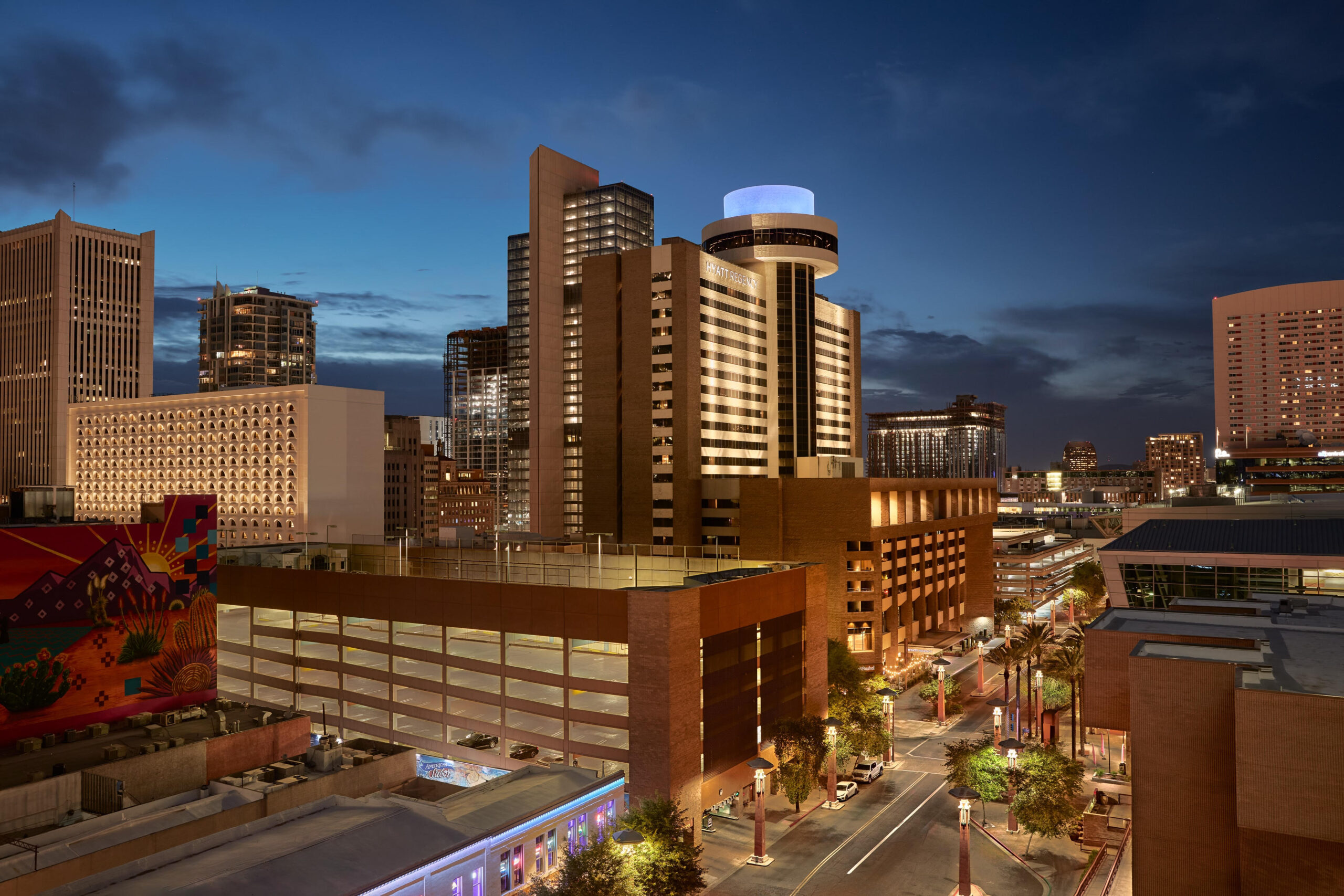
The Hyatt Regency Phoenix Marks 50 Years Above a City It Helped Build
Writer Shannon Severson // Photography Courtesy Hyatt Regency Phoenix
High above the Phoenix skyline, a dining room turns. It completes one full rotation every hour — a slow, steady circuit that has been tracking the city’s transformation since 1976. From The Compass atop the Hyatt Regency Phoenix, mountain ridgelines appear and recede, freeways unspool toward distant suburbs, and the towers that now populate its sightlines — arenas, office blocks, residential high-rises that were unimaginable when these windows first faced an open desert sky — glide past like a film reel that never reaches its end. At golden hour, amber light crosses warm wood tabletops and glass stemware. The view has changed. The room turns on.
The Compass is among the few remaining rotating restaurants in the United States, and it has had a bird’s-eye view of Phoenix for 50 years.
Jerry Herschede was there from the first day it opened. The recently retired food server, who spent her entire career at The Compass, still recalls employees donning cowboy hats and bandanas as the curtain rose on a business that never closes.
“People were scurrying around in preparation for the grand opening and our first big convention, The American National Cattlemen’s Association,” she recalls. The personality of this landmark, she adds, is “one of caring and concern for all — providing a place to feel safe and welcome.”
On the day it opened, the hotel was one of the tallest structures in a city that still had more cotton fields than skyscrapers on its periphery. Its spare geometry — angular concrete and glass, Brutalist in its structural honesty — was met with some public derision at the time. The building carries notable architectural pedigree: it was designed by Charles Luckman and Associates, the midcentury firm behind New York City’s Madison Square Garden and, closer to home, the original Phoenix Civic Plaza and Symphony Hall in 1972, and the 27-story First National Bank building, now Wells Fargo Plaza.
“Our guests frequently mention how much they enjoy the unique design and architecture of our hotel,” says Eric Fink, the general manager. “They love that it is such a recognizable landmark in the city skyline. As you ride the glass elevators up floor by floor, the desert landscape recedes and surrounding buildings shrink; then you step into The Compass. It really is an experience in itself — it brings on a sense of discovery.”
More than an architectural statement, the hotel was a calculated civic bet — a necessary addition to attract convention traffic to what was then a sparse, unfinished downtown. Over the years, its ballrooms and boardrooms became home to wedding parties, symphony fundraisers and visiting delegations, helping make downtown Phoenix a viable destination. By 1980, Phoenix had grown to the ninth-largest city in the country, pulling high-rise office and residential towers, shopping, entertainment and sports venues in its wake.
“When you look back to 1976 and see what the downtown area has become today, we are very proud to know that we played a large role in the expansion of this city,” Fink says. “As new development expands and larger or taller structures continue to surround us, we remain at the epicenter of it all and have become a central gathering place for the community. The city has grown up around us and we have grown with it.”
Herschede has watched much of that growth from the same vantage point — the proliferation of towers, the pedestrians filling streets that once emptied at sundown.
“Downtown finally feels like a big city; there’s lots more hustle and bustle,” she observes. “What feels the same is definitely the elevators and always the view — even though buildings block some of what was once unobstructed.”
A standout memory: the hotel’s role as a hub during the first Super Bowl held in the Phoenix area in 1996.
To mark its golden anniversary, the hotel’s team dug into the archives — unearthing the original handwritten guest registry from the Cattlemen’s Association, colorful brochures promising “a full city block of excitement,” and photographs of a massive brass sunburst suspended above purple and red lounge couches in the atrium, employees outfitted in sunset-hued uniforms of yellow, orange and red.
The details that surface from those archives are small but illuminating. Newspaper clippings describe civic gatherings of the city’s movers and shakers; old menus list appetizers and entrées in tones both formal and faintly Midwestern — Quiche Lorraine at $3.95, prime rib with Yorkshire pudding at $15.95. Typefaces and prices now read like artifacts of another era.
“I think celebrating this incredible milestone has given us the opportunity to look back over the past half-century to see how far we have come and to lean into our history more, so we can connect our guests to the place through storytelling,” Fink says.
Some of that storytelling is edible. Items that longtime guests have requested for decades — creamy eggplant bisque topped with shrimp, orange cornbread with smoked honey butter — have returned to the menu for the anniversary, sharing space with a contemporary selection: Arizona-sourced ribeye, coffee-rubbed duck breast, burrata and whipped ricotta with pistachios and honey, alongside Phoenix’s own Noble bread.
Just as the menu has evolved, so has the city beyond those windows. Brutalism, once dismissed as cold and institutional, is now the subject of preservation campaigns and design retrospectives — the same aesthetic that made the Hyatt unfashionable for two decades now makes it relevant again. The hotel remains central to downtown’s economic choreography, its proximity to the convention center, stadium, shopping and arts venues placing it at the intersection of whatever Phoenix is becoming next.
“Our guests continue to enjoy the iconic Compass,” Herschede says. “The stories that live there are the stories of our guests over the years — who’ve celebrated many special occasions in their lives.”
After 50 years, she knows those stories as well as anyone.
“This landmark was my second home for 50 years,” she continues. “It makes me feel proud and so honored to be able to say it. I was blessed to work here and the memories I’ve made will be with me forever.”