‘undertone’ Review
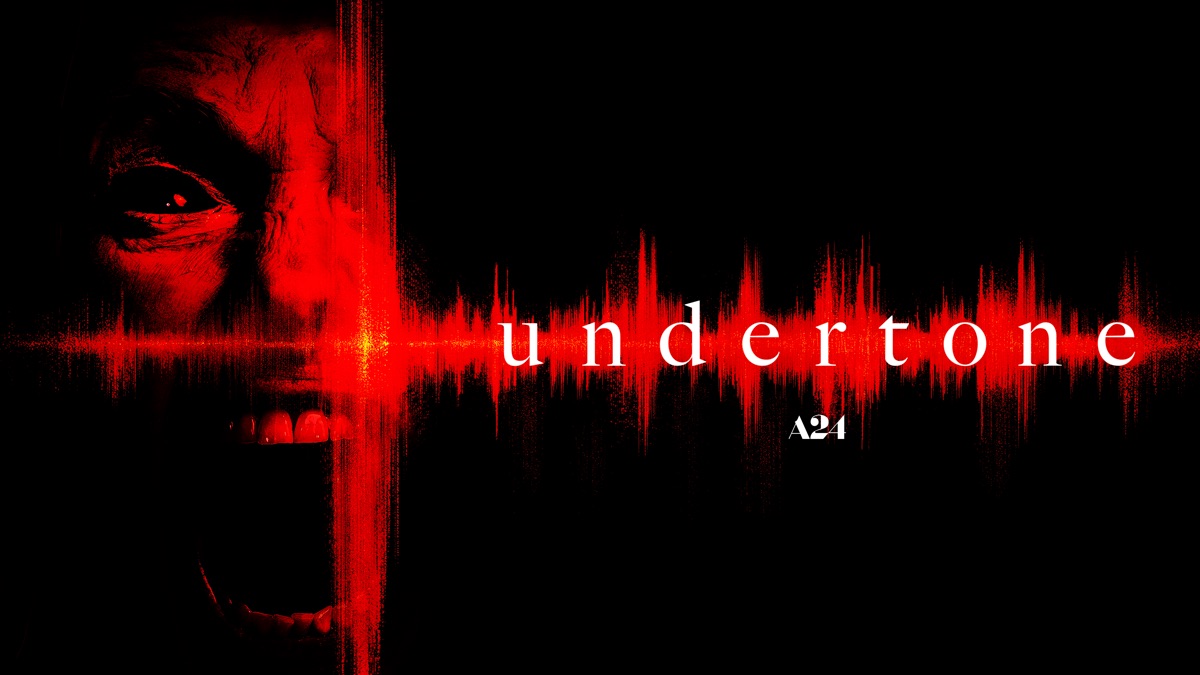
A24’s Sound-Forward Chiller Impresses the Ears, Leaves the Mind Wanting
Writer Joseph J. Airdo // Phoenix Film Critics Society
There’s a moment early in “undertone” — A24’s new atmospheric horror from debut feature director Ian Tuason — when protagonist Evy Babic sits alone at a dining room table at 3 a.m., laptop glowing, headphones clamped over her ears, listening to something the audience cannot fully decode. Her mother is dying upstairs. The house breathes around her. Something — possibly imaginary, possibly not — is getting closer. And the sound is coming from behind you.
That moment is the film. Everything “undertone” does well, it does in that scene: the spatial dread, the suffocating intimacy, the horror of a home that was once safe, and the way grief and fear are, at their core, the same animal wearing different coats.
The story, such as it is, follows Evy (Nina Kiri), host of a paranormal podcast, as she caregivers for her comatose mother in her childhood home while analyzing a series of deeply unsettling audio files submitted anonymously to the show. The files document a pregnant couple besieged by malevolent forces. Evy is a skeptic. Her remote co-host Justin (Adam DiMarco, voice only) is a believer. As Evy digs deeper, the files begin seeping into her reality — or she begins unraveling. The film, to its credit, is never entirely sure which.
Tuason arrived at this project through genuine personal trauma. He wrote the screenplay while caregiving for both parents in his Toronto childhood home — where the film was also shot — his mother dying within months of the pandemic’s onset, his father two and a half years later. That authenticity shows. The caregiving horror at the center of “undertone” registers with uncommon emotional weight because it doesn’t ask you to imagine an unlikely scenario — it asks you to imagine something you will almost certainly experience yourself one day and, until you do, cannot fully fathom. The eeriness of being trapped in a familiar house with someone you love who is actively leaving it: Tuason captures this precisely, and it is the film’s most genuinely frightening element.
The trouble is that “undertone” doesn’t fully trust this premise to carry the weight of a feature film on its own. So it adds more: a surprise pregnancy. A recovery from alcoholism. An escalating Catholic iconography that, while atmospheric, treads ground that “Hereditary,” “Midsommar” and their A24 cousins have already covered — and covered, in most cases, with sharper thematic focus. The film tries to say too many things for a work this contained. What is “undertone” ultimately about? It has a strong answer to that question when it’s discussing grief and the particular horror of caregiving. When it pivots to faith, motherhood and addiction simultaneously, the answer blurs.
Kiri, for her part, is exceptional. She carries approximately 90% of the film’s screen time alone, and does so with the kind of committed, internally consistent work that makes you forget you’re watching a performance. Her transition from skeptic to believer feels earned rather than convenient, and the film’s emotional through-line survives largely on the strength of her face in close-up.
The audio files she’s analyzing, however, present a different challenge. The deliberate murkiness — distorted nursery rhymes played backward, cryptic fragments from the besieged couple — is intentional and, atmospherically, effective. But there are moments when the obscurity tips from eerie into frustrating. You want to rewind. You want to hear what the podcasters are hearing, to follow the clues alongside them. That impulse is the film working exactly as designed — but it also creates occasional friction with a narrative that’s already asking for considerable patience. DiMarco’s Justin, meanwhile, doesn’t quite land. The voice performance reads as pushed rather than natural, which creates an odd imbalance against Kiri’s grounded work.
None of this is to say “undertone” fails. It doesn’t. As an experiential film — and that’s the right word for it — it succeeds emphatically. The Dolby Atmos sound design is the best argument for theatrical-only cinema since “Mad Max: Fury Road.” Sound designer Dane Kelly’s work, expanded in post-production by David Gertsman, turns the auditorium into the Babic home, and if you’re seated correctly, the film does exactly what Tuason promises: you stop watching and start listening. The final act earns genuine heart-rate elevation, the kind that requires no CGI assist and no jump-scare apparatus — only the creeping conviction that something is in the room with Evy, and therefore with you.
The problem is that the fear doesn’t follow you to the parking lot. “The Blair Witch Project” — perhaps the most accurate comparison in the critical record — lingered for days, its woods-and-documentary conceit burrowing under the skin long after the credits rolled. “undertone” is inventive in similar ways, experiential in similar ways, and earns comparison to that film for exactly those qualities. But where “Blair Witch” left an itch that couldn’t be scratched, “undertone” is more likely to leave you admiring the craftsmanship than sleeping with the lights on.
Tuason is, clearly, a filmmaker worth watching. The ambition and technical ingenuity on display here are genuine, and “undertone” holds its place in the current A24 horror ecosystem through sheer formal inventiveness rather than any sense of derivativeness. For horror fans, this is required theatrical viewing — not because the story demands a large screen, but because the sound design demands a sound system you are not going to have at home, and because experiencing the film in an audience, in the dark, in Dolby Atmos is precisely what the film is built to do. See it in theaters. Bring patience and good ears.
Just don’t expect to think about it much on the drive home.