

A Stitch in Time
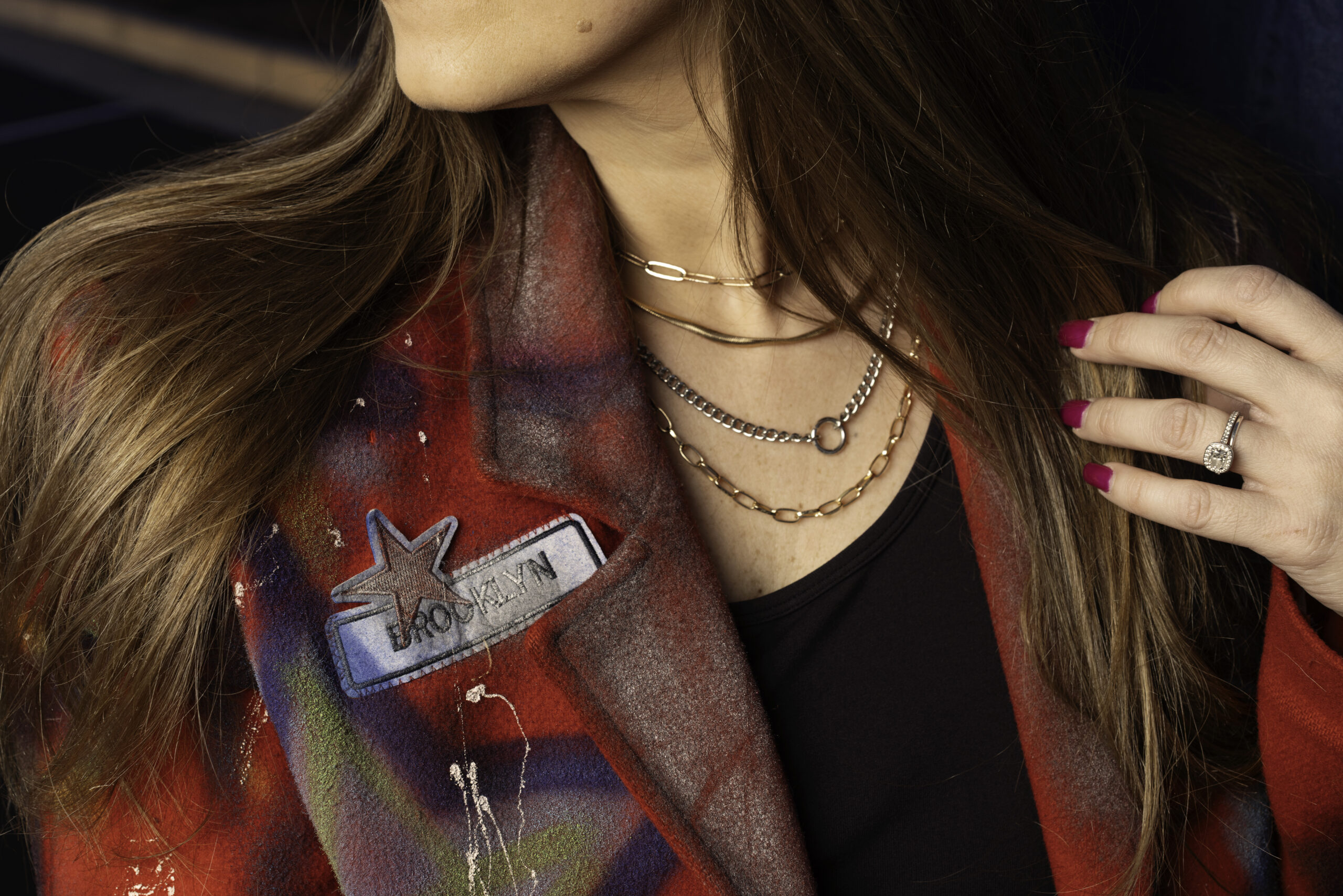
Amanda Jacobs Transforms Forgotten Fabrics Into One-of-a-Kind Couture
Writer Joseph J. Airdo // Photography by Loralei Lazurek
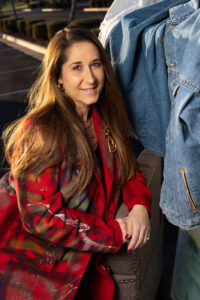
Amanda Jacobs can edit a Goodwill in 15 minutes flat. Her fingers glide across polyester blends and cotton twills with the practiced discernment of someone who once handled $3,000 jackets at Saks Fifth Avenue — feeling for quality in the seams, searching for the weight of well-made garments hiding among the castoffs.
It’s a hunt, really. And in the nearly 10 years since she moved from New York to Anthem, Jacobs has turned this peculiar talent into something extraordinary: Classic Reclaim, a sustainable fashion venture that transforms overlooked vintage pieces and cherished family heirlooms into one-of-a-kind couture.
“I’m a sucker for a coat — long, big, heavy, I love it,” Jacobs says, laughing at herself. “When you’re from New York, you wear those things for months. You need them to survive. Here? Not so much. Here it’s like a week of sweater weather, you know?”
It’s this collision of worlds — Old World craftsmanship learned at age 6 from a designer aunt, refined through a bachelor’s degree in textiles from West Virginia University, sharpened in the personal shopping club at Saks, and now reimagined in the Arizona desert — that gives Classic Reclaim its distinctive aesthetic. Jacobs calls it “classic, street and clean.” Her clients might call it magic: the way she can pull apart a mother’s wedding dress and merge it with a modern gown, preserving memory while creating something entirely new.
The story of how Jacobs arrived in Anthem reads like a love letter to suburban discovery. After college, she followed her Arizona-native husband west, landing first near State Farm Stadium before family expansion necessitated more space. A drive to visit in-laws in New River led to an exploratory detour through Anthem that changed everything.
“We just fell in love with it,” Jacobs recalls. “The community center was amazing, and we found this incredible house with a pool and a giant backyard — so much space for everybody, including our huge Lab. It felt so good and so right. We looked at each other and said, ‘Oh my God, our kids are going to have such a good time here.’”
For someone raised in a small suburb outside New York City, Anthem offered something familiar yet distinctly southwestern: that close-knit neighborhood feel, the sense of community love, a major high school anchoring local life. Nearly a decade later, married with three children who attend Anthem Elementary, Jacobs has woven herself into the fabric of the community — quite literally.
She teaches Fashion Design and Operations as a career and technical education course at Maryvale High School in the Phoenix Union High School District, now in her 12th year. And on Saturday mornings, you’ll find her at the Anthem Community Center, leading sewing classes for kids, adults, and soon, private one-on-one sessions.
“I think if I can offer what I do and what I love to our community, that’s huge,” Jacobs says. “We have a lot of homeschool students who would love to learn this skill. ‘Skills pay bills’ is our motto here. You can learn to sew and build a business out of it — start doing alterations, redesigning like I do, and put pieces back out there for people.”
But it’s the transformation work — the reclaiming — where Jacobs’ particular genius shines. Her process defies rigid planning. She starts with intention, then surrenders to what the garment reveals.
“I start out thinking, ‘Maybe I’m going to do this,’ or ‘This is what the fabric will let me do,’” Jacobs explains. “But as soon as I begin to open it up or cut into it, something else might present itself — out of necessity or just from the design revealing itself. I always allow the piece to take me on that journey.”
One project crystallizes this philosophy. A friend preparing for her wedding wanted to honor her mother by incorporating the maternal wedding dress, but the fit and silhouette weren’t right. Jacobs saw possibility where others might have seen an impasse.
“We were able to pull parts of her mother’s dress and redesign it to give her the silhouette she wanted — one that fit her body,” Jacobs says. “Everyone’s body is different, so you can’t really put two people in the same dress, even if it’s your mom’s and she wants you to.”
The solution? Merge the new dress with the heirloom, pulling different components from each. They kept it secret until the family fitting.
“Her mom kept saying, ‘That’s so weird — that looks like the detail from my wedding dress.’ Then, ‘Wait, I also have that little thing on the side.’ And then she realized: ‘Oh my gosh, is that my dress? Are those parts of my dress?’ We had pulled them out and combined them to create something unique and one of a kind. It was really, really special.”
For Jacobs, this isn’t merely clever tailoring. It’s about understanding that memory lives in fabric — an admittedly esoteric concept she acknowledges, but one that explains why people struggle to discard clothes they’ll never wear again.
“I feel like memories are kind of absorbed into the fabric. They get held there,” she says. “That’s why so many people have a hard time throwing out clothes they’ll never wear again. It’s the memory they can’t let go of, whether it’s of a person or an experience they had while wearing it. Being able to continue that memory is really meaningful. Now the piece gets to create new memories and new experiences. The life of the garment continues on.”
This philosophical approach is grounded in exceptional technical skill — a distinction Jacobs emphasizes when differentiating her work from craft projects.
“I think a lot of it is execution,” she says. “I love to teach design and fashion, and I love to teach people how to sew, because if you can acquire those skills and really master them, your work won’t look homemade — it will look professionally put together. People will look at your seams and they’ll look identical to manufactured seams. So I really think it comes down to education.”
Her nearly decade-long tenure at Saks Fifth Avenue proved transformative in this regard. Surrounded by exquisitely constructed garments she couldn’t afford on an early 20s retail salary, Jacobs studied the seams, analyzed construction, and taught herself to replicate that quality by thrifting well-made pieces and redesigning them.
“I had to use my skills to look the part without having the money to buy all those nice clothes,” she recalls. “At the time, I didn’t realize what was happening, but looking back now, I understand that I developed a really strong handle on how things should be put together — how well-made garments are sewn, what they should look like when they’re finished. You don’t find that quality at all with fast fashion pieces. They’re just slapped together crazy fast, and the quality isn’t there.”
When scouting at thrift stores throughout Anthem and North Scottsdale, Jacobs relies on this educated touch. She gravitates toward quality indicators: sturdy buttons, well-constructed zippers, certain labels, items marked “Made in Italy.” But she also thinks laterally, scanning sections most shoppers ignore.
“I always go to linens and bedding and obscure things like curtains, shower curtains and pillowcases — because all that is, is just fabric,” she explains. “Yards of fabric, however much you need and can use.”
Her favorite fabric? Lace. The trend she’s happily embraced? Wide-leg pants, a respite from skinny jeans. And the one that got away? An incredible blanket-like jacket covered in colorful fringe — talked out of buying it by a skeptical friend, it haunts her still.
“If I ever see it again, I’m buying it, no questions asked,” Jacobs declares. “Fringe is so in now, too.”
The Arizona climate initially challenged her New York-trained instincts for layering and structure.
“When I first came here, I was like, ‘Why is everyone half-naked?’ I like clothes. I like to wear clothing. And then summer hit and I was like, ‘OK, now I understand why everyone’s wearing a T-shirt and shorts,’” she says, laughing.
Even now, she admits to keeping eight jackets in her car, peeling them off throughout temperature-swinging days.
But it’s in her classroom at Maryvale High School where Jacobs sees the most reason for optimism about fashion’s future. Her classes stay full with waiting lists, and what she observes in her students gives her hope.
“I actually think this generation is going to save fashion,” Jacobs says with conviction. “They’re rejecting fast fashion. They don’t want to look like everybody else — which, weirdly, in the 1990s and 2000s was probably something you had to strive for. But they have such a great, unique take on their own individual style. And they’re environmentally conscious. They know what’s going on.”
She emphasizes the sustainable side of fashion in her curriculum, pushing students to understand the full lifecycle and ethics of their clothing.
“If you love fashion, you should care about how it was made, who got paid for it, how the business operates. You should care about that stuff. Don’t just go blindly buying at the mall,” she tells them.
Every year, her students create pieces for a fashion show — but not with virgin fabric from bolts.
“I’m like, ‘Let’s go get some clothes. Let’s rip this up. Let’s change things. Let’s use those skills in a better way.’ Because that’s definitely the way everybody should go,” she says.
Beyond teaching, Jacobs continues expanding Classic Reclaim’s presence in Arizona’s sustainable fashion community. She recently showcased four pieces at Phoenix Fashion Week’s October event and collaborated with Fabric, a Tempe-based small-batch manufacturing facility supporting emerging designers. She’s eyeing spring events including Latino Fashion Week and Arizona Fashion Week, drawing support from organizations like Arizona Sustainable Fashion, The Garment League and advocate Laura Madden.
For readers inspired to view their own closets through a reclaiming lens, Jacobs offers straightforward advice: Have a conversation with yourself about why certain pieces remain unworn. Is it memory? Is there something wearable hidden in the garment? What specifically don’t you like — sleeves? Length? Then address that specific issue.
“I think when you have an event coming up or something to do, your first thought is never to go to your closet,” Jacobs observes. “Your first thought is: I want something new, something different, something fresh that I haven’t worn or taken pictures in. But I think the first question should be, ‘OK, what do I have in my closet?’ And then, out of those things that I like, is there something I can change so I can wear it, but it looks different? That’s better than going to the mall and buying something cheap, maybe just for one wear.”
For clients seeking more hands-on guidance, Jacobs offers closet editing services — visiting homes to evaluate existing wardrobes, performing simple alterations, and identifying redesign opportunities. It’s personal styling meets sustainable fashion meets memory preservation, all filtered through the eye of someone who learned to see quality in a Saks Fifth Avenue stockroom and translate it to the desert.
Nearly a decade into her Anthem life, with three kids playing sports across the community and Saturday mornings spent teaching neighbors to sew, Jacobs has found her rhythm in this sun-scorched landscape so different from her New York origins. Classic Reclaim has become more than a business — it’s a philosophy of continuation, of honoring what came before while creating what comes next, one reclaimed seam at a time.
“Bringing my skills and education to our small community in Anthem is very important to me,” Jacobs reflects. “I’ve just fallen in love with it and I really want to teach more people here.”
The life of the garment continues. And in Jacobs’ capable hands, so do the memories woven within.