

Driving Change
Arizona Golf’s New Collaborative Hub Tees Up Unprecedented Unity
Writer Joseph J. Airdo // Photography by Loralei Lazurek
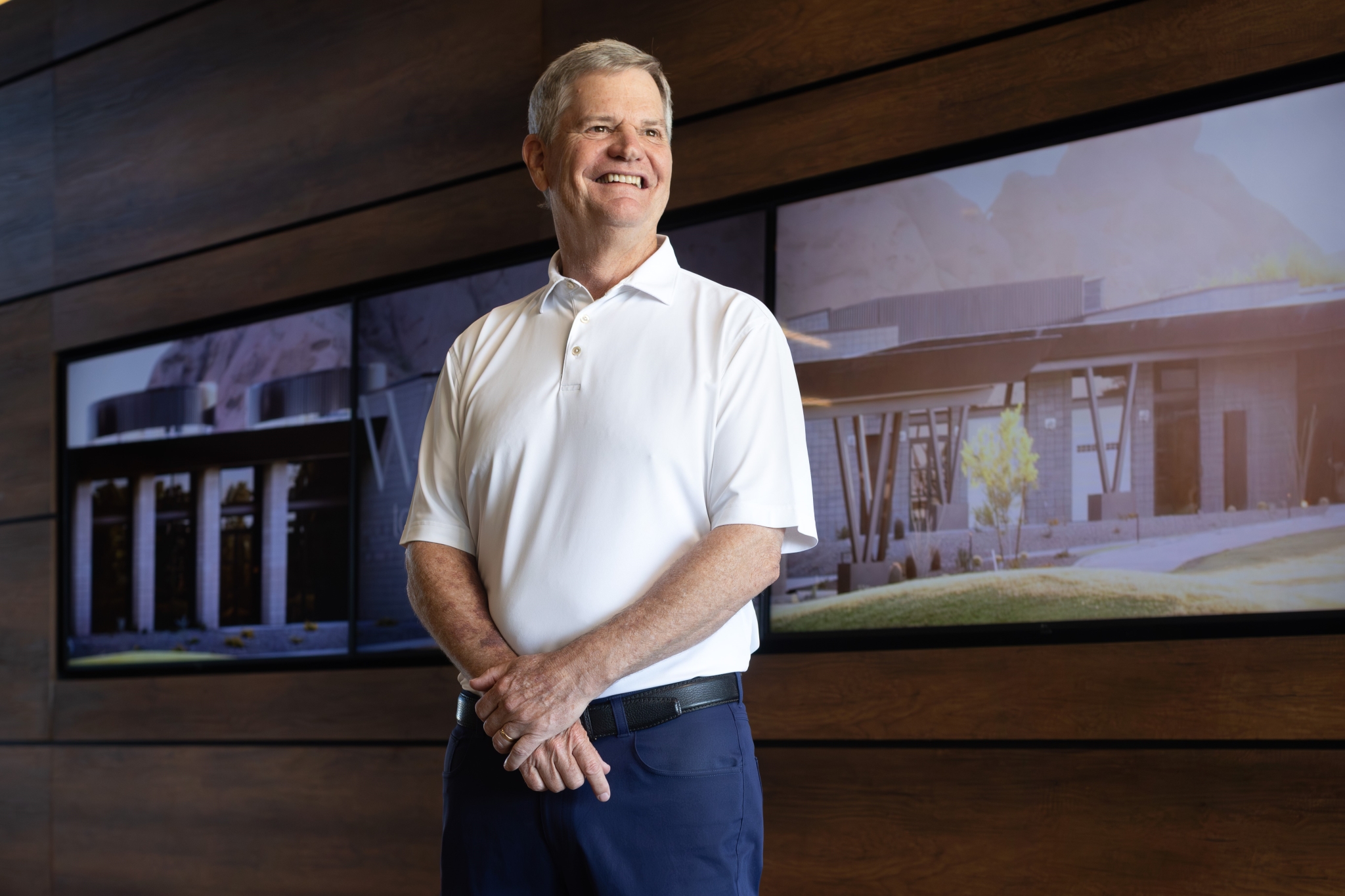
When Gregg Tryhus was first asked to help envision relocating Arizona State University’s golf teams from Karsten Golf Course to Papago, he saw more than just a new practice facility. He glimpsed the future of Arizona golf itself — a future where collaboration trumps competition, where nonprofits share resources instead of siloing them, and where the state’s $6 billion golf industry speaks with a unified voice.
That vision became reality this fall, when the Arizona Golf House officially opened its doors at Papago Golf Club, becoming the nation’s first collaborative hub uniting the state’s leading golf nonprofits under one roof.
“Gov. Doug Ducey told me, ‘If golf isn’t organized at the table, it’ll end up on the menu,’” Tryhus recalls, explaining the catalyst that transformed his initial vision into something far more ambitious than a simple office building. “That led to the formation of the Arizona Alliance for Golf — uniting nonprofits and private organizations to advocate for golf.”
The stakes, as Tryhus knows intimately, are higher than most Arizonans realize. Golf’s annual water usage comprises less than 2% of the state’s total, while agriculture accounts for more than 70%. Yet when water restrictions loom, it’s often golf courses that face scrutiny. Agriculture generates $23 billion in economic impact; golf generates $6 billion. Neither figure includes property taxes, real estate absorption, hotel stays, or the presence of 700,000 golfers calling Arizona home.
“We didn’t need to reinvent what already existed,” Tryhus says. “We just needed to amplify it, improve messaging and show people how they can participate.”
The 11 major nonprofits now headquartered at the 14,000-square-foot facility represent Arizona’s golf ecosystem writ large. The Arizona Golf House tenant list reads like a comprehensive directory of the state’s golf community: Arizona Alliance for Golf, AZ Caddie and Leadership Academy, AZ GOLF, Cactus and Pine Golf Course Superintendents Association, Evans Scholars Foundation, First Tee – Phoenix, Greater Southwest Club Management Association of America, Junior Golf Association of Arizona, LPGA*USGA Girls Golf – Phoenix, Southwest PGA, and Youth on Course.
For Tryhus, who spent six years volunteering with ASU’s athletic department helping restructure the Sun Devil Club, the journey to this moment required patience and strategic partnerships. When Michael Crow asked him to help relocate the university’s golf teams, an innovative partnership between ASU, the City of Phoenix, and the Arizona Golf Community Foundation was formed, with Tryhus positioning himself as a third-party link between public and private sectors.
“Phoenix leased Papago to ASU, which assigned it to the foundation, with ASU — under Dr. Morgan Olsen and his team — keeping asset management and oversight rights,” Tryhus explains. “From there, with a significant gift from the Grubb Foundation, we developed what’s now Lou’s Bar & Grill — a highly successful community restaurant. We created Evie’s Pavilion, a versatile meeting space, and secured a state-of-the-art facility for the ASU teams and improved the golf course.”
Early planning considered a traditional office building with enclosed suites, but budget and timeline constraints prevented that vision from materializing within the three-year construction window. In hindsight, Tryhus says, the delay proved fortuitous.
“Not building that old-fashioned office building turned out to be lucky, especially given the shift in the last six to eight years toward collaborative workspaces,” he reflects. “Instead of sectioned-off offices with walls, Golf House is designed for open communication — people sit next to one another, and collaboration happens naturally.”
The architectural philosophy, designed by Douglas Fredrikson Architects, built by Wespac Construction and overseen by ASU’s architecture and construction teams, between June 2024 and May 2025, reflects what Tryhus calls “moderately spartan” luxury.
“There are glass garage doors that open to bring the outdoors in, along with straightforward heating and air-conditioning systems,” Tryhus says. “The facility features a public area that anyone can rent for events, as well as a boardroom available for private functions.”
This revenue-generating public space serves a crucial function: it allows the Arizona Golf House to avoid charging rent or operating expenses to the nonprofit tenants working in the back of the building. The design intentionally blends public gathering areas with private tenant spaces that remain connected and accessible — a physical manifestation of the collaborative spirit Tryhus envisioned from the start.
“Because of this setup, people are already talking, sharing ideas, and working together,” he notes. “Scheduling conflicts are easier to avoid, and the ability to walk down the hall and, for example, ask someone for help with the AZ Caddie program or get data on how many First Tee kids live in a certain part of town becomes effortless.”
The collaboration extends beyond daily operations. Katie Prendergast, executive director of the Arizona Alliance for Golf, oversees all implementation efforts and a board featuring influential leaders including Visit Phoenix President and CEO Ron Price, Arizona Lodging and Tourism President and CEO Kim Sabow, and Experience Scottsdale President and CEO Rachel Sacco.
“We’re not just delivering hospitality day to day but working alongside people who shape that industry,” Tryhus says. “Now, the very individuals who lead these major organizations are active members of the Arizona Alliance board. They realize that golf is deeply embedded in the heart of Arizona’s hospitality network.”
The interconnected ecosystem Tryhus has built extends beyond the Golf House itself. He describes four overlapping circles: Papago, the Alliance, Golf House, and the Arizona Golf Fund — a philanthropic vehicle established through the $2.1 billion Arizona Community Foundation, founded by Bert Getz.
“With Katie and Jock Holiman, we’ve created a website and portal for the Arizona Golf Fund, providing those who want to give back a clear pathway to help protect and grow the game by helping the nonprofits serve Arizona on an even larger scale,” Tryhus explains.
The Arizona Golf House’s impact on youth programming particularly animates Tryhus. The resident nonprofits collectively reach more than 150,000 kids annually through various mentorship and educational programs — a figure most Arizonans don’t realize.
“Whether it’s your daughter or son who wants to get involved — become a junior caddie, join First Tee, or try any other program — all the opportunities are accessible there,” he says. “It used to be difficult to find and connect with these nonprofits; now, they’re centralized.”
For Tryhus, the mission transcends golf instruction. It’s about instilling values.
“If we teach kids to finish what they start, play it as it lies, handle their challenges and treat others with respect, the game can truly shape their futures in positive ways,” he says. “That’s the real mission.”
Looking ahead, the Arizona Golf House is designed to become a center for workforce development, offering real-world training, internships, and career placement in golf, hospitality, tourism, and philanthropy. The facility will also serve as a research hub, collaborating with Arizona State University, University of Arizona, Grand Canyon University, and Northern Arizona University on projects ranging from drought-tolerant grass strains to improved water-use efficiency.
Several tenant organizations already maintain robust internship programs. AZ GOLF regularly recruits interns. The Club Management Association of America Southwest Chapter partners with Northern Arizona University and other local higher education institutions. The Junior Golf Association of Arizona trains ASU interns each summer, and First Tee – Phoenix recently welcomed its first ASU intern with plans to expand.
“Arizona probably has the most sophisticated statewide irrigation systems in the country — because we have to,” Tryhus notes, addressing the sustainability concerns that prompted the Alliance’s formation. “Water here is extremely expensive.”
He cites Gov. Bruce Babbitt’s “brilliant” 1986 decision to cap golf courses at just 90 acres of turf — a strict limitation requiring careful site selection and responsible management.
“We never overwater,” Tryhus emphasizes. “In fact, we’re laser-focused on figuring out how to use less water for grass and actively reducing our turf footprint. We’re continuously removing grass and making every effort to be responsible stewards of our water resources.”
But sustainability, in Tryhus’ view, encompasses more than agronomy and research efforts. It means workforce development, helping people find meaningful careers, and protecting the industry that supports 66,000 jobs across Arizona. It also means Papago, managed daily by Daryl Crawford and Mike Conner of Troon, needed to be designed and operated as the sustainable and profitable business it has become.
“Perhaps most importantly, sustainability to me also means safeguarding the values the game brings: economic impact, integrity, respect, all of it,” Tryhus says. “By allowing all these elements to work together — environmental, economic and social — we’re supporting the values that shape our way of life.”
The choice of Papago Golf Club as the site carries symbolic weight. As a public and municipal facility, it represents golf’s democratic promise — affordability and accessibility for everyone, regardless of economic status.
“I believe the Alliance’s role is to protect the game, which has always been a significant part of my life,” Tryhus reflects. “When I was given the opportunity to help move the ASU teams to Papago, I saw the chance to help Papago become what it was meant to be — a place where golf is accessible to everyone. Once you establish that, no one can take it away because it’s a public facility. It’s not the kind of place someone can just sell out from under you, and that’s what made the effort worthwhile for me.”
Having worked in Arizona’s golf industry for more than 30 years, Tryhus leveraged deep relationships to bring the Golf House vision to fruition. Those same relationships now populate the Alliance board and tenant organizations, creating an interconnected network poised to amplify golf’s impact across the state.
The Alliance’s tagline — “Golf is good for everyone” — was created by Mike Petty, who has been involved with Tryhus from the beginning. It reflects their shared belief that the game’s benefits extend far beyond those who play it. Property values increase in golf communities. Heat island effects diminish where courses provide tree canopy and green space. Charitable fundraising flows through golf tournaments, generating more than $100 million annually for Arizona nonprofits. The WM Phoenix Open alone, hosted by the Thunderbirds at TPC Scottsdale, has raised $110 million for Arizona charities since 2012.
“It’s not just about golfers — the benefits extend to nongolfers in a very real way,” Tryhus insists.
As the Arizona Golf House enters its operational phase, Tryhus sees his role shifting from visionary to facilitator to cheerleader. The infrastructure is built. The partnerships are forged. The nonprofits are collaborating daily under one roof. Now comes the work of maximizing that collaborative advantage.
“What’s next is for the tenants to take this as far as they can in the Arizona golf world,” he says. “Golfers will continue to give their time, money and advocacy to help protect the game. The system is in place.”
His vision for long-term impact is both ambitious and pragmatic: if each of Arizona’s 700,000 golfers learns the industry’s economic and environmental statistics, they become advocates — at home, in coffee shops, on golf courses with friends. Golfers have always served as mentors to kids. The possibilities for positive impact multiply exponentially.
“With 700,000 golfers in Arizona, the possibilities for making a positive impact on the quality of life for everyone are endless,” Tryhus says.
Standing at Papago Golf Club, where the Sonoran Desert landscape frames perfectly manicured fairways and the new Arizona Golf House gleams in the afternoon sun, Tryhus’ vision feels both realized and just beginning. The building is complete. The organizations are collaborating. The foundation is laid.
What happens next depends on how Arizona’s golf community embraces the opportunity Tryhus has created — not just to play the game, but to protect it, grow it and ensure its values shape future generations.
“I truly believe that,” Tryhus says, returning to the Alliance’s central message. “Golf is good for everyone.”