

Guardians of the Hills
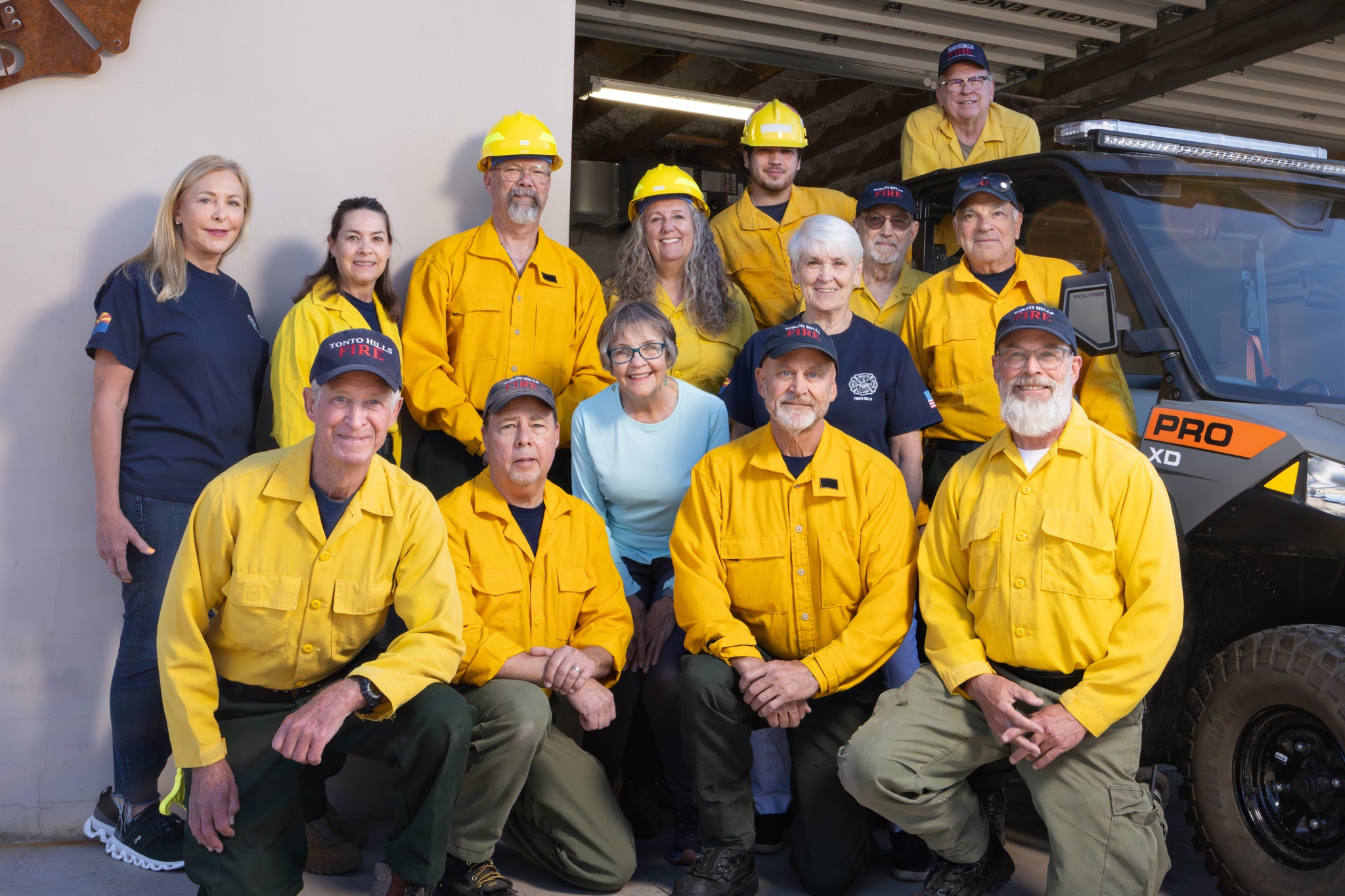
Volunteers Fight Fire with Heart
Writer Joseph J. Airdo // Photography by Loralei Lazurek
The radio crackles at 2 a.m. Lightning has struck somewhere in the Tonto Hills, and with gusting winds fanning the flames, what starts as a flicker can become an inferno in minutes. In this exclusive desert enclave — where 150 homes nestle against 7.9 million acres of Tonto National Forest — the difference between a contained brush fire and a catastrophic wildfire often comes down to 3–8 minutes.
That’s how long it takes the Tonto Hills Volunteer Fire Department, under the leadership of Fire Chief Rick Holasek, to get water on a fire.
“When you’re facing an actual wildfire, you want to know there’s something in place to protect you,” says Ann DiChiara, administrative president and fundraiser for the nonprofit, all-volunteer department and a recently retired neonatal intensive care nurse from HonorHealth. “Right now, we only have one truck. When those winds pick up and flames are 10 feet or 20 feet high, it’s a whole different situation. That’s when you realize: We really need some serious power out here.”
It’s a sobering assessment from a woman who has spent two decades serving her community — first as a firefighter, now as a leader and organizer. But DiChiara isn’t sounding an alarm; she’s rallying support for a critical mission that extends far beyond Tonto Hills’ borders.
A Legacy Built on Neighborly Commitment
The Tonto Hills Volunteer Fire Department traces its origins to 2000, when residents Lou Frederick and Ed Voss recognized the isolation their small community faced. With emergency response times stretching 18 to 22 minutes from the nearest station, these early pioneers embodied what Scott Bell, retired captain and training officer, calls “classic cowboy mentality.”
“Lou’s philosophy was simple: when a neighbor needs help, we’ll be there,” says Bell, who spent nearly 20 years volunteering with the department while simultaneously serving as a Southwest Airlines captain. “It wasn’t just about fire emergencies — we ended up getting to know our neighbors extremely well. We all came from different backgrounds and had various opinions and beliefs, but when someone needed help, everyone came together.”
That ethos remains the department’s foundation. Whether it’s rattlesnake removal, medical emergencies, or searching for a neighbor with Alzheimer’s who wandered from home, THVFD volunteers respond to whatever their community needs. They’ve installed AED machines throughout the neighborhood — some purchased by residents themselves — because a 15-minute response time for chest pain is simply too long. They’ve trained in wilderness first responder techniques along with wildland firefighting protocols to bridge the gap until Rural Metro arrives. They’ve even mastered the art of convincing stubborn neighbors to actually get into ambulances.
“There was one neighbor who fell down a 60-foot ravine behind her house,” Bell recalls. “She managed to crawl back up in the dark, but she had severe head contusions. She was actually unbuckling herself from the stretcher in the ambulance and pulling out her IVs, trying to leave because she was afraid nobody would come pick her up from the hospital. Bell said, ‘Don’t worry — I’ll come get you.’”
These kinds of moments — intimate, urgent, fundamentally human — define what it means to be a volunteer firefighter in one of Arizona’s most exclusive communities. The department’s 20-plus volunteers don’t just protect property; they safeguard the lives and wellbeing of neighbors who have become friends.
Living on the Edge of Wildfire
Geography makes Tonto Hills particularly vulnerable. The community sits at the wildland-urban interface, bordered by Tonto National Forest to the north and Desert Mountain to the south. When the Cave Creek Complex Fire roared through the area in 2005, burning 248,000 acres, THVFD volunteers stood alongside their mutual aid partners holding the fireline as planes dropped fire retardant slurry nearby.
“The only thing that saved us was a change in the wind and a rainstorm at 3 a.m.,” Bell says. “If that hadn’t happened, our community and the community of Desert Mountain could have been lost.”
That near-miss galvanized the community. In 2021, Tonto Hills achieved Firewise community designation, and the fire department now proactively visits homes — especially those of new property owners — to offer guidance on creating defensible space and fire-safe landscaping. DiChiara, who helps welcome new residents through an informal committee, provides information packets emphasizing the importance of clearing at least 30 feet around homes.
“Homeowners often reach out to us to ask if their property looks safe, and the fire department is happy to offer advice,” DiChiara says. “We really work well as a community when it comes to fire mitigation. Everyone is engaged and willing to help, which makes all the difference here.”
But community engagement, while essential, cannot compensate for inadequate equipment.
The department currently operates with one dependable brush truck — a 2007 vehicle on long-term loan from the U.S. Forest Service. When THVFD received it in 2017, the diesel turbocharger was out, the transmission wasn’t working, and it needed significant repairs.
The truck carries 300 gallons of water — not much by structural firefighting standards, but critical for initial attack on brush fires. Combined with the team’s intimate knowledge of local terrain and rapid response capability, it has proven invaluable. But a single truck, now approaching two decades of hard service on rugged forest roads, leaves the community dangerously exposed.
The department’s second truck required so many repairs that it was beyond saving. In its place, they purchased a side-by-side utility vehicle that can deploy 400 to 500 feet of hose connected to standpipes throughout the community. While useful for small incidents, it’s not equipped to carry water — a critical limitation when fires move fast.
The mathematics of wildfire spread are unforgiving. In the 15 minutes it takes Rural Metro to climb the hill from Carefree, a half-acre fire can triple in size — even more with wind. By the time outside agencies arrive, flames that THVFD could have contained in minutes become multiacre threats to homes.
A Practical Path Forward
The solution doesn’t require a $200,000 brand new truck. Quality used brush trucks — regularly upgraded by professional departments — are available for $40,000 to $60,000. That’s THVFD’s target: a well-maintained vehicle with a functioning pump that can serve as primary equipment, allowing the current Forest Service truck to become backup.
“We just need a reliable vehicle we can count on during a fire,” DiChiara says. “If we need two trucks on site, we have to make it happen for the safety of everyone.”
The department has made progress through persistent grassroots fundraising. Small community events — typically organized by DiChiara — raise $2,000 to $4,000 at a time. Local businesses like Harold’s Cave Creek Corral and Raven’s View have provided tremendous support, hosting fundraisers and rallying neighbors.
Sunny Parker, founder and president of Arizona Foothills 911, has become an irreplaceable asset by connecting THVFD with volunteer and professional fire departments across Arizona. These partnerships have yielded training opportunities, equipment donations and ongoing support that help THVFD provide safer, better-equipped service to their community. Parker also launched a Facebook campaign that secured new helmets for every firefighter — vital equipment the department’s limited budget could not otherwise afford.
These efforts demonstrate both the community’s commitment and the challenge of reaching a $50,000 goal through small increments. With approximately 150 homes in Tonto Hills, even broad participation yields modest totals.
“This little development truly needs help to get a fire truck, and we’re grateful for any support the community can provide,” DiChiara says.
The stakes extend beyond one small community. If a fire isn’t stopped at Tonto Hills, it moves south toward Desert Mountain and its high-value homes, or north into millions of acres of national forest. THVFD serves as the first line of defense not just for its own residents, but for a broader swath of North Scottsdale.
That support network has proven crucial throughout the department’s history. The U.S. Forest Service has been a keystone, providing the foundation to keep THVFD standing. It has volunteered hundreds of hours of training, supplied the department with surplus wildland uniforms and equipment, and secured the long-term lease of the current brush truck — resources that helped THVFD become a capable wildland firefighting force.
Mutual aid agreements with agencies from the U.S. Forest Service, Rural Metro and Cave Creek have strengthened regional preparedness, while organizations like Marie Peck’s Fetch Foundation have supplied specialized equipment, including FIDO bags for animal rescue and resuscitation.
“It truly took contributions from various communities to make our fire department possible,” Bell says.
Now, the department needs that collaborative spirit to help secure its future.
Answering Back
For readers considering how to support THVFD, the need is straightforward: funding for a quality used brush truck that can reliably serve the community for years to come. But support can take multiple forms beyond direct donations.
The department welcomes assistance with grant writing — whether for government grants, municipal programs or foundation funding. Connections to retired equipment from professional departments could prove invaluable; many agencies regularly upgrade trucks that would serve THVFD perfectly. Even expertise in navigating the surplus equipment market or fundraising strategy would make a significant difference.
For DiChiara, the vision is both practical and profound: a fire department equipped to protect its community today while inspiring the next generation of volunteers to carry the mission forward.
“For our residents, having a reliable fire truck isn’t just a luxury — it’s a safety necessity,” she says.
In Tonto Hills, that necessity is born from two decades of neighbors answering the call — showing up for medical emergencies, snake removals and wildfire threats with equal dedication. It’s a legacy built on Lou Frederick’s simple philosophy: when a neighbor needs help, we’ll be there.
Now, these volunteers are asking their broader community — from Desert Mountain to North Scottsdale to the entire Valley — to answer that call in return.