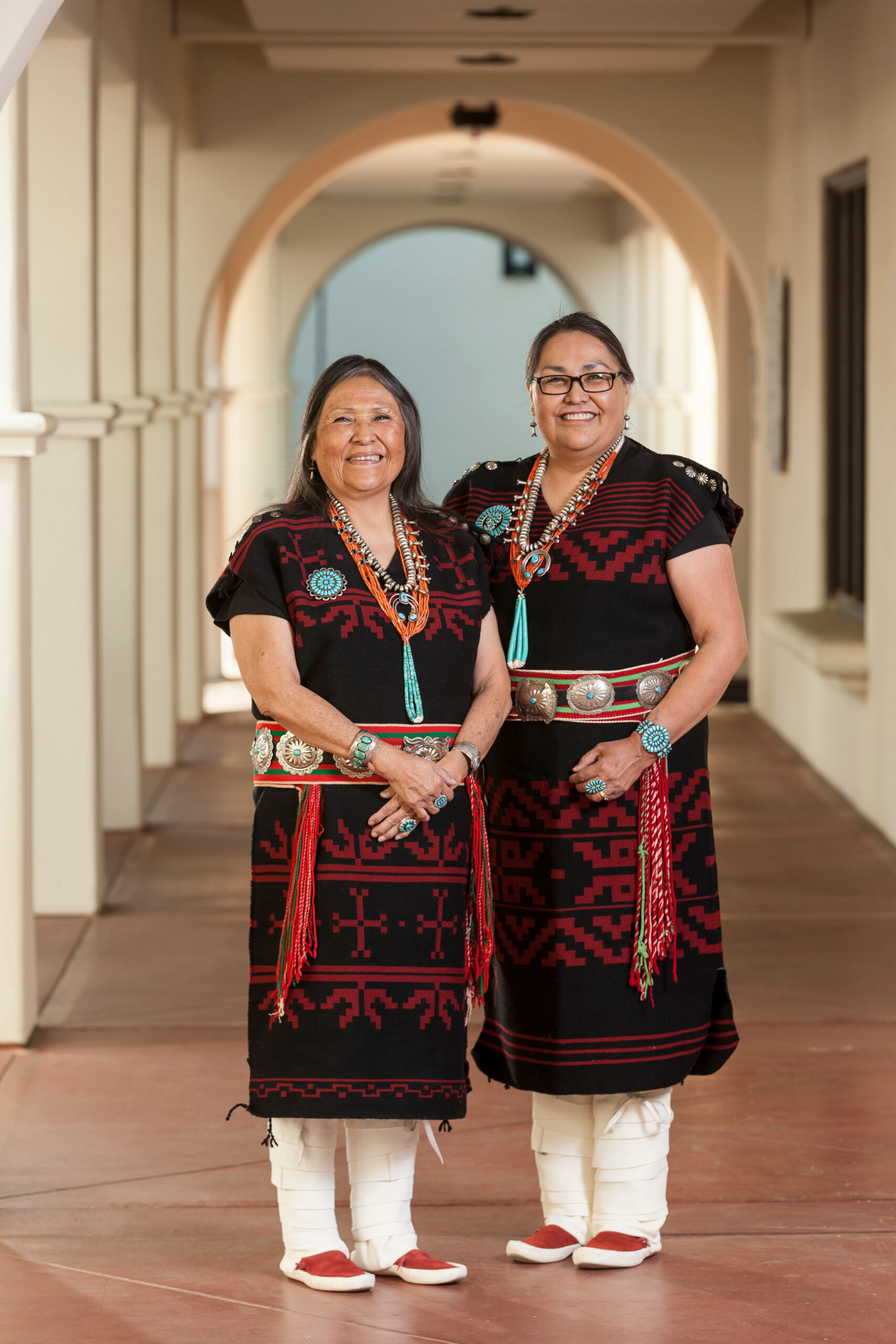
With nimble fingers, a Diné (Navajo) weaver guides wool thread through an upright loom, drawing the shuttle and tamping each weft with a comb as the intricate pattern grows — revealing personal creativity and a century of cultural knowledge, passed from generation to generation. The faint lanolin scent of wool sheared from Churro sheep fills the studio. It’s been hand-carded to coax natural hues of deep saddle brown, gray, cream, sand and white from its fibers. For Barbara Teller Ornelas, a fifth-generation Two Grey Hills weaver, the textiles represent family survival, pride of place and Diné culture — and a creative freedom she had to claim for herself. That freedom has taken her around the world.
The Heard Museum’s new exhibition, Twilight: Trading Posts & Creative Legacies, traces Diné weavers through the latter decades of the 20th century to the present. The trading posts many of them were associated with from the 1930s through the 1960s — Two Grey Hills, Burnham, Ganado, Teec Nos Pos, Burntwater, Shiprock and more — were central to local life, serving as grocery stores, livestock and farm-equipment suppliers, public telephone booths and de facto galleries where artists sold their work to collectors and the public.
Ornelas and her younger sister Lynda Teller Pete — also an award-winning weaver, author and Rollin and Mary Ella King Native Artist Fellow at the School of Advanced Research — were among five siblings who grew up working at the Two Grey Hills post, established in 1897. Their father began in trading posts at age 11 and ran Two Grey Hills for 35 years.
“I learned the mix of trading and weaving from my parents,” the 71-year-old Ornelas says. “My mom was an amazing weaver. People would come from all over the world to watch her in our little apartment behind the store.”
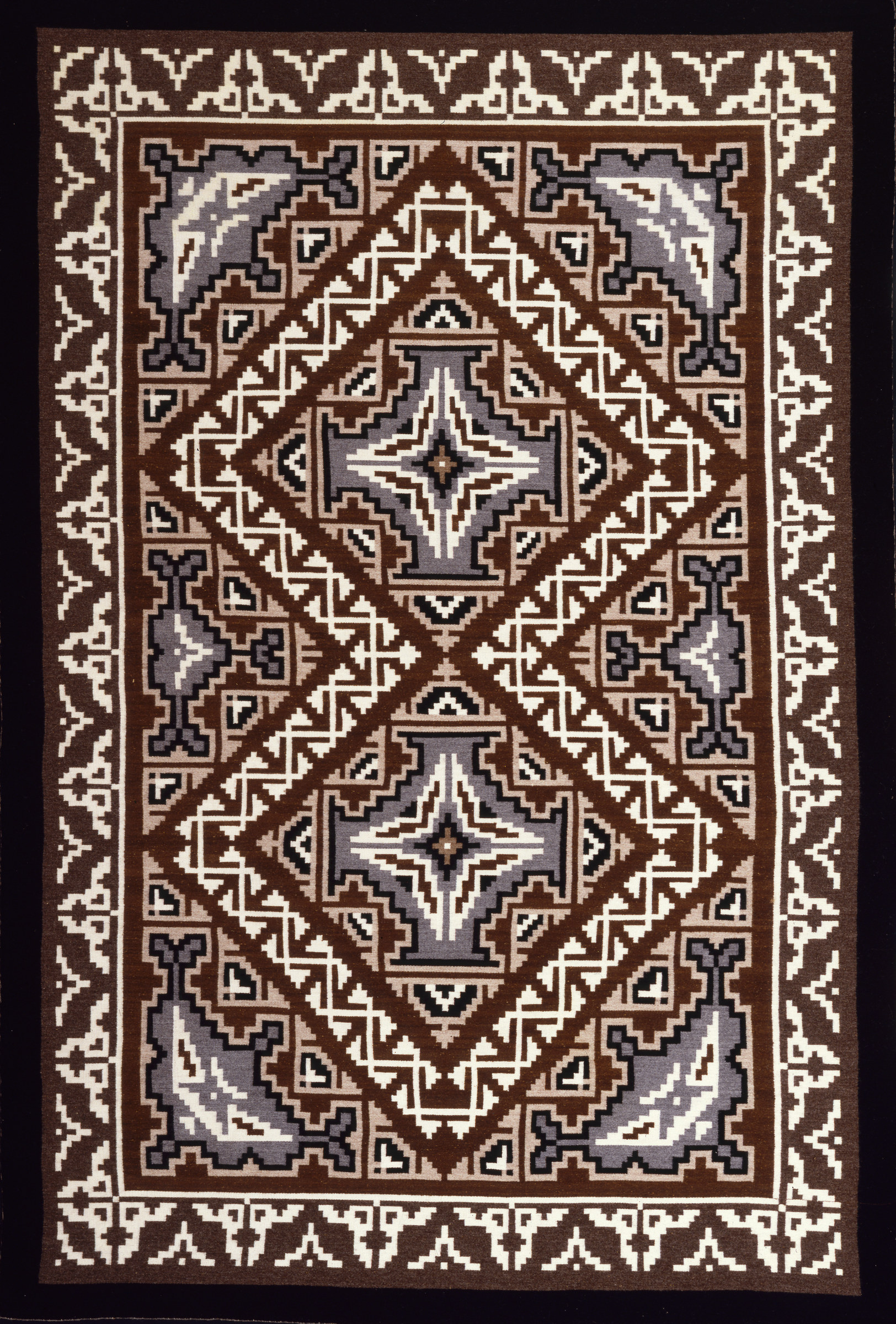
Diné, b.1954
Two Grey Hills textile, 1995
Handspun wool, natural wool colors, 71 x 47 1/4 Inches
The Santa Fe Collection of Navajo Rugs donated by Dr. Charles and Linda Rimmer, 4650-31
For a long time, the woven works were known only by the name of their region or trading post, not by the names of individual artists. The posts set prices and largely dictated the inventory.
“As I was growing up, my mother, grandmother, great-grandmother and great-great-grandmother were all Two Grey Hills weavers,” Ornelas recalls. “It’s the only way I was taught. They stressed not to cross that and said if you weave something else you will get banned, so all my family was loyal to Two Grey Hills; whatever they made they would sell to the trading post and get credit for food or what they needed. They’d pay their credit off and end up with very little money and a box of groceries. It was like a little mouse trap with no way out.”
That closed system began to loosen in the later decades of the 20th century. Improved transportation and communication allowed weavers to reach buyers beyond the posts.
One of the clearest markers of the shift came when Helen Begay, known for the distinctive “Burnham” style she and her sisters developed in the early 1970s, walked into the Toh-Atin Gallery in Durango, Colo., with a textile. Proprietor Jackson Clark asked what style it was.
“It’s a Helen Begay style,” she replied.
Clark later cited the exchange as the start of his family’s practice of marketing weavers by name rather than regional style. The barriers fell away, artist by artist. Ann Marshall, the Heard’s director of research and curator of Twilight, calls the moment emblematic.
“That’s why the exhibition title includes trading posts and creative legacies,” she explains. “The creative legacy belongs to those families.”
Traders remain a resource for collectors, but they’re no longer the only ones. Weavers like Calvin Toney post on Instagram, documenting the process down to the moment a piece finally leaves the loom.
Family legacies extend beyond the 70 textiles in the show. Alongside the textiles by weavers, known and unknown, the exhibition displays art related to the legacy of trading posts — among them pottery, jewelry and stories told in still and video photography. Weavers and trading post owners share memories in their own words. Marshall describes the relationship between weavers and traders as symbiotic despite the difficulties of earlier decades. Ornelas, as her own account above makes clear, remembers the system less kindly.
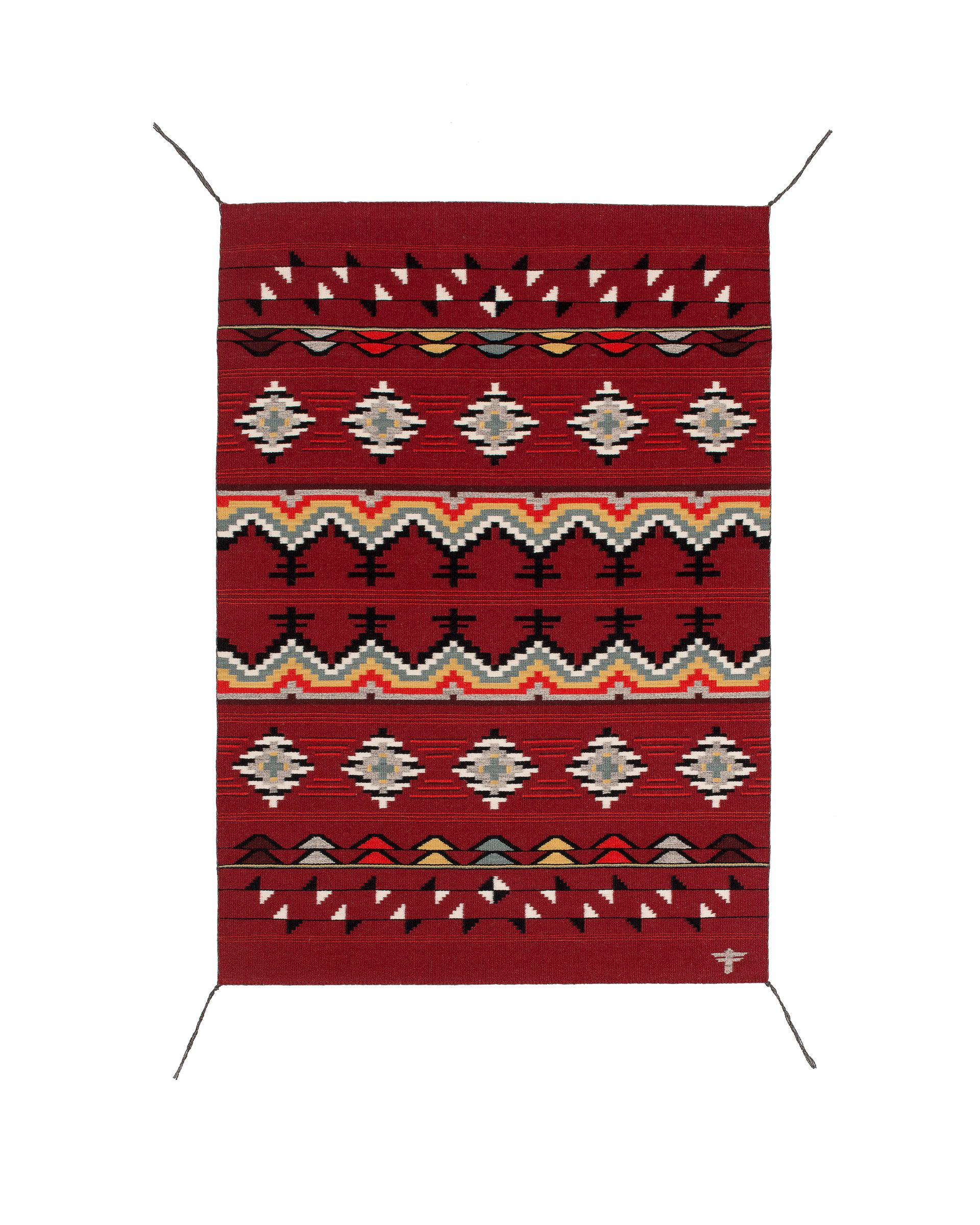
Diné, b. 1958
Migration of the Dragon Flies, 2015
Handspun and commercial wool, natural wool colors, aniline dye
36 x 25 1/2 inches
Gift of Mark and Julie Dalrymple, 4951-57
“Even when someone has passed away, their voice is still important,” Marshall says. “It’s been an absolute joy from start to finish to be able to share these wonderful works of art and to have the opportunity to present them in a context that celebrates the legacy.”
In the modern era, the legacy has taken on new colors and styles. Ornelas first learned of dyed wool at the Heard, where weavers used pastel colors she had never seen and couldn’t purchase in her own community. She sought out dyeing classes outside it and then worked her way backward to Native dyes as she also began weaving different styles.
“I started bucking the system. I showed my mom and all hell broke loose with her, my grandmother and aunts,” she recalls with a laugh. “They said I’d never work again if I did this. I was bypassing the trading post because I started having my own customers asking for what I was weaving.”
She says they came around once she started winning awards and participated in cultural exchanges in far-flung locales, including Uzbekistan and Great Britain, where she once struck up a conversation with the late Prince Philip at London’s British Museum.
Getting her foot in the door wasn’t easy, but the Heard gave her the chance to weave her own way and find an audience for her skills.
“They told me, ‘You’re a weaver, you can weave anything you want.’ I never had anyone tell me that,” she says.
Fifty years into her career, she has slowed a bit, weaving full time but not pushing herself as hard as before. She has passed her weaving knowledge down to her son Michael Teller Ornelas and now her grandson. She occasionally teaches alongside Pete and only travels stateside, working with museums and attending her sister’s and son’s exhibitions. She weaves commissioned pieces and brings new works to two shows per year: the Heard in March and Santa Fe’s Indian Market in August. She holds on to the hope that someone might renovate Two Grey Hills one day. Part of her heart will always live there.
“I always taught my kids from the day they were born until this day, ‘Two Grey Hills is your home. The pattern, the style, the colors … you’re free to roam; you can leave your home to visit other places and explore, but remember Two Grey Hills is home base for all of us,’” she reflects.
Twilight celebrates that birthright legacy and the talent — and sometimes hardscrabble survival — of families like hers. Still standing; still weaving.
“My two loves have come together at the exhibit,” Ornelas says. “The [Two Grey Hills] trading post where I grew up with my father and mother in their prime and the Heard Museum, which has supported me for so long. If it wasn’t for these two things, I wouldn’t be where I’m at today.”
Photography Courtesy of the Heard Museum