When Marti Skloven sits down at a potter’s wheel, she still feels the same sense of wonder she experienced when she first discovered clay five decades ago.
“Every pot carries the earth it came from, the hands that shaped it, the fire that changed it. After 50 years, I still find this alchemy miraculous. It is what keeps me coming back to the wheel, to the flame and to the simple act of forming something lasting from raw earth,” says Skloven, a Scottsdale resident.
Skloven is one of 151 artists participating in the 30th Annual Hidden in the Hills Artist Studio Tour, which takes place during the last two weekends of November: Friday, Saturday and Sunday, Nov. 20–22 and Nov. 27–29. Coordinated by the nonprofit Sonoran Arts League, this year’s free, self-guided tour features 38 studios throughout the scenic Desert Foothills communities of Cave Creek, Carefree and North Scottsdale.
Hidden in the Hills is Arizona’s largest and longest-running artist studio tour, drawing thousands of patrons who appreciate fine art across a range of mediums, styles and price points — along with holiday shoppers hunting for gifts they won’t find in a store. Each artist’s studio is open from 10 a.m. to 5 p.m. during both weekends of the tour, giving patrons plenty of time to visit multiple studios.
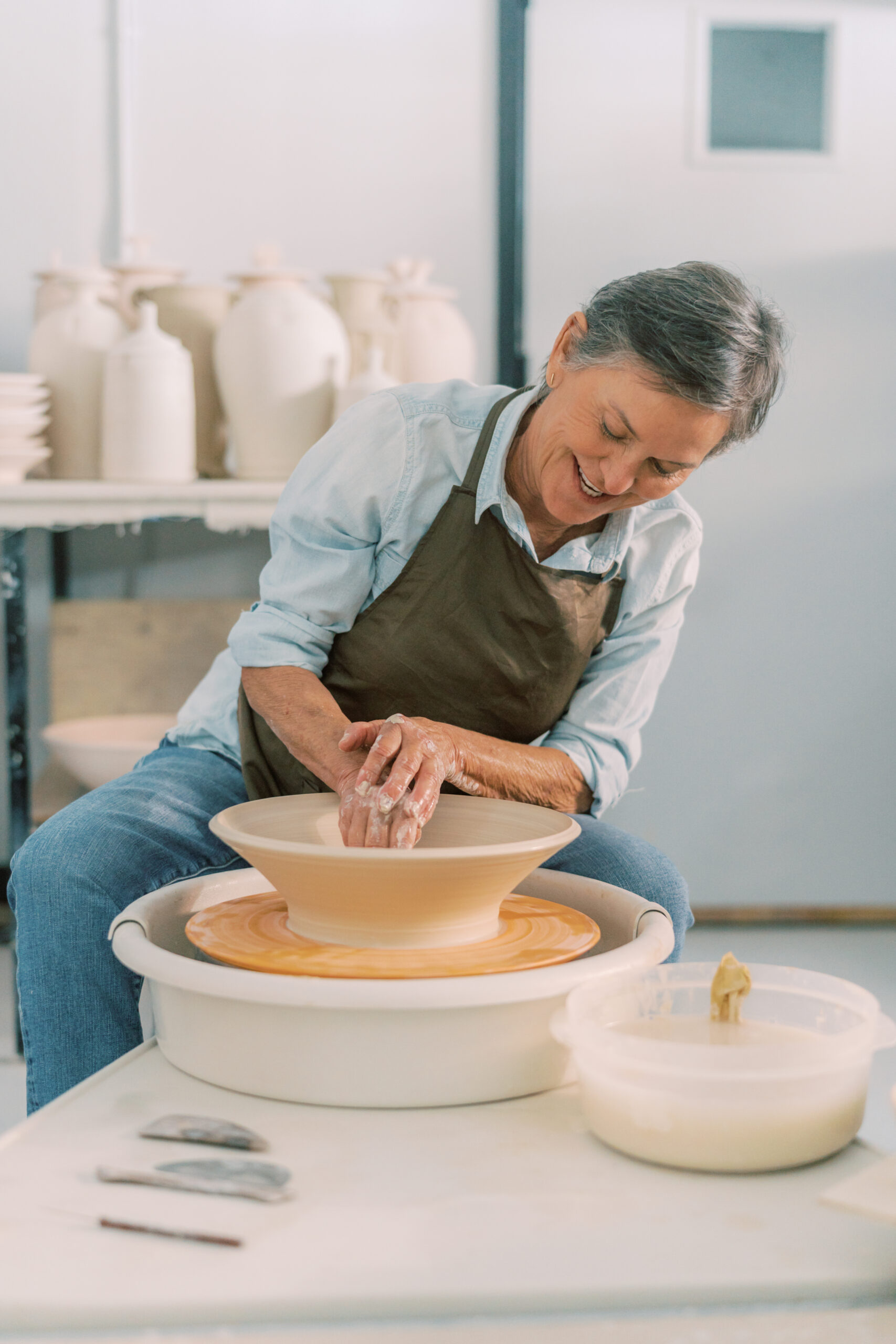
Nursing Career Introduced Her to Clay
Skloven was born in Wisconsin and grew up in Southern California. While many of her family members were artists or worked in creative fields, her interests gravitated toward science and math. She earned her nursing degree and became a critical care nurse at a children’s hospital, working in oncology.
“It was a high-burnout field, and we were told we needed to find some type of outlet to balance the intensity of the job,” she recalls. “I was probably 23 years old. We were given a choice of going to group therapy or taking an engaging art class. My friend and I chose pottery. I still remember how I felt when I first sat down at the wheel. I loved it and knew I wanted to do more.”
She continued taking pottery classes whenever she could and eventually moved to Berkeley, Calif., where she joined the Arts and Crafts Cooperative, Inc., known as the Berkeley Art Co-op on Shattuck Avenue. The bustling, community-focused space showcased ceramics, woodwork, jewelry, textiles and other handcrafted works.
“I still worked at a hospital, but I spent every minute I could at the co-op. After work, I would trade my nurse outfit for overalls. Clay became a big part of my life, and because everyone there was so much more experienced than me, I learned how to make glazes, fire the kiln, and other important skills,” she says.
She describes the co-op environment as intense, but it was a creative force she cherished.
“Pottery is very Zen-like,” she says. “It’s like rock climbing or ballet … it requires every bit of your concentration and senses.”
Newspaper Ad Changed Her Career
When Skloven’s husband was offered a job as a cardiologist in Atlanta, Ga., she accepted a critical care nursing position with Grady Memorial Hospital, a major trauma center.
She was waiting to start her job when she saw a newspaper ad for a studio assistant position at Callanwolde Fine Arts Center, located in the former estate of Charles Howard Candler, a former president of The Coca-Cola Company.
“On a whim I drove up there. It was a fantastic arts center. I interviewed for the job, and they hired me shortly after,” she says.
It was a turning point in her career. “I enjoyed my nursing career, but I felt like I was missing something,” she says. “Even the years that I was not making pots, I was often thinking and dreaming about it.”
She looks back at her time at Callanwolde with fond memories, noting that the experience helped her grow as an artist.
“I loved it. It was at a time when the National Endowment for the Arts was well-funded. While I was there, we were able to bring in famous potters during the pinnacle of what was happening in contemporary pottery,” she says, adding that she also exhibited her own art in one-person shows and at arts and crafts festivals.
Three years later, her husband and her brother built her a large studio, and she began working independently as a production potter.
“I was hired by Hyatt Regency to work closely with its executive chef,” she says. “Their properties had fine-dining French restaurants and bistros that needed serving pieces, such as huge platters and crocks. We also created pieces for their concierge levels and corporate gifts. It became a very successful partnership that lasted about six years.”
She credits that experience with helping her learn how to run a business.
“It was so labor-intensive and there was a lot of pressure,” she recalls. “I had to be very disciplined. I managed a team, and we often worked six months out on large orders. Fortunately, I have a very organized mind and I love science. Everything had to be exact — the glazes had to be made the same way, and the kiln had to be fired consistently.”
When her husband’s career brought the family to Arizona in 1989, Skloven had three young children. She eventually returned to nursing, working as a school nurse for 15 years. But pottery found its way back into her life.
She met the school’s new art teacher, who told her about Phoenix Center for the Arts. Skloven began paying for studio time there and eventually became an instructor. She also joined the Sonoran Arts League, where she found another community of fellow artists.
“I was a fish out of water in Atlanta. I used to complain that I couldn’t see the horizon, and the color of the sky always seemed yellow or green. When we moved to Arizona, I was instantly attracted to the warm hues of purples, pinks and blues. It was like a lungful of fresh air that felt good again,” she says.
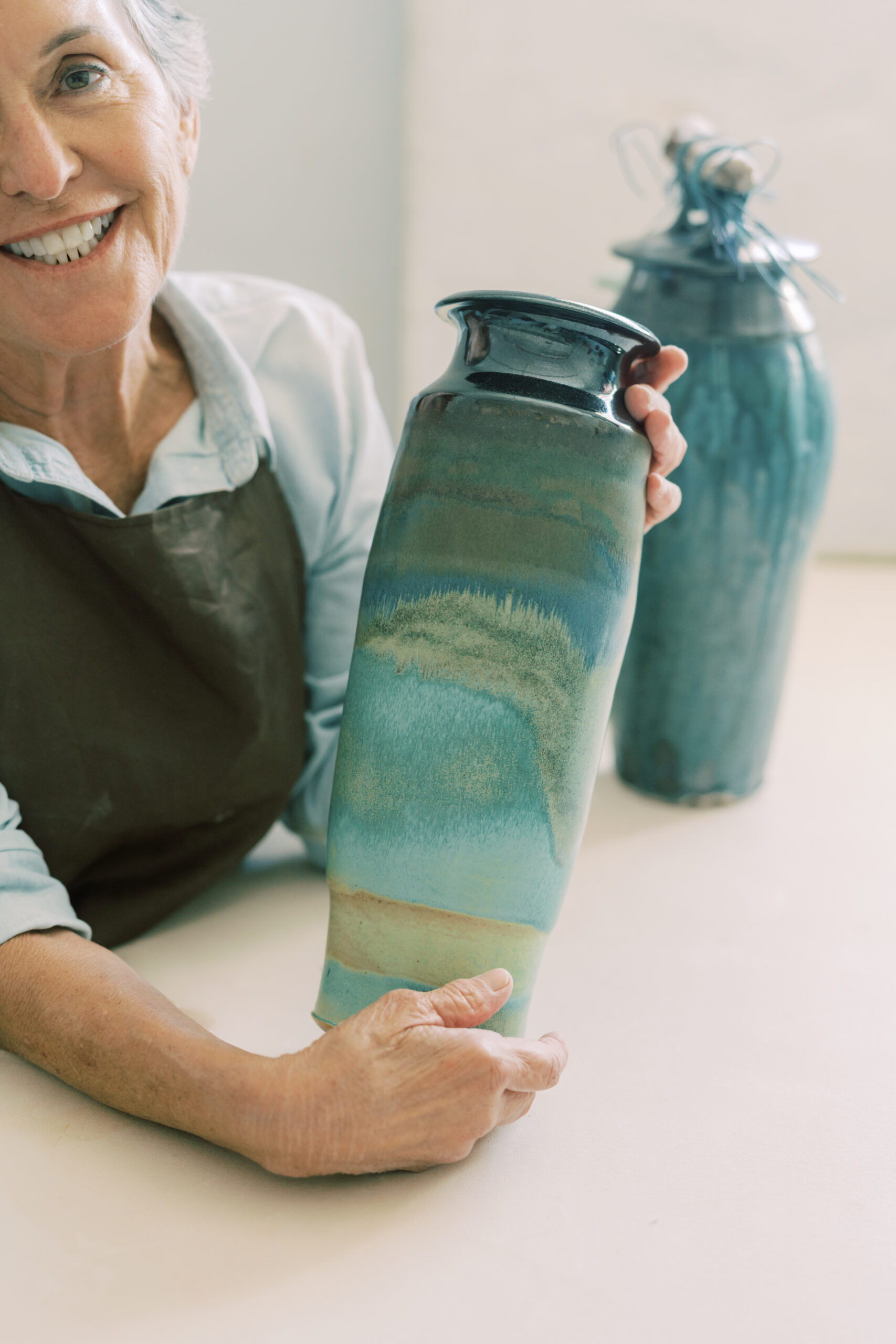
Traditional Shapes Come Alive with Texture
This will be Skloven’s second year participating in Hidden in the Hills. She will exhibit her new pottery at mixed-media artist Dena Johnson’s Tree Loft Studio, No. 6, in Carefree.
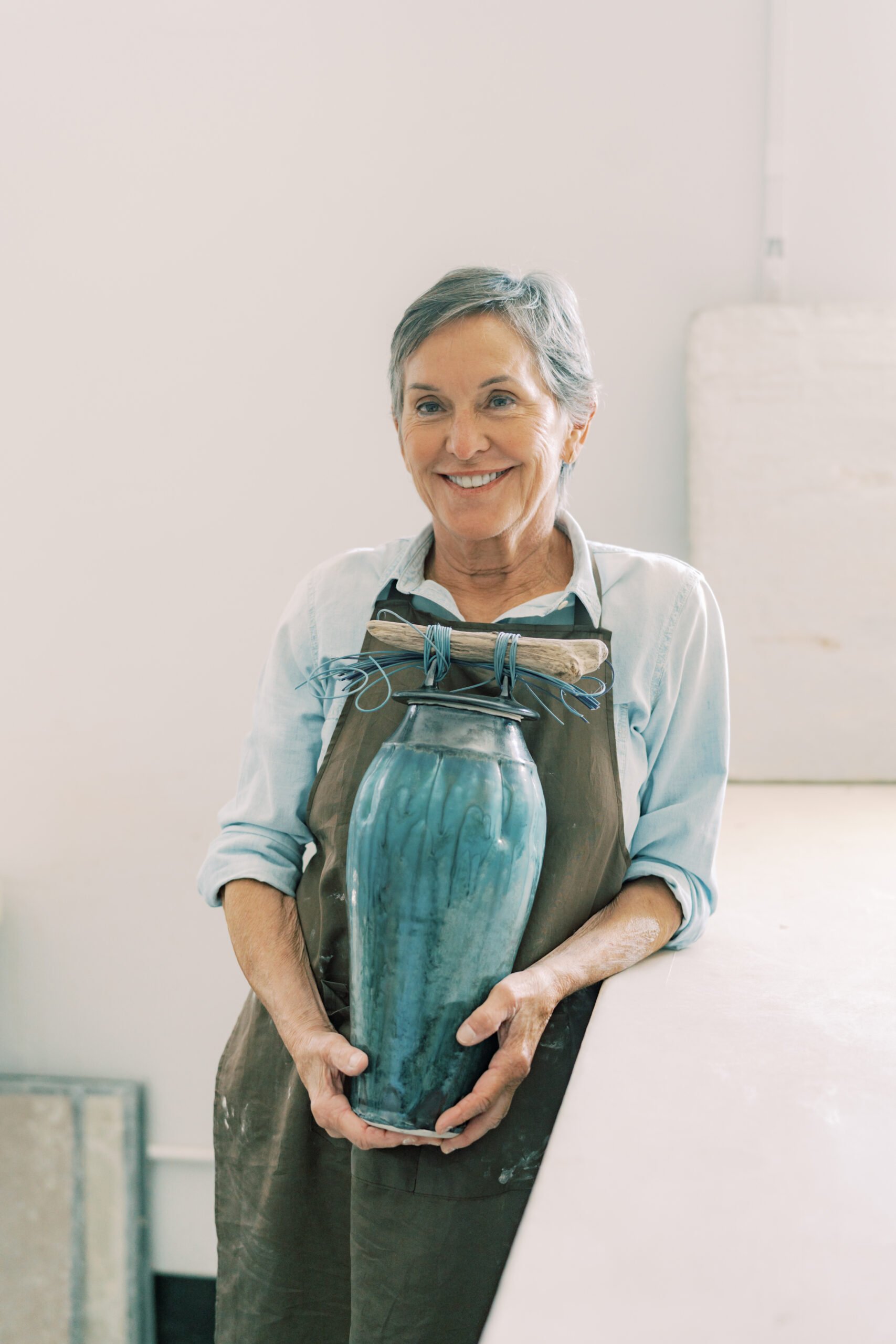
“My current functional ceramics are deeply rooted in traditional vessel forms — ranging from daily ware like plates, bowls and mugs to jars, vases and baskets — but I intentionally push each piece so it feels alive, fluid and unexpected,” she says.
Once a form is made, she carves or cuts away parts of the clay to create depth or movement, using handmade stamps and found tools to alter the surface. These marks and textures change how the glaze behaves, making it pool, flow or break in ways that add energy to the piece.
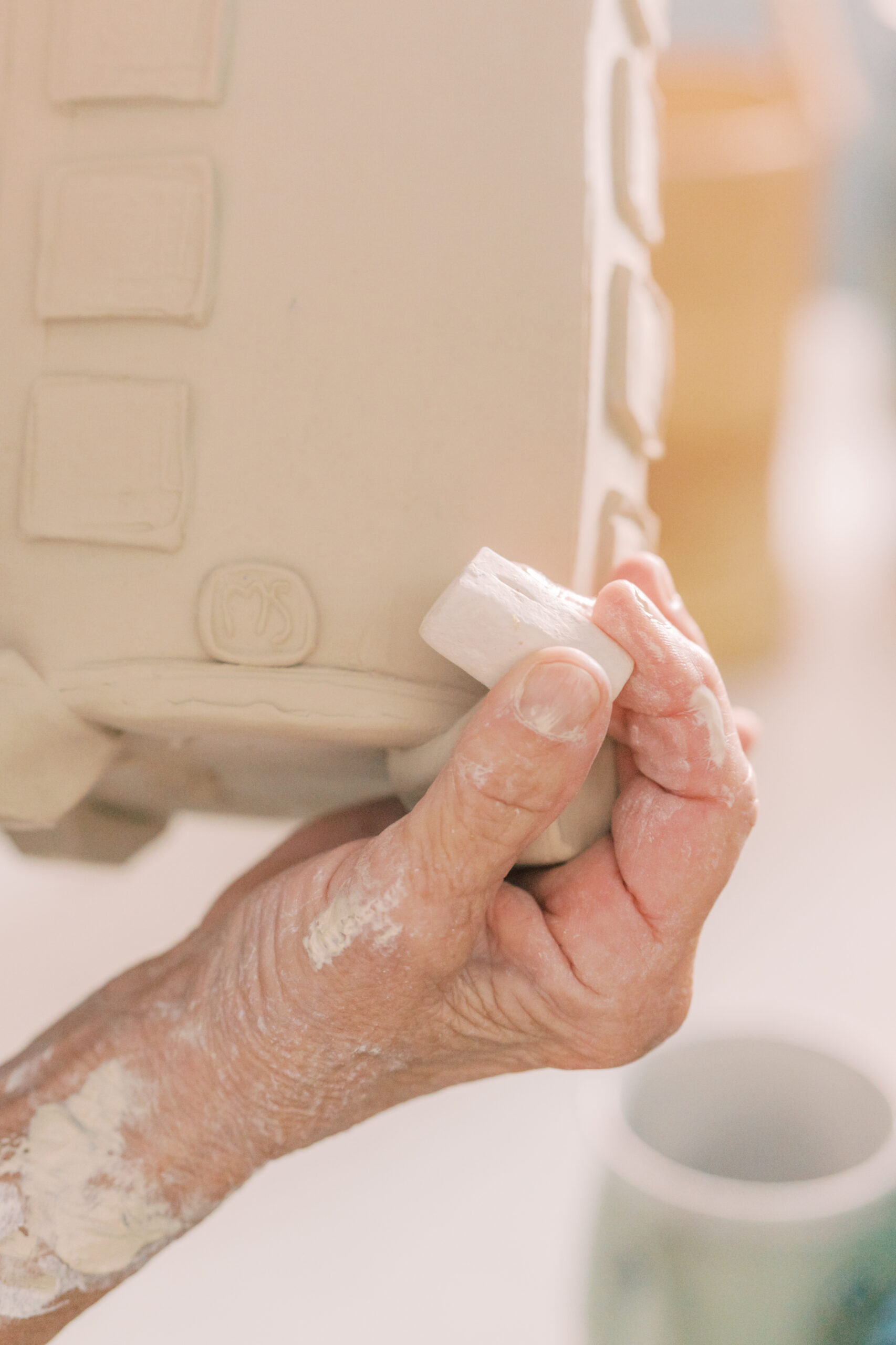
“I’m not a potter who erases finger marks,” she says. “I don’t trim a lot of my pots. I want there to be evidence that my hands were on my pieces. I really believe the finished product should look as close to the newly thrown, wet piece as possible.”
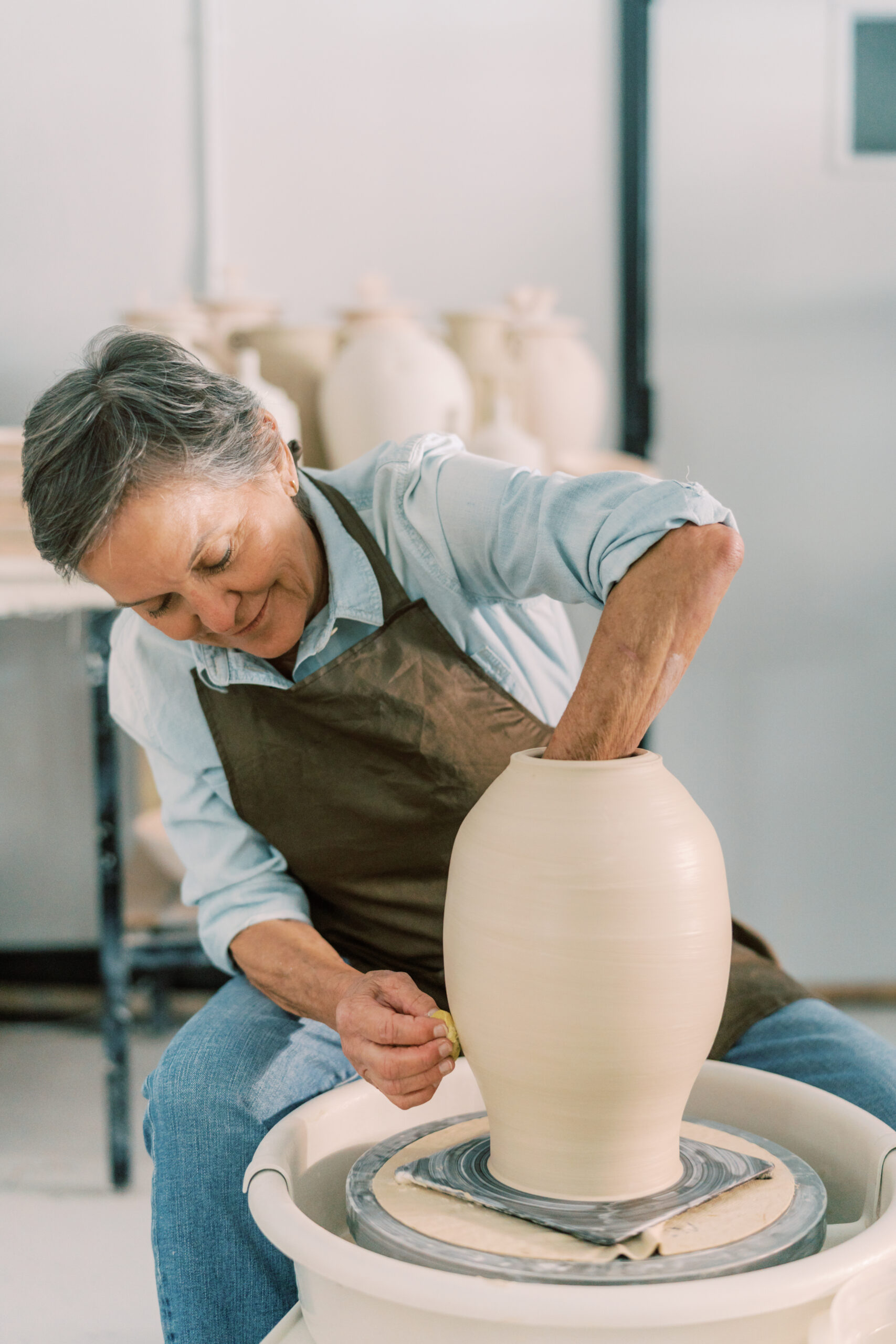
She also incorporates natural elements such as rattan and driftwood, bringing an organic contrast to the ceramic forms and connecting each piece back to the environment it came from.
“The contrast between fired permanence and natural impermanence fascinates me, appealing to both the sense of touch and the visual beauty of the form,” she says.
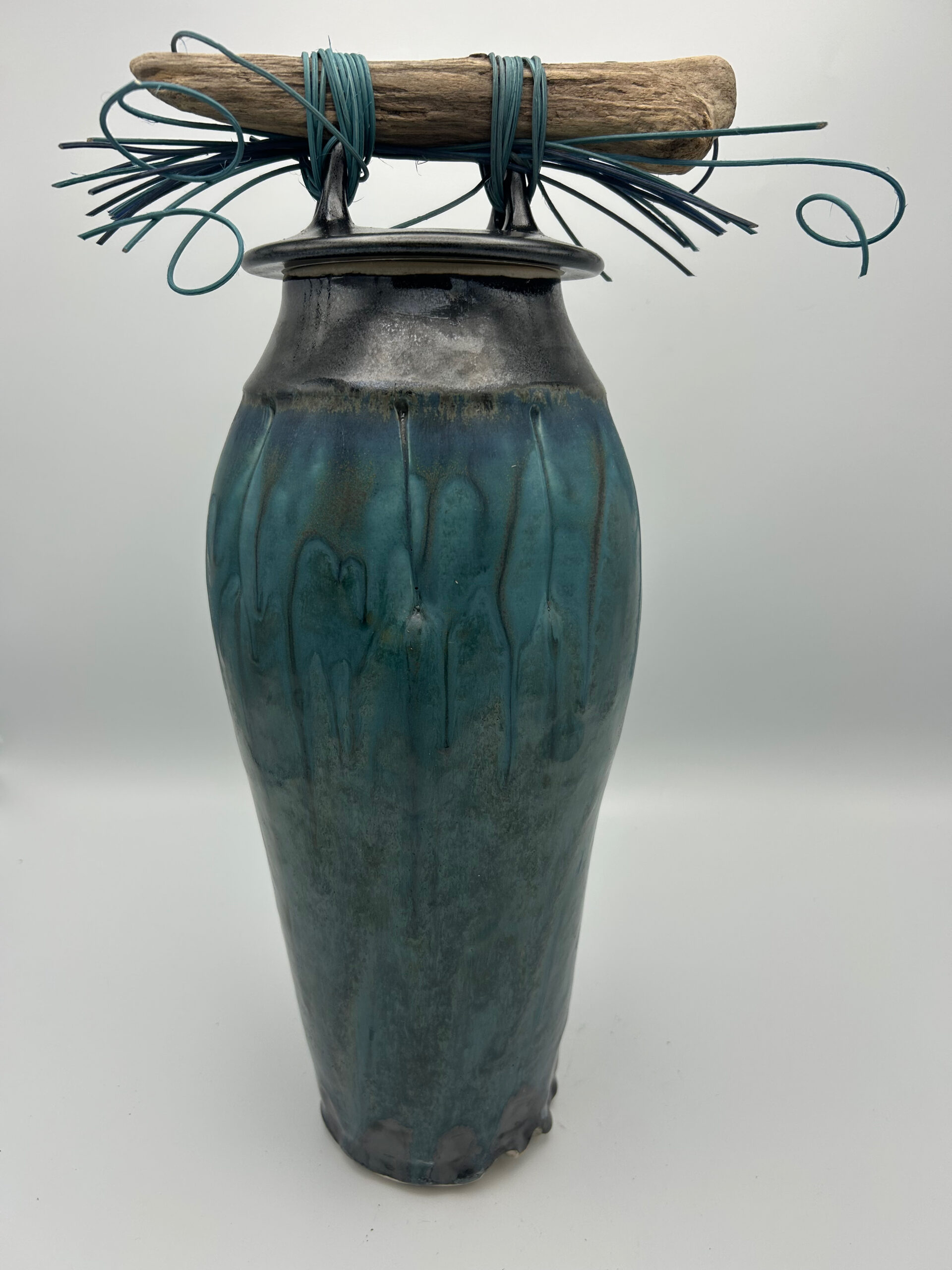
Skloven has been preparing for Hidden in the Hills since April, eager to share her work with visitors this November.
“Throughout my life, I have always felt a pull toward clay, yet I still love science,” she says. “Working as a potter allows me to be both creative and analytical. I’m also grateful for the many mentors I’ve had along my journey. Now, as an instructor, I have the chance to share what I’ve learned with others, which is very rewarding.”
Photography Courtesy of Paige Lorin Photography and Marti Skloven